Muutke küpsiste eelistusi

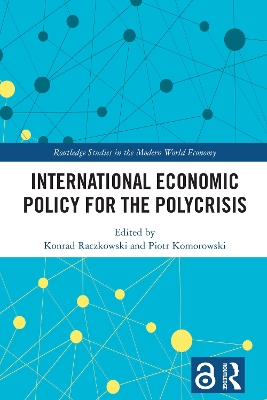
International Economic Policy for the Polycrisis [Pehme köide]

Edited by , Edited by
  • Formaat: Paperback / softback, 288 pages, kõrgus x laius: 234x156 mm, 24 Tables, black and white; 69 Line drawings, black and white; 69 Illustrations, black and white
  • Sari: Routledge Studies in the Modern World Economy
  • Ilmumisaeg: 22-Jun-2026
  • Kirjastus: Routledge
  • ISBN-10: 1032784474
  • ISBN-13: 9781032784472
Teised raamatud teemal:
  • Pehme köide
  • Hind: 48,81 €*
  • * hind on lõplik, st. muud allahindlused enam ei rakendu
  • Tavahind: 65,09 €
  • Säästad 25%
  • See raamat ei ole veel ilmunud. Raamatu kohalejõudmiseks kulub orienteeruvalt 3-4 nädalat peale raamatu väljaandmist.
  • Kogus:
  • Lisa ostukorvi
  • Tasuta tarne
  • Tellimisaeg 2-4 nädalat
  • Lisa soovinimekirja
  • Formaat: Paperback / softback, 288 pages, kõrgus x laius: 234x156 mm, 24 Tables, black and white; 69 Line drawings, black and white; 69 Illustrations, black and white
  • Sari: Routledge Studies in the Modern World Economy
  • Ilmumisaeg: 22-Jun-2026
  • Kirjastus: Routledge
  • ISBN-10: 1032784474
  • ISBN-13: 9781032784472
Teised raamatud teemal:
The struggle for world leadership between China and the United States, resulting in Russia's war with Ukraine, among other things, underscores the reality of structural changes in the global economy and the global system. This book explains that a new era of egocentrism and polycrisis in a multipolar system has emerged in international economic policy, with a strong drive toward interventionism and protectionism of national economies. Dynamic economic imbalances are becoming a constant factor in disrupting international competitiveness and forcing changes in both monetary policy and general economic policy. This prompts a new, more pragmatic definition of fundamental concepts in the theoretical sphere as well as an up-to-date and viable cause-and-effect narrative that is not disconnected from decision-making processes in the economic and political spheres.

This book provides a comprehensive diagnosis of the current global economy landscape and evaluates the processes affecting the economic and financial realities and the effectiveness of economic policies. The recent dynamics have rendered much of the existing literature outdated or confined to individual economies, economic systems, and regions. The book describes the evolution of international economic policy, offering a comparative analysis of foreign trade theories, especially in the context of macroeconomic trends and the impact of international trade in goods and services in the new balance of power of the global economy.

Targeted primarily at academics, students, and researchers in economics, finance, international relations, and management, it will also serve as a valuable resource for policymakers shaping and implementing contemporary state economic policies.

Chapters 1 and 6 of this book are freely available as a downloadable Open Access PDF at http://www.taylorfrancis.com under a Creative Commons Attribution-Non Commercial-No Derivatives (CC-BY-NC-ND) 4.0 license.
1. International economic policy theory and practice
2. The great
reset and the new global economic order
3. Opportunities and threats of
global socio-economic processes selected aspects
4. Realism of market
economy models in the face of the challenges of the new world order
5.
Current and expected fragmentation of the global economy: its reasons,
evidence, and consequences
6. International financial system versus economic
stability
7. Banking sector macro-stability in the post-pandemic environment
8. The polycrisis and the political economy of natural resources
9. The
military and economic potential of the countries globally assessment and
analysis of the impact on international security
10. The impact of the
Covid-19 pandemic on economic and social change in the world order
11.
Sustainable development and post Covid-19 pandemic, in mainstream
socio-economic models
12. The inconvenient truth about personal income
taxation in the international economic policy
13. Financing our global
commons in the Anthropocene era: new monetary policy and financial
engineering instruments to fund, hedge, and manage our global commons
Konrad Raczkowski is Full Professor of Economics and Vice-Rector of the Cardinal Stefan Wyszyski University in Warsaw, Poland; Visiting Research Scholar at the City University of New York; Former Deputy Minister of Finance in Poland; and member of the National Development Council of the President of Republic of Poland. More at: www.konradraczkowski.info

Piotr Komorowski has a PhD in economics and is Deputy Director of the Centre for the World Economy and Assistant Professor at the Institute of Economics and Finance at the Cardinal Stefan Wyszynski University in Warsaw, Poland; the manager and member of many project teams, and practitioner in the field of banking and business.