Muutke küpsiste eelistusi

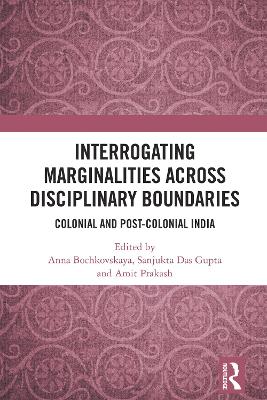
Interrogating Marginalities across Disciplinary Boundaries: Colonial and Post-Colonial India [Kõva köide]

Edited by , Edited by (Jawaharlal Nehru University, New Delhi, India), Edited by
  • Formaat: Hardback, 276 pages, kõrgus x laius: 234x156 mm, kaal: 690 g, 14 Tables, black and white; 2 Line drawings, black and white; 2 Illustrations, black and white
  • Ilmumisaeg: 18-Dec-2024
  • Kirjastus: Routledge India
  • ISBN-10: 1032438657
  • ISBN-13: 9781032438658
Teised raamatud teemal:
  • Kõva köide
  • Hind: 149,06 €*
  • * hind on lõplik, st. muud allahindlused enam ei rakendu
  • Tavahind: 198,75 €
  • Säästad 25%
  • Raamatu kohalejõudmiseks kirjastusest kulub orienteeruvalt 3-4 nädalat
  • Kogus:
  • Lisa ostukorvi
  • Tasuta tarne
  • Tellimisaeg 2-4 nädalat
  • Lisa soovinimekirja
  • Raamatukogudele
  • Formaat: Hardback, 276 pages, kõrgus x laius: 234x156 mm, kaal: 690 g, 14 Tables, black and white; 2 Line drawings, black and white; 2 Illustrations, black and white
  • Ilmumisaeg: 18-Dec-2024
  • Kirjastus: Routledge India
  • ISBN-10: 1032438657
  • ISBN-13: 9781032438658
Teised raamatud teemal:
"This volume adopts an inter-disciplinary approach to rethink the multiple dimensions of marginality - political, societal, economic, cultural, legal, spatial. It explores their new representations in colonial and postcolonial India. Departing from extant analyses of experiences of marginalization in diverse social groups, it proposes to problematize the conceptualization of marginality, focusing on its evolution through space and time. A relational position, marginality, it is argued, presupposes a confrontation with centrality or the 'mainstream' within a common discourse of knowledge and power. The volume emphasizes that the process of marginalization is not a 'marginal' phenomenon and draws attention to the historical processes which determine, establish and perpetuate the margins. The book reflects on varied aspects of evolving marginalities - structural, cultural and psychological - in South Asia in diverse temporal, spatial or societal contexts. It examines the discourses, institutional mechanismsand economic processes within which marginalities are located. This work will be an important read for scholars and researchers of history, anthropology, subaltern studies, exclusion studies, South Asian history, post-colonial studies, political studies,Indian history, cultural studies, and history, in general"--

This volume adopts an inter-disciplinary approach to rethink the multiple dimensions of marginality – political, societal, economic, cultural, legal, spatial. It explores their new representations in colonial and postcolonial India. Departing from extant analyses of experiences of marginalization in diverse social groups, it proposes to problematize the conceptualization of marginality, focusing on its evolution through space and time. A relational position, marginality, it is argued, presupposes a confrontation with centrality or the ‘mainstream’ within a common discourse of knowledge and power. The volume emphasizes that the process of marginalization is not a ‘marginal’ phenomenon and draws attention to the historical processes which determine, establish and perpetuate the margins.

The book reflects on varied aspects of evolving marginalities – structural, cultural and psychological – in South Asia in diverse temporal, spatial or societal contexts. It examines the discourses, institutional mechanisms and economic processes within which marginalities are located. This work will be an important read for scholars and researchers of history, anthropology, subaltern studies, exclusion studies, South Asian history, post-colonial studies, political studies, Indian history, cultural studies, and history, in general.


This volume adopts an inter-disciplinary approach to rethink the multiple dimensions of marginality – political, societal, economic, cultural, legal, spatial.

List of Tables vii About the Authors viii Acknowledgements xi
Introduction: Multiple Dimensions of Marginalities 1 ANNA BOCHKOVSKAYA,
SANJUKTA DAS GUPTA AND AMIT PRAKASH PART I Interpretation: Contexts and Texts
13 1 At the Margins of the Empire-Making Project: Masters, Servants and the
Household in Colonial India 15 SVETLANA SIDOROVA 2 Marginalizing Histories,
Historicizing Marginalization: Representations of Adivasi Pasts in Jharkhand
42 SANJUKTA DAS GUPTA 3 Representing Slices in Time: Marginal Scriptures
in Contemporary Punjab 62 ANNA BOCHKOVSKAYA PART II Representation:
Discourses and Themes 81 4 Surviving in the Margins: The Politics of
Disowning Citizens in Contemporary South Asian Fiction 83 DEBJANI BANERJEE 5
Exploring Marginalities: Male Domestic Workers and Intimate Labour in Two
Films on Colonial and Post-Colonial Bengal 104 SWAPNA M. BANERJEE PART III
Identification: Societies and Genders 121 6 Victimized in the Name of
Protection: Revisiting Institutional Reforms for Marginalized Women in
Shelter Homes 123 PALLAVI BERI 7 Transgressing Boundaries and
(Re)constructing Identity: The Hijra Community in Post-Colonial Rajasthan 142
LEENA SHARMA PART IV (Non)recognition: Rights and Options 159 8
Marginalization Through Empowerment: The Policy of Reservation for Scheduled
Castes in India 161 PADMANABH SAMARENDRA 9 Cultural Rights and Minorities in
India 180 GHAZALA JAMIL AND FAIZ ULLAH 10 Intersectional Marginality:
Compounding Structural Violence Against Dalit Christians in India 200 M.
SUDHIR SELVARAJ PART V Exclusion: New Forms and Locations 221 11 Spheres of
Marginality in the Urban Space: Exploring Interconnections in a Global City
223 PRIYANKA NUPUR 12 Liberal Script and New Marginalities: The Case of
Tribals in Jharkhand 247 AMIT PRAKASH Index 269
Anna Bochkovskaya is Associate Professor in the Department of South Asian History, Institute of Asian and African Studies, Lomonosov Moscow State University, Russia.

Sanjukta Das Gupta is Associate Professor of Indian History in the Department of Oriental Studies, Sapienza University of Rome, Italy.

Amit Prakash is Professor of Law and Governance at the Centre for the Study of Law and Governance, Jawaharlal Nehru University, New Delhi, India.