Muutke küpsiste eelistusi

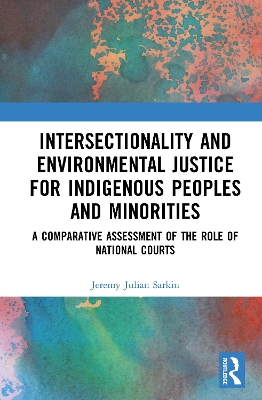
Intersectionality and Environmental Justice for Indigenous Peoples and Minorities: A Comparative Assessment of the Role of National Courts [Kõva köide]

  • Formaat: Hardback, 356 pages, kõrgus x laius: 234x156 mm
  • Ilmumisaeg: 23-Jun-2026
  • Kirjastus: Routledge
  • ISBN-10: 1041100043
  • ISBN-13: 9781041100041
  • Kõva köide
  • Hind: 159,19 €*
  • * hind on lõplik, st. muud allahindlused enam ei rakendu
  • Tavahind: 212,25 €
  • Säästad 25%
  • See raamat ei ole veel ilmunud. Raamatu kohalejõudmiseks kulub orienteeruvalt 3-4 nädalat peale raamatu väljaandmist.
  • Kogus:
  • Lisa ostukorvi
  • Tasuta tarne
  • Tellimisaeg 2-4 nädalat
  • Lisa soovinimekirja
  • Formaat: Hardback, 356 pages, kõrgus x laius: 234x156 mm
  • Ilmumisaeg: 23-Jun-2026
  • Kirjastus: Routledge
  • ISBN-10: 1041100043
  • ISBN-13: 9781041100041

This book presents an innovative critical socio-legal analysis that examines how the concept of intersectionality could be better used by national courts in environmental justice cases concerning minorities and Indigenous Peoples.


This book presents a deeply researched, extensively referenced, innovative, and critical socio-legal analysis of how the concept of intersectionality could be used more effectively by national courts in environmental justice cases, especially concerning minorities and Indigenous Peoples.

A wide range of environmental injustices are being committed against minorities and Indigenous Peoples around the world. In response, this book provides an overview of the problems faced by these groups globally, showing how an intersectional approach offers important benefits. Examining a range of environmental justice court cases - covering the United States, South Africa, Canada, Australia and Israel - the book offers a comparative analysis of how intersectionality has been, or could be used, to approach such cases, identifying ways in which these issues can be more effectively addressed. In doing so, it demonstrates the value of intersectionality for achieving environmental justice for Indigenous Peoples and minorities. The work integrates knowledge and methods from a range of disciplines, drawing from both the social sciences and the natural sciences. The benefit of this approach is the creation of intellectual engagement across multiple disciplines, leading to a deeper understanding of the issues.

This book will be essential reading for judges, lawyers, activists, affected groups, researchers, practitioners, students, and others. It will be useful for both research and practice, especially for those interested in how these issues intersect in national courts.

Arvustused

"This groundbreaking book offers an insightful exploration of intersectionality in environmental justice, focusing on Indigenous and minority groups globally. Through rigorous research, comparative analysis, and case studies, it provides innovative insights into addressing systemic inequalities and environmental harm. A must read for scholars, policymakers, and advocates seeking equitable and sustainable solutions." Ntombizozuko Dyani-Mhango, Faculty of Law, University of Pretoria, South Africa.

"Wise and deeply researched, this book offers a positive pathway for fighting environmental injustices by recognizing their universal nature and intersectional impact. Sarkin utilizes cross disciplinary analysis to identify common and interrelated environmental injustices impacting marginalized groups, including Indigenous Peoples, and argues for interconnected solutions to these injustices." Michael Stein, Harvard Law School, USA.

"In this new book, Jeremy Sarkin trains his critical eye on one of the most important challenges in environmental rights: how should we assess the many compounding and intersectional impacts of worsening environmental conditions on Indigenous Peoples and minority groups? Sarkins comparative lens focuses on how national courts in five countries have and have not adopted intersectionality to better understand, explain and address environmental injustices including climate change. Sarkins unique approach shines a light on this important but overlooked issue and shows us the path forward." Erin Daly, Widener University Delaware Law School, USA.

"Eminent human rights scholar Jeremy Sarkin has again produced another top-quality piece about a crucial theme for todays world. He has studied the practice of national courts in five countries and their potential application to a variety of contentious environmental topics. His thorough legal analysis is complemented by rich insights from other disciplines. He is widely known for his excellent capacity to analyse complex themes, and his work is widely consulted." Stephan Parmentier, Faculty of Law and Criminology, KU Leuven, Belgium.

"Sarkins deeply researched scholarly work offers innovative socio-legal analysis of how intersectionality could transform environmental justice outcomes for minorities and Indigenous peoples. Through comparative examination of cases from the US, South Africa, Canada, Australia and Israel, it demonstrates how courts might better address systemic environmental injustices. Essential reading for environmental law scholars and practitioners." Damien Short, Institute of Commonwealth Studies, University of London, UK.

1. Introduction
2. Understanding Environmental Justice, the Violence and
Conflicts Caused by Environmental Injustices and Intersectionality
3.
Environmental Justice and Intersectionality in the United States
4.
Environmental Justice and Intersectionality in South Africa
5. Environmental
Justice and Intersectionality in Canada.
6. Environmental Justice and
Intersectionality in Israel
7. Environmental Justice and Intersectionality in
Australia
8. Conclusion: Why Intersectionality Needs to Be Used Much More
Often by Domestic Courts
Jeremy Julian Sarkin is a Senior Research Fellow in the School of Advanced Study, University of London, and also an Extraordinary Professor of Law, Department of Jurisprudence, University of Pretoria. He teaches courses on human rights and transitional justice as well as a doctoral course on the methodology of legal research. He has a BA LLB from the University of KwaZulu-Natal, a Master of Laws degree from Harvard Law School, and a Doctor of Laws degree on comparative and international law from the University of the Western Cape (UWC). He is admitted to practice as an attorney in New York and South Africa. He has served as an acting judge in the High Court in South Africa. He served as Chairperson-Rapporteur of the United Nations Working Group on Enforced or Involuntary Disappearances for three years and member of the group for six years. He is a member of 23 journal editorial boards. He has published 22 books and more than 350 journal articles and book chapters. He has worked in the field of transitional justice for many years after being involved in the Truth and Reconciliation Commission process in South Africa.