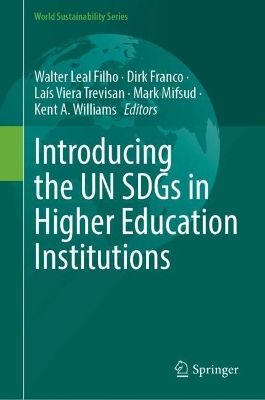
This book, "Introducing the UN SDGs in Higher Education Institutions" explores the interconnections between higher education an and the UN SDGs . Authored by a diverse group of scholars and practitioners, the book argues that much can be gained, by taking the SDGs into account in initiatives undertaken by universities.
The book Introducing the UN SDGs in Higher Education Institutions is essential for integrating sustainability into academia. It provides a roadmap for universities to align curricula, research, and operations with the Sustainable Development Goals (SDGs), fostering responsible global citizens. Higher education institutions play a pivotal role in achieving the 2030 Agenda, equipping students with knowledge and skills to address pressing challenges like climate change, inequality, and poverty. This book bridges theory and practice, offering case studies, strategies, and tools to inspire action. By embedding the SDGs, universities can drive innovation, social impact, and sustainable development, ensuring a better future for all. The authors delve into various matters related to sustainability in highe4 education, describing various approaches, methods, initiatives and projects aimed at inspiring and motivating individuals and communities to adopt more sustainable practices. By drawing on lessons from across the world, the book advocates for a holistic approach to sustainability, that integrates technical, environmental, economic and social dimensions.
In summary, the book "Introducing the UN SDGs in Higher Education Institutions" is a thought-provoking exploration of how the UN SDGs may be taken into account by higher education institutions. This book is a valuable resource for researchers, students, policymakers, and practitioners interested on sustainability issues. It invites readers to rethink how sustainability is tackled, while inspiring transformative actions that prioritise sustainability and equity, and offers practical insights and fresh perspectives for anyone committed to promoting sustainability in higher education.
Chapter
1. Assessment Strategy to embed key competencies for
sustainability into the curriculum: A case study of Politics and
International Relations.
Chapter
2. Cultivating Sustainable Futures:
Enhancing Study Programs in Africa for Environmental Stewardship.
Chapter
3.
Sustainable Minds: Developing an International & Interdisciplinary SDG Course
in Higher Education.
Chapter
4. Transatlantic Summer School for
Sustainability - interdisciplinary, transatlantic and project-oriented.-
Chapter
5. Transcending Boundaries: The Fusion of Sustainability Education
and Software Engineering Education in a Masters Course.
Chapter
6.
Transformative Learning for Sustainability: Bridging Inner Development Goals
(IDG) and Sustainable Development Goals (SDG).
Chapter
7. Integrating
sustainability into courses and programmes - A transdisciplinary approach
using labelling criteria and SDGs at University of Gothenburg.
Chapter
8.
Project DITTS: Digital introduction of the Sustainable Development Goals into
Higher Education Teaching Regional aspects from South Africa and Brazil.-
Chapter
9. Evaluation of the Integration of UN SDGs in Architecture Final
Undergraduate Projects: Insights from Latin America.
Chapter
10. Integrating
the SDGs into the ongoing activities of Lithuanian higher education
institutions.
Chapter
11. Fostering sustainability-related soft skills
through experiential Learning: An investigation of interdisciplinary
approaches in Higher Education.
Chapter
12. Integration of the Sustainable
Development Goals in Industrial and Environmental Engineering Education.-
Chapter
13. Serious Games as a Starting Point for Sustainability Education: A
Behavioral Approach to Teaching the SDGs.
Chapter
14. Latin American
Universities Lead the Path to Sustainability: 24 Institutions Participate in
the Course on Leadership and Sustainable University Governance.
Chapter
15.
Artificial Intelligence in Universities: Enhancing Teaching, Research, and
Extension for Sustainable Development.
Chapter
16. Empowering Sustainable
Leaders: OAUs Role in SDG Education.
Chapter
17. Global Education and
Sustainability in Japanese Universities: A Case Study of Sophia University.-
Chapter
18. A Journey to professionalism in ESD: A Story from the
Mediterranean.
Chapter
19. Another One Bites the Change Change Management
at Universities for Holistic Sustainability Establishment in Engineering
Education.
Chapter
20. Bridging Knowledge and Action: The role of SDGs
implementation in developing inner skills within higher education
institutions.
Chapter
21. Change making in culinary arts education to
promote sustainability: the challenges and opportunities presented by
Participatory Action Research.
Chapter
22. Environmental Destructions: A
Macroeconomic Approach Leaded By Anthropology.
Chapter
23. Higher Education
Institutional Sustainability Strategy Requirements: Addressing strategy at
SOAS University London.
Chapter
24. Identification of Knowledge and Skills
Gaps related to Sustainable Development: Two Exploratory Studies with Higher
Education Students and Teachers in Europe.
Chapter
25. Insights of the
analysis of the integration of Education for Sustainable Development with
employability perspective in Higher Education. A historical review.
Chapter
26. Shaping future-oriented managers: integrating sustainability competencies
into the business economics curriculum.
Chapter
27. Strategic Advancement:
Intentionally Aligning University Library Practices with the UN SDGs.-
Chapter
28. Transforming Cities, Empowering Universities: The City-University
Partnerships Model at the Universitat Politčcnica de Valčncia for SDGs.-
Chapter
29. Empowering a Growth Mindset for Sustainable Development in Higher
Education by Design Thinking.
Chapter
30. The sustainable reporting of a
Higher Education Institution: A pilot project where AI-guided document
analysis facilitates the Environmental, Social, and Governance reporting.-
Chapter
31. The Sustainable Development Goals (SDGs) and academic activism:
Organisational culture and teaching and learning.
Chapter
32. IDENTIFYING
AND DEVELOPING PROFESSIONAL COMPETENCIES THAT FOSTER SUSTAINABILITY
ORIENTATION.
Chapter
33. Transdisciplinary Approaches to Water Security and
Food Security: Insights from ASEAN Universities.
Chapter
34. Assessing the
Carbon Footprint of Thai Nguyen University of Agriculture and Forestry: A
Step Toward Sustainability in Vietnams Higher Education.
Chapter
35.
Sustainable Synergy: Virtual Exchanges for Technical Students.
Chapter
36.
Bridging Cultures in Higher Education: The Role of Cross-Cultural
Communication in Achieving the UN Sustainable Development Goals.
Chapter
37.
Permaculture in Higher Education: A Pathway to Sustainable Development and to
Achieve the United Nations Sustainable Development Goals (SDGs).
Chapter
38.
Experiential Training Groups: Interpersonal Learning for Competence
Development and Sustainability.
Chapter
39. Non-financial Reporting and
SDGs: Advancing Sustainability in Higher Education Institutions through
Measuring and Reporting.
Chapter
40. Re-Imagining Capacity Building in
Higher Education to Promote Learning and Teaching for Sustainability.-
Chapter
41. Enhancing SDG 17: A Case Study of Co-Creation at a Norwegian
University in a European University Alliance.
Chapter
42. Challenges and
Opportunities in Advancing Sustainability: The Case of Green Campus Nord.-
Chapter
43. Sowing Seeds for Regenerative Futures: Transdisciplinary
Approaches in Higher Education.
Chapter
44. Advancing the SDGs through
higher education: Opportunities and challenges in the Triple Helix model.
Prof. Dr. Walter Leal Filho is a Senior Professor and Head of the Research and Transfer Centre "Sustainable Development and Climate Change Management at Hamburg University of Applied Sciences in Germany, and Chair of Environment and Technology at Manchester Metropolitan University, UK. He is the initiator of the Word Sustainable Development Symposia (WSSD-U) series, and chairs the Inter-University Sustainable Development Research Programme. Professor Leal Filho has written, co-written, edited or co-edited more than 800 publications, including books, book chapters and papers in refereed journals.
Dirk Franco is a part-time professor at the Hasselt University, where, in addition to basic chemistry, he also teaches environmental technology, sustainable development and environmental chemistry. He combines this with a part-time job within the PXL as a policy advisor with a focus on sustainability within the organization. From that position he oversees the Energy Quick Scans within the Energy Efficiency Services (EES) process of the PXL. He has recently also become co-coordinator of the new postgraduate Cleantech at Hasselt University. Currently he is the SPOC in the SDG story of the PXL, and we are the first university of applied sciences with the UN SDG Pioneer label, and he is involved in regenerative economy. Laķs Viera Trevisan holds a PhD in Business Administration from the Federal University of Rio Grande do Sul (Brazil), including a DAAD-funded research period at Hamburg University of Applied Sciences (Germany). She also earned a Masters degree in Management of Public Organisations and a Bachelors degree in Business Administration from the Federal University of Santa Maria (Brazil), with academic exchange experience at the Universidad Autónoma de Madrid (Spain). She is a Project Manager and Research Associate at HAW Hamburg, author of over fifty international journal articles and various books published by Springer. Her work focuses on sustainable development, climate change, sustainability in higher education, digital transformation, and smart campuses.
Mark Mifsud is a Full Professor at the University of Malta and outgoing Director of the Centre for Environmental Education and Research, where he leads programmes in Education for Sustainable Development. He has contributed to EU-funded projects, advised on environmental policy and education strategy, serves on international committees including the IUCN Commission on Education & Communication, and is Chief Examiner for the IB Environmental Systems & Societies programme. He has published over 100 works, focusing on sustainability and transformative pedagogy. Kent A. Williams is Lecturer in Business & Society at the Beedie School of Business, Simon Fraser University, Adjunct Professor at Dalhousie University, and Research Fellow with the Centre for Regenerative Futures at the University of Victoria. His scholarship explores regenerative leadership, social-ecological systems, and transformative learning in higher education. His work focuses on enabling emerging leaders to navigate and embrace the complexities of a climate-changed world through relational, values-driven, and experiential approaches.