Muutke küpsiste eelistusi

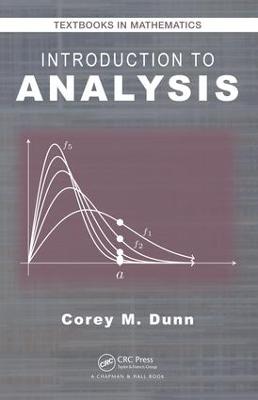
Introduction to Analysis [Kõva köide]

  • Formaat: Hardback, 398 pages, kõrgus x laius: 234x156 mm, kaal: 700 g, 40 Tables, black and white; 46 Illustrations, black and white
  • Sari: Textbooks in Mathematics
  • Ilmumisaeg: 06-Jun-2017
  • Kirjastus: Chapman & Hall/CRC
  • ISBN-10: 1498732011
  • ISBN-13: 9781498732017
Teised raamatud teemal:
  • Formaat: Hardback, 398 pages, kõrgus x laius: 234x156 mm, kaal: 700 g, 40 Tables, black and white; 46 Illustrations, black and white
  • Sari: Textbooks in Mathematics
  • Ilmumisaeg: 06-Jun-2017
  • Kirjastus: Chapman & Hall/CRC
  • ISBN-10: 1498732011
  • ISBN-13: 9781498732017
Teised raamatud teemal:
Introduction to Analysis is an ideal text for a one semester course on analysis. The book covers standard material on the real numbers, sequences, continuity, differentiation, and series, and includes an introduction to proof. The author has endeavored to write this book entirely from the students perspective: there is enough rigor to challenge even the best students in the class, but also enough explanation and detail to meet the needs of a struggling student.

From the Author to the student:

"I vividly recall sitting in an Analysis class and asking myself, What is all of this for? or I dont have any idea whats going on. This book is designed to help the student who finds themselves asking the same sorts of questions, but will also challenge the brightest students."

Chapter 1 is a basic introduction to logic and proofs. Informal summaries of the idea of proof provided before each result, and before a solution to a practice problem. Every chapter begins with a short summary, followed by a brief abstract of each section. Each section ends with a concise and referenced summary of the material which is designed to give the student a "big picture" idea of each section. There is a brief and non-technical summary of the goals of a proof or solution for each of the results and practice problems in this book, which are clearly marked as "Idea of proof," or as "Methodology", followed by a clearly marked formal proof or solution. Many references to previous definitions and results. A "Troubleshooting Guide" appears at the end of each chapter that answers common questions.
Preface xi
List of Figures
xix
1 Sets, Functions, and Proofs
1(58)
1.1 Logic and an Introduction to Proof
2(9)
1.2 Sets and Their Operations
11(11)
1.3 Mathematical Induction
22(7)
1.4 Functions
29(10)
1.5 Cardinality
39(16)
1.6 Troubleshooting Guide for Sets, Functions, and Proofs
55(4)
2 The Real Numbers
59(34)
2.1 The Real and Extended Real Number System
60(15)
2.2 The Supremum and Infimum
75(7)
2.3 The Completeness Axiom
82(8)
2.4 Troubleshooting Guide for The Real Numbers
90(3)
3 Sequences and Their Limits
93(126)
3.1 Sequences
95(11)
3.2 Limits and Convergence
106(18)
3.3 Limit Theorems
124(19)
3.4 Subsequences
143(6)
3.5 Monotone Sequences
149(12)
3.6 The Bolzano-Weierstrass Theorems
161(10)
3.7 Cauchy Sequences
171(11)
3.8 Infinite Limits
182(13)
3.9 The lim sup and lim inf
195(16)
3.10 Troubleshooting guide for Sequences and Their Limits
211(8)
4 Series of Real Numbers
219(34)
4.1 Infinite Series
220(7)
4.2 Convergence Tests for Series with Nonnegative Terms
227(8)
4.3 Other Convergence Tests for Series
235(10)
4.4 Rearrangements
245(6)
4.5 Troubleshooting Guide for Series of Real Numbers
251(2)
5 Limits and Continuity
253(56)
5.1 Limits of Functions
254(9)
5.2 Properties of Limits
263(11)
5.3 Infinite Limits
274(7)
5.4 Continuity and Discontinuity
281(7)
5.5 Consequences of Continuity
288(8)
5.6 Uniform Continuity
296(8)
5.7 Troubleshooting Guide for Limits and Continuity
304(5)
6 Differentiation
309(42)
6.1 The Derivative
310(14)
6.2 The Mean Value Theorem
324(10)
6.3 Taylor Polynomials
334(6)
6.4 L'Hopital's Rule
340(8)
6.5 Troubleshooting Guide for Differentiation
348(3)
7 Sequences and Series of Functions
351(38)
7.1 Sequences of Functions
352(8)
7.2 Consequences of Uniform Convergence
360(7)
7.3 Infinite Series of Functions
367(8)
7.4 Power Series
375(12)
7.5 Troubleshooting Guide for Series of Real Numbers
387(2)
Appendix A List of Commonly Used Symbols 389(4)
Bibliography 393(2)
Index 395
Dr. Corey M. Dunn is a Professor of mathematics at California State University, San Bernardino. His interests include Differential Geometry, Geometric Analysis, Linear Algebra, and involving undergraduates in his research. He received his PhD from the University of Oregon in 2006.