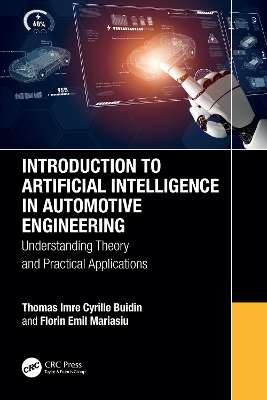
This book serves as a practical and timely guide to understanding how artificial intelligence can be applied and leveraged in automotive engineering. It demystifies complex methods of applying artificial intelligence and provides readers with the tools to creatively and immediately apply them to their own engineering challenges.
This book serves as a practical and timely guide to understanding how artificial intelligence can be applied and leveraged in automotive engineering. It demystifies complex methods of applying artificial intelligence and provides readers with the tools to creatively and immediately apply them to their own engineering challenges, transforming information into knowledge.
Drawing on the authors' teaching experience, the book takes a practical approach to applying artificial intelligence tools - such as regression, classification, clustering, deep learning and reinforcement learning- to real-world engineering problems. Through clear explanations and step-by-step algorithmic structures, readers are introduced to the fundamental concepts of artificial intelligence and their practical application by building AI models using automotive data. Examples include predicting the energy consumption of electric vehicles under varying environmental and operating conditions, assessing battery degradation, analyzing brake system wear, and implementing intelligent control for thermal management (HVAC systems). The book shows how the application of artificial intelligence techniques and methods can optimize performance, increase safety, and stimulate innovation in the automotive sector.
The book represents an essential guide for all those interested in exploring the application of artificial intelligence in automotive engineering (and beyond) and equally constitutes an effective support in the teaching process (courses, laboratories, projects) of applied artificial intelligence concepts.
Preface. Introduction: AI and Automotive Engineering. About the
Authors 1. Introduction to Artificial Intelligence 2. Regression Methods
3.
Classification Tools
4. Decision Trees Method
5. K-means and Hierarchical
Clustering
6. Support Vector Machine Method
7. Neural Networks
8.
Reinforcement Learning. Index.
Thomas Imre Cyrille Buidin is assistant professor in the Department of Automotive Engineering and Transports at the Technical University of Cluj-Napoca (UTCN), and a member of the Electric Mobility Applied Research Center (EMARC) research group. He earned his PhD in Mechanical Engineering from UTCN (2024) with a summa cum laude distinction. His thesis analyzed the efficiency of battery thermal management systems, and he was the first within the UTCN to incorporate AI methods into a doctoral thesis from the Mechanical Engineering domain. His domains of research and interest are hybrid and electric vehicles and lithium-ion batteries, with a focus on the energy efficiency optimization of innovative thermal management solutions and systems. The results of his research activity can be summarized as one patent, seven published scientific articles, 200 citations and ten prizes and awards for research and innovation in the fields of Mechanical and Automotive Engineering.
Florin Emil Mariasiu is a full professor at the Technical University of Cluj-Napoca (UTCN), specializing in Automotive and Transport Engineering. He earned his PhD in Mechanical Engineering from the UTCN (2003), as well as his Habilitation diploma in Mechanical Engineering (2015) from the UTCN. His areas of research interest are sustainable energy solutions for mechanical and thermal systems, along with recent concerns related to the application of AI tools in engineering and hybrid education in the automotive field. His research activity can be summarized as four patents, 15 books/chapters, over 100 published scientific articles, over 1,500 citations and more than 20 national and international awards and distinctions for research and innovation in the fields of Mechanical and Automotive Engineering.