Muutke küpsiste eelistusi

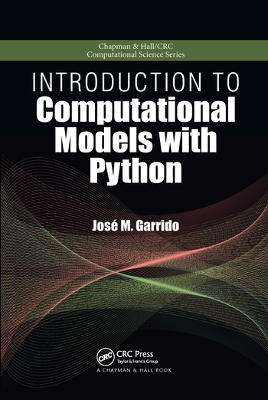
Introduction to Computational Models with Python [Pehme köide]

(Kennesaw State University, Georgia, USA)
  • Formaat: Paperback / softback, 496 pages, kõrgus x laius: 234x156 mm, kaal: 780 g
  • Sari: Chapman & Hall/CRC Computational Science
  • Ilmumisaeg: 30-Jun-2020
  • Kirjastus: Chapman & Hall/CRC
  • ISBN-10: 0367575531
  • ISBN-13: 9780367575533
  • Pehme köide
  • Hind: 50,84 €*
  • * hind on lõplik, st. muud allahindlused enam ei rakendu
  • Tavahind: 67,79 €
  • Säästad 25%
  • Raamatu kohalejõudmiseks kirjastusest kulub orienteeruvalt 3-4 nädalat
  • Kogus:
  • Lisa ostukorvi
  • Tasuta tarne
  • Tellimisaeg 2-4 nädalat
  • Lisa soovinimekirja
  • Raamatukogudele
  • Formaat: Paperback / softback, 496 pages, kõrgus x laius: 234x156 mm, kaal: 780 g
  • Sari: Chapman & Hall/CRC Computational Science
  • Ilmumisaeg: 30-Jun-2020
  • Kirjastus: Chapman & Hall/CRC
  • ISBN-10: 0367575531
  • ISBN-13: 9780367575533
Introduction to Computational Models with Python explains how to implement computational models using the flexible and easy-to-use Python programming language. The book uses the Python programming language interpreter and several packages from the huge Python Library that improve the performance of numerical computing, such as the Numpy and Scipy modules. The Python source code and data files are available on the authors website.


The books five sections present:


An overview of problem solving and simple Python programs, introducing the basic models and techniques for designing and implementing problem solutions, independent of software and hardware tools


Programming principles with the Python programming language, covering basic programming concepts, data definitions, programming structures with flowcharts and pseudo-code, solving problems, and algorithms


Python lists, arrays, basic data structures, object orientation, linked lists, recursion, and running programs under Linux


Implementation of computational models with Python using Numpy, with examples and case studies


The modeling of linear optimization problems, from problem formulation to implementation of computational models


This book introduces the principles of computational modeling as well as the approaches of multi- and interdisciplinary computing to beginners in the field. It provides the foundation for more advanced studies in scientific computing, including parallel computing using MPI, grid computing, and other methods and techniques used in high-performance computing.

Problem Solving: Problem Solving and Computing. Simple Python Programs. Basic Programming Principles with Python: Modules and Functions. Program Structures. The Selection Program Structure. The Repetition Program Structure. Data Structures, Object Orientation, and Recursion: Python Lists, Strings, and Other Data Sequences. Object Orientation. Object-Oriented Programs. Linked Lists. Recursion. Fundamental Computational Models with Python: Computational Models with Arithmetic Growth. Computational Models with Quadratic Growth. Models with Geometric Growth. Computational Models with Polynomial Growth. Empirical Models with Interpolation and Curve Fitting. Using Arrays with Numpy. Models with Matrices and Linear Equations. Introduction to Models of Dynamical Systems. Linear Optimization Models: Linear Optimization Modeling. Solving Linear Optimization Models. Sensitivity Analysis and Duality. Transportation Models. Network Models. Integer Linear Optimization Models.

José M. Garrido is a professor in the Department of Computer Science at Kennesaw State University. Dr. Garrido is the author of several books and numerous research papers. His research interests include software development, operating systems, computational modeling, object-oriented simulation, and system formal specification.