Muutke küpsiste eelistusi

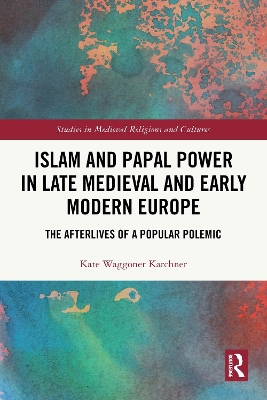
Islam and Papal Power in Late Medieval and Early Modern Europe: The Afterlives of a Popular Polemic [Pehme köide]

  • Formaat: Paperback / softback, 212 pages, kõrgus x laius: 234x156 mm, 1 Line drawings, black and white; 1 Illustrations, black and white
  • Sari: Studies in Medieval Religions and Cultures
  • Ilmumisaeg: 22-Jun-2026
  • Kirjastus: Routledge
  • ISBN-10: 1032472685
  • ISBN-13: 9781032472683
  • Pehme köide
  • Hind: 48,81 €*
  • * hind on lõplik, st. muud allahindlused enam ei rakendu
  • Tavahind: 65,09 €
  • Säästad 25%
  • See raamat ei ole veel ilmunud. Raamatu kohalejõudmiseks kulub orienteeruvalt 3-4 nädalat peale raamatu väljaandmist.
  • Kogus:
  • Lisa ostukorvi
  • Tasuta tarne
  • Tellimisaeg 2-4 nädalat
  • Lisa soovinimekirja
  • Formaat: Paperback / softback, 212 pages, kõrgus x laius: 234x156 mm, 1 Line drawings, black and white; 1 Illustrations, black and white
  • Sari: Studies in Medieval Religions and Cultures
  • Ilmumisaeg: 22-Jun-2026
  • Kirjastus: Routledge
  • ISBN-10: 1032472685
  • ISBN-13: 9781032472683
Islam and Papal Power in Late Medieval and Early Modern Europe traces the influential history of another book: Riccoldo da Montecroces Contra legem Sarracenorum. Around 1301, a Dominican missionary named Riccoldo da Montecroce wrote a treatise on the Quran, arguing against the validity of the Muslim faith. Over the next two hundred years, Europeans read, copied, translated, and circulated Riccoldos work more than any other text on Islam. This study overviews and contextualizes that popularity in order to analyze Christian understandings of Islam in early modern Europe.

Analysing the thirty-four surviving manuscript copies, this book studies the way the text was transcribed, the notes that readers made in the margins, and the contexts in which it was copied. Critically, this book also puts the transmission analysis into the broader context of major European historical developments. This context reveals that Contra legem became a tool for Europeans who linked fear of the Ottoman Empire to instability within the Church. Specifically, readers used Riccoldos descriptions of the dangers of the Quran to conflate the Ottoman Empire with a broader Islamic threat to Christian society. Such positioning helped readers to substantiate the divine authority of the western Church and especially the papacy as a bulwark against this threat.

This book will be of interest to scholars working on interreligious dialogue and Christian-Muslim relations in medieval and early modern Europe and the Mediterranean. It will appeal to historians of religion, scholars of late medieval and early modern thought, and students of pre- and early modern history at the upper undergraduate and graduate levels.
Introduction: How an Italian Monk Came to Write a Bestselling Book on
the Quran

1. Viral Vitriol: Reading and Reproducing an Anti-Islamic Polemic

2. Authority and Authenticity in the Making of an Early Modern Bestseller

3. Papal Power: Using Islam to Maintain Control of the Catholic Church

4. The Sword and the Pen: European Responses to the Rise of the Ottomans

5. Philosophy, Philology, and Polemic during the Renaissance

Afterword. Legacies from Martin Luther to 9/11

Appendix A. Contra legem Manuscript Corpus: Descriptions and Observations

Appendix B. Contents of the Contra legem Manuscript Corpus

Bibliography
Kate Waggoner Karchner is an independent scholar living and working in Ohio. Waggoner Karchner earned her PhD in History with a certificate in Medieval Studies from the University of Michigan in 2019. While there, Waggoner Karchner focused on medieval and early modern European history with an emphasis on religious history and Christian-Muslim relations. Waggoner Karchners past publications include Two New Manuscript Copies of Riccoldo da Montecroces Contra legem Sarracenorum (2019) and Deciphering the Quran in late medieval Europe: Riccoldo da Montecroce, Nicholas of Cusa, and the text-centred development of interreligious dialogue (2020).