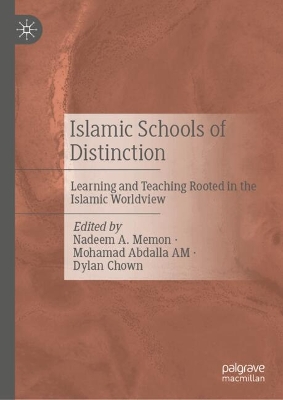
This book aims to provide a practical and accessible resource for school leaders and educators in Islamic schools, focusing learning and teaching rooted in the Islamic worldview. Drawing from theoretical insights and school and classroom-based case studies, it offers innovative approaches for renewing educational practice in Islamic schools across Australia and beyond. The book serves as an inspiration for educational renewal of Islamic Schools to become schools that advance distinct models of holistic faith-informed educational practice. Through contributions from experienced practitioners and seasoned academics, this book seeks to bridge the gap between theory and practical implementation in Islamic schooling.
Chapter 1: Introduction: What makes an Islamic School distinct and why
Islamic Worldview is necessary? - Nadeem Memon, Mohamad Abdalla, Dylan
Chown.- Part I: Theoretical Foundations: Education Rooted in the Islamic
Worldview.
Chapter 2: From Worldview to Praxis: Islamic Schooling Renewal
through Design and Distinction - Mohamad Abdalla, Dylan Chown, and Nadeem
Memon.
Chapter 3: Educating from and for an Islamic worldview: The
Shakhsiyah Schools Story - Dr Farah Ahmed.
Chapter 4: Towards an Educational
Framework Rooted in an Islamic Worldview: Multiplexity as a Case Study -
Samir Mahmoud.
Chapter 5: Internalizing Beauty: Re-imagining behaviour
education as spiralling towards beautified excellence in all things - Dr.
Claire Alkouatli.- Part II: Examples of Theoretical Foundations: Drawing on
the Islamic Worldview to Advance Distinct Islamic Schooling.
Chapter 6:
Reclaiming Critical Thinking in Islamic Schools: A Quintessential Pedagogy
for Navigating Complexity - Dr. Nada Ghamra-Oui.
Chapter 7: Fitrah Focused
Islamic Schools: A Solution for Teacher Burnout and Student Behaviour
Management - Kathryn Jones.
Chapter 8: Rethinking Behavior & Discipline at
Islamic Schools through Prophetic Principles of Tarbiyah - Wadud Hassan.-
Part III: School Case Studies: Australian Islamic Schools Journeying to
Distinction.
Chapter 9: The Niyyah Project: A Journey of renewal in an
Australian Islamic School - Zachariah Matthews.
Chapter 10: A Renewed Look
at Curriculum, Pedagogy and Assessment Through a Prophetic Paradigm: A Case
Study of Playford College - Abrahim Al-Zubeidi.
Chapter 11: Turning Inward:
Leading School Renewal Through Islamic Worldview at Irfan College - Samah
Taki.
Chapter 12: Sidrah Gardens: A Philosophy in Practice Courage,
Conviction, and Renewal in Islamic Schooling - Dylan Chown and Leyla
Mahamoud.
Chapter 13: Islamic Worldview, Teacher Education and Professional
Learning: Reframing Professional Identity in Islamic Schools - Dr. Ayda
Succarie.- Part IV: Classroom Case Studies: Curriculum, Pedagogy, and
Assessment Rooted in the Islamic Worldview.
Chapter 14: Niyyah in Practice:
Transforming Science Education through Islamic Pedagogy - Thamina Kassar.-
Chapter 15: Transformation and Redesign: Teaching English through an Islamic
Worldview - Dr Ozan Angin & Fatima Jalloul.
Chapter 16: Exploration of the
Islamic worldview from a Sporting Lens - Esra Boz.
Chapter 17: Family,
Kinship, and Identity: An Islamic Pedagogical Approach to Teaching Aboriginal
Histories in English - Eman Aweida.
Nadeem A. Memon is an Associate Professor in the Centre for Islamic Thought and Education (CITE) in the School of Education at Adelaide University. His research focuses on teacher education with particular emphasis on Islamic Pedagogy, comparative faith-based schooling, philosophy of religious education, and culturally and religiously responsive pedagogy.
Mohamad Abdalla AM is a Professor and the Founding Director of the Centre for Islamic Thought and Education (CITE) in the School of Education at Adelaide University. He has worked in the field of Islamic Studies for over 25 years and played a leading role in establishing Islamic Studies across several Australian universities.
Dylan Chown is a lecturer in the Centre for Islamic Thought and Education (CITE) in the School of Education at Adelaide University. His research focuses on teacher education, with emphasis on Islamic pedagogy and culturally and religiously responsive pedagogy as well areas of inclusion and justice and school renewal.