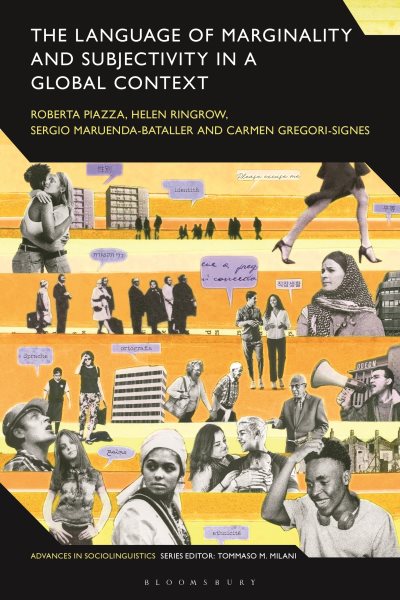
Explores the language of diversity and marginalisation in a variety of contexts and countries.
This book expands and deepens the investigation of the language associated with or produced by groups that are socially, culturally, racially and economically outliers and whose marginalisation results in a different engagement with and participation in mainstream society's activities.
It features case studies from across the globe, including Ghana, Norway, Poland, Saudi Arabia, South Africa and Zambia, addressing the construction (and self-construction) of marginalisation and diversity in discourse and society, bringing to light many unheard and hidden voices and perspectives. The 14 chapters explore a wide range of forms of marginalisation and diversity as global issues that have an impact on societies worldwide, in terms of exclusion in the guise of non-participation in mainstream society's activities and contestation in different international contexts.
The contributions in the book capture how vulnerable individuals and groups occupying the in-between spaces of marginality navigate through them and construct themselves as dissenting and diverse; how they are aware of their condition at a certain point in time and how they are able to reflect resourcefully on it. Aspiration to a safe place away from the street for individuals at risk of rough sleeping can find an echo in the desire to escape the oppression of a despotic regime that limits Saudi women's freedom. On the contrary, cases of negative self-exclusion are exemplified by the language of Men's Rights Activists who, critical of society's oppression of men, engage in a condemnation of women and feminism. In both cases, there is a conflict between periphery of society and mainstream, although the language of the excluded still engages with the hegemonic society in a form of intrinsic contestation.
Arvustused
Each chapter in this edited collection contributes a rich and textured exploration of the language of marginality in a global context, engaging critically with the complexity of subjectivity. It makes a compelling and nuanced case for the study of subjectivity when considering the language of marginality in a global context. The range of global scholars contributing to this collection is impressive. By bringing together scholars at different stages of their careers this book forges a path for inclusivity, in the process als0 addressing marginality in academic contexts. * Rosalchen Whitecross, Senior Lecturer in Criminology, Bath Spa University, UK and Research Associate, University of the Witwatersrand (Wits University), South Africa * This book investigates the language associated with or produced by groups that are socially, culturally, racially and economically outliers and whose marginalisation results in a different engagement with and participation in mainstream societys activities. * Ram Ashish Giri, Academic, Monash College/Monash University, Australia *
Muu info
Explores the language of diversity and marginalisation in a variety of contexts and countries.
List of Contributors
Introduction: The Language of Marginality and Subjectivity in a Global
Context, Roberta Piazza (University of Sussex, UK), Helen Ringrow (University
of Portsmouth, UK), Sergio Maruenda-Bataller (University of Valencia, Spain)
and Carmen Gregori-Signes (University of Valencia, Spain)
Part I: Narrating the Experience of Marginalisation
1. Understanding the Nexus between Problem-Solution Discourse and
Stigmatisation in Different Phases of HIV/AIDS in South Africa and United
Kingdom: A Case Study, Otto Mponda (University of Roehampton, UK)
2. Trauma-Based Care as Marginalizing Practice, Tale Steen-Johnsen, Lisbeth
L. Skreland (University of Agder, Norway) and Eric Kimathi (University of
Agder, Norway)
Part II: Public Discourses and Practices of Marginality
3. Dirty You: The Discourse of Dirt around Travellers and Gypsies in the
UK Press, Roberta Piazza (University of Sussex, UK) and Carmina Gregori
Signes (Universitat de Valčncia, Spain)
4. Spurious Language Proximity: Linguistic Marginalisation of Ukrainian
Migrants by Polish Institutions, Michal Wanke (University of Opole, Poland),
Marcin Deutschmann (University of Opole, Poland), Magdalena Piejko-Plonka
(University of Opole, Poland) and Clara Kleininger (University of Exeter, UK)
5. Why Arent You Learning Anything? Challenging Questions in Parole
Hearings Involving Prisoners Serving IPP Sentences, David Peplow and Jake
Phillips (Sheffield Hallam University, UK)
6. The Biopolitics of Pan-Africanism: The Plight of South Africas LGBTIQ
Community, Veeran Naicker (Stellenbosch University, South Africa) and Kathy
Luckett (Rhodes University, South Africa)
Part III: Constructing and Contesting Marginalisation and the Media
7. Resisting Parliamentarians: A Critical Discourse Analysis of Ghanas
#DropThatChamber, Mark Nartey (University of the West of England, UK)
8. The Response to Womens Exclusion in a Conservative Religious Country:
Tweets After the Lifting of the Ban on Women Driving in Saudi Arabia, Fatmah
Alhazmi (Jazan University, Saudi Arabia) and Roberta Piazza (University of
Sussex, UK)
9. Marginalized Men Online: A Feminist Critical Discourse Analysis Approach
to the Construction of Identity within the Online Mens Rights Community,
Alexandra Kempton (University of Sussex, UK)
Index
Roberta Piazza is Associate Professor in English Language and Linguistics at the University of Sussex, UK. Helen Ringrow is Senior Lecturer in English Language and Linguistics at the University of Portsmouth, UK. Sergio Maruenda-Bataller is Associate Professor in English Language and Linguistics at the University of Valencia, Spain. Carmen Gregori-Signes is Associate Professor in English Language and Linguistics at the University of Valencia, Spain.