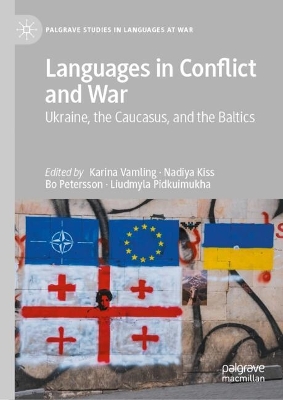
This book explores language conflicts in Soviet successor states: Ukraine, the Russian North Caucasus, Georgia, and the Baltics. Current violent developments in these multiethnic countries with their shared legacies of Russian domination highlight the intertwining of language with conflict and war, reflecting confrontation and challenges to peace. It is shown how core values attached to language in identity formation and feelings of belonging or marginalization, along with attitudes to language use by the in-group in contrast to others, are easily subject to politicization. Forced migration, language erasure and shift, central in today’s post-Soviet conflicts, are also experienced by minorities in the Russian North Caucasus—such as the Circassians—based on their history of Russian colonization. The book will be of interest to readers in a wide range of fields, including sociolinguistics, language policy, and language contact, as well as identity politics, migration linguistics, state and nation building, area studies, post-Soviet and European studies, political science, international relations, and peace and conflict studies.
Finally, please note that you have not included the authors’ biographies in the marketing text you shared, but this is required so I can check the changes they have made (I was copied on their emails, so I know there have been changes). Please share the full back cover text for me to check properly before it is approved.
1 Karina Vamling, Bo Petersson and Nadiya Kiss: Introduction.- 2
Liudmyla Pidkuimukha: Weaponizing Language: How Russia Commits Linguicide on
the Occupied Territories of Ukraine.- 3 Nadiya Kiss: Languages at war:
Language shift, contested language diversity and ambivalent enmity in
Ukraine.- 4 Svetlana Lnyavsky: I am a Russian Ukrainian, but I will not
learn Ukrainian just for you! Language ideological debates, linguistic
vigilantism, and Internally Displaced People at the time of war.- 5 Andrey
Makarychev: Estonian Russophones: A Biopolitical Story.- 6 Lena Herceberga:
Todays ambivalence or someones future hopes: Critical analysis of the
discourse of a good young Russian speaker in Latvia.- 7 Lidia Zhigunova:
Russias War on Indigenous Languages: The Case of Circassian in theNorth
Caucasus.- 8 Valeriya Minakova: It all starts in the family: Placing
discourses on the role of families in Circassian language preservation into a
historical-political context.- 9 Lars Funch Hansen: The marginalisation of
Circassian language through local history teaching, with cases from Krasnodar
Krai including the Black Sea coast.- 10 Mariam Manjgaladze: Issues of the
Official Language Ecology in Contemporary Georgia.- 11 Tinatin Bolkvadze: How
to assess the functioning of the Russian language in Georgia.- 12 Giorgi
Alibegashvili and Maka Tetradze: Georgian on the Streets as a Reflection of
the functioning of the State language in Georgia.- 13 Karina Vamling, Bo
Petersson and Nadiya Kiss: Conclusion.
Karina Vamling is a Professor emerita of Caucasus Studies at Malmö University, Sweden, specializing in Caucasian languages and linguistics, language policy, and ethnic minorities. She is a co-founder of the research center Russia, Ukraine and the Caucasus Regional Research (RUCARR). Nadiya Kiss is a Gerda Henkel Fellow at the Department of History of Science, University of Erfurt, Germany. Her research interests include sociolinguistics, migration linguistics, and higher education research.
Bo Petersson is Professor of Political Science at Malmö University, Sweden, where he heads the research center Russia, Ukraine and the Caucasus Regional Research (RUCARR). He specializes in Russian and post-Soviet politics, particularly legitimation of authoritarian political systems, and political myth.
Liudmyla Pidkuimukha is a Postdoctoral Researcher in the Department of Slavic Languages and Literatures at Justus Liebig University Giessen, Germany. Research interests include language ideology, language policy and language planning, and anthropological linguistics.