Muutke küpsiste eelistusi

Large Carnivore Conservation and Management: Human Dimensions [Pehme köide]

Edited by (University of Cyprus, Cyprus)
  • Pehme köide
  • Hind: 38,69 €*
  • * hind on lõplik, st. muud allahindlused enam ei rakendu
  • Tavahind: 51,59 €
  • Säästad 25%
  • Raamatu kohalejõudmiseks kirjastusest kulub orienteeruvalt 3-4 nädalat
  • Kogus:
  • Lisa ostukorvi
  • Tasuta tarne
  • Tellimisaeg 2-4 nädalat
  • Lisa soovinimekirja
  • Raamatukogudele
Large carnivores include iconic species such as bears, wolves and big cats. Their habitats are increasingly being shared with humans, and there is a growing number of examples of human-carnivore coexistence as well as conflict. Next to population dynamics of large carnivores, there are considerable attitude shifts towards these species worldwide with multiple implications.


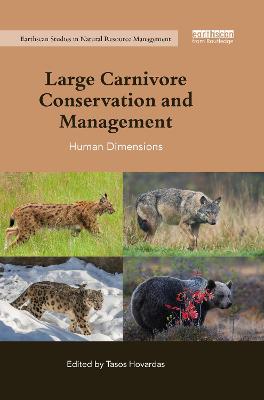
This book argues and demonstrates why human dimensions of relationships to large carnivores are crucial for their successful conservation and management. It provides an overview of theoretical and methodological perspectives, heterogeneity in stakeholder perceptions and behaviour as well as developments in decision making, stakeholder involvement, policy and governance informed by human dimensions of large carnivore conservation and management. The scope is international, with detailed examples and case studies from Europe, North and South America, Central and South Asia, as well as debates of the challenges faced by urbanization, agricultural expansion, national parks and protected areas. The main species covered include bears, wolves, lynx, and leopards.


The book provides a novel perspective for advanced students, researchers and professionals in ecology and conservation, wildlife management, human-wildlife interactions, environmental education and environmental social science.

Arvustused

'This excellent volume condenses decaded of high-quality research into who the relevant stakeholders are, how they interact with each other, and how their value systems, mandates and actions influence the legitimacy and outcomes of carnivore management policies...This book is neither dogmatic nor does it contain unnecessary jargon, making it an accessible resource that provides generous practical guidance...The book covers a lot of ground and it provides a valuable resource for those involved in, or unfamiliar with, the human dimensions of large carnivore conservation and management.' - Florian J. Weise, Ongava Research Centre, Namibia in Fauna & Flora International, Cambridge, UK (https://doi.org/10.1017/S0030605319000486)

Part I Theoretical and methodological perspectives
1. Addressing human
dimensions in large carnivore conservation and management: Insights from
environmental social science and social psychology
2. Research amidst the
contentious issue of wolf presence: Exploration of reference frames and
social, cultural, and political dimensions
3. Socio-political illegal acts as
a challenge for wolf conservation and management: Implications for
legitimizing traditional hunting practices
4. Situated, reflexive research in
practice: Applying feminist methodology to a study of human-bear conflict
5.
A methodology for stakeholder analysis, consultation and engagement in large
carnivore conservation and management Part II Heterogeneity in perceptions of
and behaviour towards large carnivores
6. A community divided: Local
perspectives on the reintroduction of Eurasian lynx (Lynx lynx) to the UK
7.
Heterogeneity in perceptions of large carnivores: Insights from Sanjay Gandhi
National Park, Mumbai, and Ladakh
8. Considering wolves as active agents in
understanding stakeholder perceptions and developing management strategies
9.
Attitudes towards large carnivore species in the West Carpathians: Shifts in
public perception and media content after the return of the wolf and the bear
10. Rural-urban heterogeneity in attitudes towards large carnivores in
Sweden, 1976-2014
11. Challenging the false dichotomy of Us vs Them:
Heterogeneity in stakeholder identities regarding carnivores Part III
Decision-making, stakeholder involvement, and policy in large carnivore
conservation and management
12. Inappropriate consideration of animal
interests in predator management: Towards a comprehensive moral code
13.
Science, society and snow Leopards: Bridging the divides through
collaborations and best practice convergence
14. Between politics and
management: Governing large carnivores in Fennoscandia
15. Trans-boundary and
trans-regional management of a large carnivore: Managing brown bears across
national and regional borders in Europe
16. Good practice in large carnivore
conservation and management: Insights from the EU Platform on coexistence
between people and large carnivores
Tasos Hovardas is the Human Dimensions Expert of CALLISTO - Wildlife and Nature Conservation Society, and through CALLISTO, he is providing consultancy services to the EU Platform on Coexistence between People and Large carnivores. Tasos acts as Editor-in-Chief of Society & Natural Resources (2017-2020) together with Prof. Linda Prokopy (2017-2020). He is an Editorial Board Member of the Journal of Research in Science Teaching (2017-2020) and a member of the Research in Science & Technology Education Group at the University of Cyprus.