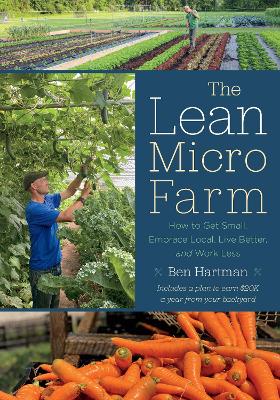
Oftentimes, the desire in farming is to open up more land, grow more crops, and get bigger. In The Lean Micro Farm, Ben Hartman doesnt just illuminate the enormous potential in getting smallfor communities, for the environment, for the profitability of farmshe lays out a roadmap for how to achieve it.
As Ben eloquently demonstrates, small doesnt mean less, small can just as easily mean more. Small can mean better. Small can mean, in the immortal words of economist E. F. Schumacher, beautiful. More importantly, when the desire is to grow more and earn more, sometimes getting smaller is actually the answer.
I was delighted and a bit terrified to pick up Ben Hartmans new book, because every time I read something Ben wrote, significant portions of my farm change. And The Lean Micro Farm is no exception. Chapter by chapter you see the ways in which shrinking their farm has led Ben and his wife Rachel to a happier, healthier, more sustainable, more localized farm without risking income. Each section is filled with examples and strategies for how they got small and what it looks like in practice. Its well-written, thought-provoking, and potentially life-altering. I immediately found myself penciling out ways to make our farm smaller.
So fair warning, this book will change your farm.
Jesse Frost, author of The Living Soil Handbook The Lean Micro Farm is a game changer for farming and food production. With well-thought-out principles and innovative techniques for planning and maintaining profitable tiny farms, Ben Hartman opens the door to a future of micro farms everywhere, rather than fewer and fewer large farms in rural locations only. This easy-to-read book is full of time-saving and ecologically sustainable techniques, such as flipping beds of both short and tall-growing crops with minimal soil disturbance so that multiple crops can be grown well each year in a small space. Bens tested methods can be applied to gardens and homesteads as well as small farms. Thank you, Ben, for bringing the ideas of my hero, E. F. Schumacher, into the 21st century and showing that they are as relevant as they were when his book, Small Is Beautiful, was first published!
Helen Atthowe, Woodleaf Farm, Montana; author of The Ecological Farm Ben is a shining example of the powerful ideas and efficient methods he describes. He has a way of making things simple and a simple way of explaining them! Small is beautiful and small makes sense, now more than ever. Bens one third of an acre is understandable, achievable, and hugely productive of nutritious food. Its my pleasure to learn more about and endorse his approach. Heres to health with Hartman.
Charles Dowding, author of No Dig Gardening, No Dig Cookbook, and No Dig Children's Gardening Book We urgently need to be experimenting with new ways of producing food locally, keeping an eye on future uncertainties, present realities, and past wisdom. Few have done so with more thoughtfulness and rigorous practicality than Ben Hartman, as showcased in this excellent book. I wish its treasure trove of hard-earned insight had been available when I was starting my own small market garden. Its sure to help a new generation of small-scale growers hit the ground running.
Chris Smaje, author of Saying NO to a Farm-Free Future In the field, Ben never zags. The crops are in perfect alignment. Zagging would be wasteful motion. However, in a world thats obsessed with scaling, whether the business is technology or never-enough farming, Ben has zagged by getting small. For the sake of his family and community, Ben simply wants to live better and work less. Dont we all? In this book, he explains how to achieve that goal by getting small with lean thinking. In other words, he explains how the philosophy of just enough is a zag we should all consider putting into practice.
Josh Howell, president and executive team leader, Lean Enterprise Institute I am immensely grateful to have come across this book and its older siblingsthey have helped us so much on our farm. The mindset of doing better instead of growing more is the best advice a young farmer can receive. In this new book you will be immersed in the ideas of great thinkers like Schumacher, Pareto, Gandhi, as well as Japanese philosophy, while also receiving concrete steps to be productive and profitable. Clay Bottom Farm is the most productive small farm we have visited, measured in income by square meter, and we are still trying to catch up.
Francisco Vio, Huerto Cuatro Estaciones, Aysén, Chile