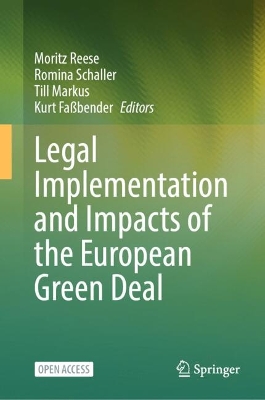
The book offers a comprehensive analysis of the legal implementation and impacts of the European Green Deal (EGD), introduced in 2019 to transform the EU towards a sustainable, carbon-neutral economy. Covering key research areas such as energy transition, biodiversity, circular economy, and climate law, it explores topics like the EU's potential withdrawal from the Energy Charter Treaty, the role of Power Purchase Agreements in energy markets, and the intersection of energy efficiency and biodiversity. The volume also addresses legal pathways for circularity in construction, marine ecosystem sustainability, forest conservation, and climate targets at the Member State level. Drawing on contributions from the 10th European Environmental Law Forum (2023, Leipzig), this book provides valuable insights for policymakers, legal professionals, and scholars working towards a climate-neutral Europe.
This open access book
Introduction.- The european green deal and its constitutional
implications need for a greening of the treaties.- National climate framework
laws in europe how do they relate to national ownership.- The rise and fall
of a treaty is the eus withdrawal from the energy charter treaty in line or
at odds with its ambitions to achieve a locally driven energy transition.-
Unlocking the potential of long term contracts in the eu energy landscape.-
New regulatory framework for air pollution and greenhouse gas emissions in
the aviation sector under the green deal.- Will european biodiversity be
sacrificed on the green transition altar perspectives on habitats and species
protection in times of energy crises.-Legal instruments to ensure circularity
in construction a focus on products procurement and the process.- Diving into
the marine dimension of the european green deal something old something
borrowed but how new and blue.- Caring for forests here and abroad the eus
strategies for sustainable forest ecosystems around the world.
Moritz Reese is Head of the Department of Environmental and Planning Law at the UFZ in Leipzig. He is also professor for European environmental law at the Faculty of Law of Leipzig University. His research focuses on European and national environmental law, particularly in the areas of water law, circular economy law, climate adaptation law, nature conservation law, immission control law, and urban and infrastructure planning law. In addition, his work addresses the theoretical foundations of environmental law and the overarching legal dimensions of the sustainability transformation. He is also Chair of the European Environmental Law Form (EELF), co-editor of the Zeitschrift für Umweltrecht (Journal for Environmental Law) and co-editor of the Journal for European Environmental & Planning Law (JEEPL).
Romina Schaller is a Postdoctoral Researcher in the Department of Environmental and Planning Law at the Helmholtz Centre for Environmental Research-UFZ (Germany). She also coordinates the Competence Network Challenges of Environmental Law (KomUR). Her work focuses on international and European environmental law, particularly in climate change mitigation (e.g. forest protection through REDD+) as well as on ecosystem services and sustainable development. Her current research explores the legal aspects for the regulation of carbon dioxide removal technologies (CDR) and the emerging challenges linked to their governance.
Till Markus is Deputy Head of the Department of Environmental and Planning Law at the Helmholtz Centre for Environmental Research (UFZ), Leipzig, a position he has held since April 2024. He has been a Privatdozent at the Faculty of Law, University of Bremen, since February 2020. He serves as Co-Chief Editor of the Zeitschrift für Umweltrecht (Journal of Environmental Law, ZUR) and as Editor of the International Yearbook of Soil Law and Policy (Springer). His research and teaching focus on international and European law, environmental law, the law of the sea, comparative law, and legal theory.
Kurt Faßbender is a Professor of Public Law, with a specialization in Environmental and Planning Law, and serves as the Executive Director of the Institute for Environmental and Planning Law (Institut für Umwelt- und Planungsrecht, IUPR) at Leipzig University in Germany. His research focuses on European and German environmental law, particularly in the areas of water law, circular economy law, climate law, nature conservation law, and urban and infrastructure planning law. He is also the Editor of the Zeitschrift für Umweltrecht (Journal of Environmental Law, ZUR).