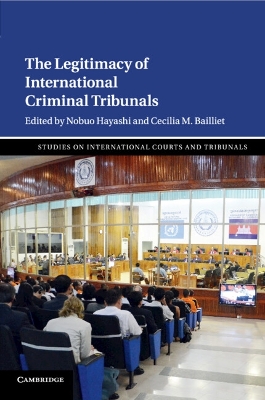
With the ad hoc tribunals completing their mandates and the International Criminal Court under significant pressure, today's international criminal jurisdictions are at a critical juncture. Their legitimacy cannot be taken for granted. This multidisciplinary volume investigates key issues pertaining to legitimacy: criminal accountability, normative development, truth-discovery, complementarity, regionalism, and judicial cooperation. The volume sheds new light on previously unexplored areas, including the significance of redacted judgements, prosecutors' opening statements, rehabilitative processes of international convicts, victim expectations, court financing, and NGO activism. The book's original contributions will appeal to researchers, practitioners, advocates, and students of international criminal justice, accountability for war crimes and the rule of law.
Today's international criminal jurisdictions are at a critical juncture - their legitimacy cannot be taken for granted. This multidisciplinary volume investigates the challenge of attaining legitimacy by international criminal courts and tribunals. Expert authors and emerging scholars challenge received wisdom and shed new light on a range of issues.
Muu info
This multidisciplinary volume investigates the challenge of attaining legitimacy by international criminal courts and tribunals.
Introduction Nobuo Hayashi, Cecelia M. Bailliet and Joanna Nicholson;
Part I. Theories and Perspectives:
1. The legitimacy of international
criminal tribunals Larry May and Shannon Fyfe;
2. Conceptualising and
measuring the legitimacy of international criminal tribunals Silje Aambų
Langvatn and Theresa Squatrito;
3. Between international criminal justice and
injustice: theorising legitimacy Sergey Vasiliev;
4. Legitimacy, legality,
and the possibility of a pluralist international criminal law Asad Kiyani;
5.
The legitimacy and effectiveness of international criminal tribunals: a
criminal policy perspective Athanasios Chouliaras; Part II. Norms and
Objectives:
6. Legitimacy and ICC jurisdiction following Security Council
referrals: conduct on the territory of non-Party States and the legality
principle Rogier Bartels;
7. Is the Yugoslav Tribunal guilty of
hyper-humanising international humanitarian law? Nobuo Hayashi;
8. 'One of
the challenges that can plausibly be raised against them'? On the role of
truth in debates about the legitimacy of international criminal tribunals
Jakob V. H. Holtermann;
9. Hidden legitimacy: crafting judicial narratives in
the shadow of secrecy at a war crimes tribunal - a speculation Timothy
William Waters; Part III. Complementarity and Regionalism:
10. Positive
complementarity and legitimacy - is the International Criminal Court shifting
from judicial restraint towards intervention? Ignaz Stegmiller;
11. African
supranational criminal jurisdiction: one step towards ending impunity or two
steps backwards for international criminal justice? Dorothy Makaza;
12.
Legitimacy defects and legal flaws of the Special Tribunal for Lebanon:
dilemmas of the 'peace through justice' theorem Martin Wählisch; Part IV.
Parties to the Proceedings:
13. Prosecutors' opening statements: the rhetoric
of law, politics and silent war Damien Rogers;
14. Effectiveness of
international criminal tribunals: empirical assessment of rehabilitation as
sentencing goal Barbora Hola, Jessica Kelder and Joris van Wijk;
15.
Procedural justice, legitimacy, and victim participation in Uganda Stephen
Smith Cody; Part V. States and NGOs:
16. Things fall apart: battles of
legitimation and the politics of noncompliance and African sovereignty from
the Rwanda tribunal to the ICC Victor Peskin;
17. Financing lady justice: how
the funding systems of ad hoc tribunals could lend themselves to the
possibility of judicial bias Mistale Taylor;
18. Claiming authority in the
name of the other: human rights NGOs and the ICC Kjersti Lohne.
Nobuo Hayashi is a researcher at PluriCourts at Universitetet i Oslo. He is a specialist in international humanitarian law, international criminal law, and moral philosophy. Cecilia M. Bailliet is Professor and Director of the Masters Program in Public International Law at Universitetet i Oslo. She has published widely within the areas of international law, human rights, refugee law, counter-terrorism and peace. She is currently on the Steering Committee of PluriCourts research project where she is Coordinator of the International Criminal Law Pillar.