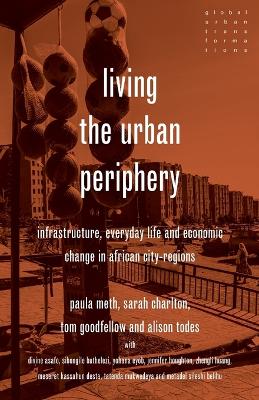
The edges of cities are increasingly understood as places of dynamism and change, but there is little research on African urban peripheries, the nature of building, growth, investment and decline that is shaping them and how these are lived. This co-authored monograph draws on findings from an extensive comparative study on Ethiopia and South Africa, in conversation with a related study on Ghana. It examines African urban peripheries through a dual focus on the experiences of living in these changing contexts, alongside the logics driving their transformation. Through its conceptualisation and application of five logics of periphery, it offers unique, contextually-informed insights into the generic processes shaping urban peripheries, and the variable ways in which these are playing out in contemporary Africa for those living the peripheries.
This electronic version has been made freely available under a Creative Commons (CC BY-NC-ND) licence, thanks to the support of the Economic and Social Research Council (ESRC). -- .
Arvustused
'This book greatly contributes to the reconceptualization of the urban peripheries discourse bringing to the fore the lived experience of people. Studying cities such as Addis Ababa, where its periphery is under dynamic transformation, beyond lending a fresh analytical perspective, generates learning on new frontiers hitherto undetailed.' Dr. Elias Yitbarek Alemayehu, Addis Ababa University
'Africa is poised to take the top spot in terms of the scale and pace of urbanisation globally. It must therefore be central to the urban conversation. In an engaging comparative study this book links the realities and experiences of three urban peripheries on the continent to a dynamic field of international debate. It is empirically rich and conceptually innovative.' Professor Phil Harrison, Wits University
'Taking forward their innovative conceptualisation of the varied logics of peripheral urbanisation, this collaboratively written and collectively researched comparative analysis builds on a rich, personal engagement with the lived experiences of residents in peripheral areas of rapidly expanding urban regions in South Africa, Ethiopia and Ghana. The authors draw inspiration directly from personal diaries and the daily lives of people they worked closely with in each of the case study areas, eThekwini (Durban), the Gauteng City-Region (Johannesburg), Addis Ababa and Accra. The book works carefully through different aspects of peripheral areas, from governance to investment, housing and land markets, jobs, transport and economy. In doing so, it showcases the potential to build new insights and conceptualisations starting from these contexts, too often neglected in urban studies theorisations. In this reflective comparative analysis, South Africa, Ethiopia and Ghana are the starting points for theoretical insights which will inform and encourage researchers and practitioners in many different contexts who are grappling with the implications of newly emerging, highly contested urbanising territories, which can be very difficult to inhabit. Residents identify peripheries as often boring places, emerging far from work, government and retail, with often unpredictable power relations, but also sometimes scope for co-operation. This poses significant challenges for residents and government. But these kinds of peripheral urban places will likely constitute a core element of global urbanism in an era increasingly characterised by dispersed, fragmented and often far-flung urbanising territories. This book therefore establishes what will surely be one of the pillars of an urban studies agenda, urgently needed for the twenty-first century, to understand the great diversity of rapidly urbanising areas across peripheries, whether relatively close to or remote from existing urban centralities.' Professor Jennifer Robinson, University College London
'Every chapter is steeped in rich, sometimes dense empirical and historical (as needed) detail that reflects an astoundingly substantive project, one that will be vital reading for anyone working on urban questions in Africa, particularly in the case-study metro regions and countries.' James T. Murphy, Journal of Urban Affairs -- .
Introduction - Paula Meth, Sarah Charlton, Tom Goodfellow and Alison
Todes
1: Visions of the Urban Periphery: Ethiopia and South Africa - Alison Todes
and Tom Goodfellow
2. Investment and Economic Change on the Urban Periphery - Alison Todes,
Sarah Charlton and Tom Goodfellow
3: Jobs and livelihoods: accessing work within and beyond the periphery -
Alison Todes, Tom Goodfellow and Jen Houghton
4: Governing the urban peripheries - Tom Goodfellow, Yohana Eyob, Paula Meth,
Tatenda Mukwedeya and Alison Todes.
5: Housing in Addis Ababa: policy, programmes and lived experience - Zhengli
Huang, Tom Goodfellow and Meseret Kassahun Desta
6: Housing, history and hope in South Africas urban peripheries - Sarah
Charlton, Alison Todes and Paula Meth
7: Peri-urban transformations: Changing land market and the issue of
(in)security in peri-urban Accra, Ghana - Divine M. Asafo
8: Transport and mobility (in South Africa and Addis Ababa) - Tom Goodfellow,
Paula Meth and Sarah Charlton
9: Producing Places: services, infrastructure and the public realm in South
Africa and Addis Ababa - Paula Meth, Sarah Charlton and Alison Todes
10: Social differentiation, boredom and crime within the peripheries - Paula
Meth, Metadel Sileshi Belihu and Sibongile Buthelezi
11: Supermarkets, retail and consumption in peripheral areas - Sarah Charlton
and Meseret Kassahun Desta
Conclusions - Paula Meth, Sarah Charlton, Tom Goodfellow and Alison Todes -- .
Paula Meth is Reader in the Department of Urban Studies and Planning at the University of Sheffield, and Visiting Associate Professor in the School of Architecture and Planning at the University of the Witwatersrand. Sarah Charlton is Professor in the School of Architecture and Planning at the University of the Witwatersrand. Tom Goodfellow is Professor of Urban Development at the Global Development Institute (GDI) and CEO of the African Cities Research Consortium (ACRC) at the University of Manchester. Alison Todes is Professor in the School of Architecture and Planning at the University of Witwatersrand.
Additional contributions from: Sibongile Buthelezi, School of Built Environment & Development Studies, University of KwaZulu Natal. Metadel Sileshi Belihu, PhD Candidate at Bauhaus-Universität Weimar, Weimar, Germany. Yohana Eyob, Architect and Urban Planner, Addis Ababa, Ethiopia. Dr Jennifer Houghton, Senior Lecturer, Department of Town and Regional Planning, Durban University of Technology Dr Divine Mawuli Asafo, Lecturer in Human Geography, University of Hull. Dr Tatenda Mukwedeya, Lecturer in Sociology, Department of Sociology, University of the Witwatersrand Dr Zhengli Huang, Researcher, School of Geography and Planning, University of Sheffield Dr Meseret Kassahun Desta, Independent Researcher, Nairobi, Kenya -- .