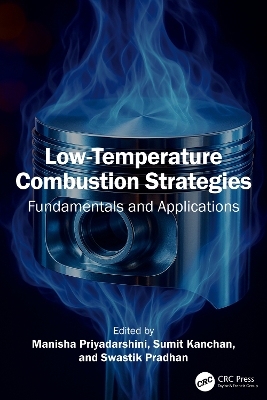
The book Low Temperature Combustion Strategies: Fundamentals and Applications is a comprehensive guide to one of the most promising approaches in advanced engine technology—Low Temperature Combustion (LTC). Bridging the gap between fundamental science and engineering practice, this book explores the mechanisms, strategies, and real-world implementations of LTC systems to enable cleaner, more efficient internal combustion engines. Covering a range of cutting-edge topics—including Homogeneous Charge Compression Ignition (HCCI), Stratified Charge Compression Ignition (SCCI), dual-fuel systems, combustion chemistry, emission control, and advanced engine configurations—the book provides in-depth analysis and engineering insights.
Features:
• Presents the low temperature combustion (LTC) techniques, including combustion modeling, combustion modes, optimization techniques, and emission formation control.
• Delves into advanced combustion modes offering detailed insights into their operation, control strategies, and optimization techniques.
• Discusses advanced combustion control and optimization techniques.
• Includes real-world case studies and applications in automotive and power generation sectors.
• Explores the future directions and emerging trends in LTC research, including the integration of renewable fuels and prospects for commercialisation.
Practical case studies, current research findings, and emerging trends make this an indispensable reference for students, researchers, and professionals in automotive engineering, combustion science, and sustainable energy systems.
This book is a comprehensive guide to one of the most promising approaches in advanced engine technology—Low Temperature Combustion. Bridging the gap between fundamental science and engineering practice, it explores the mechanisms, strategies, and real-world implementations of LTC systems to enable efficient internal combustion engines.
Chapter
1. Introduction to Low Temperature Combustion.
Chapter
2.
Fundamentals of Low Temperature Combustion Chemistry and Kinetics.
Chapter
3.
Thermodynamics of Low Temperature Combustion.
Chapter
4. Combustion Modeling
and Simulation Techniques.
Chapter
5. Homogeneous Charge Compression Ignition
(HCCI).
Chapter
6. Stratified Charge Compression Ignition (SCCI).
Chapter
7.
Dual-Fuel Combustion Strategies.
Chapter
8. Combustion Control and
Optimization Techniques.
Chapter
9. Emission Formation and Control in
Low-Temperature Combustion.
Chapter
10. Future Directions and Emerging Trends
in Low Temperature Combustion.
Chapter
11. Case Studies and Applications in
Automotive and Power Generation.
Chapter
12. Exploring the Depth and
Navigating the Complexities of Low-Temperature Combustion Process - A Review
Manisha Priyadarshini holds a Ph.D. in Mechanical Engineering from the National Institute of Technology, Rourkela. With more than 40 research publications in reputed international journals and conferences, her work focuses on advanced mechanical aspects and manufacturing technologies with energy efficiency. She has collaborated with researchers, academicians, and industry experts on several projects and serves as a peer reviewer for published journals.
Sumit Kanchan is an automobile engineer, researcher, and learning architect with expertise in building industry-aligned ecosystems for EV, R&D, and AI-driven learning. As Head-Projects & Capacity Building at ISIEINDIA, he leads national initiatives including Project Saksham, AI-integrated EV test-bench development, and multi-sector capacity-building programs. He has authored 30+ papers, filed 15 patents, and developed 30+ EV lab and production frameworks. Formerly at LPU, he guided teams to 90+ awards and mentored startups generating 6 crore+ annually. He is an Innovation Ambassador and a Ph.D. researcher in low-temperature combustion at NIT Jalandhar.
Swastik Pradhan received his Ph.D. in Production Engineering from NIT Rourkela and currently serves as Assistant Professor in the School of Mechanical Engineering at Lovely Professional University, Punjab, India. With over 7 years of teaching and research experience, he has guided more than 20 research projects and published over 60 research papers. His expertise lies in CAD/CAM, traditional and non-traditional machining, FEA, and industrial safety. Dr. Pradhan is also an active peer reviewer for leading journals.