Muutke küpsiste eelistusi

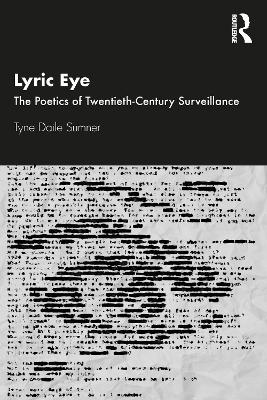
Lyric Eye: The Poetics of Twentieth-Century Surveillance [Pehme köide]

(The University of Melbourne, Australia)
  • Formaat: Paperback / softback, 204 pages, kõrgus x laius: 234x156 mm, kaal: 480 g
  • Ilmumisaeg: 06-Aug-2021
  • Kirjastus: Routledge India
  • ISBN-10: 1032052082
  • ISBN-13: 9781032052083
  • Pehme köide
  • Hind: 43,75 €*
  • * hind on lõplik, st. muud allahindlused enam ei rakendu
  • Tavahind: 58,34 €
  • Säästad 25%
  • Raamatu kohalejõudmiseks kirjastusest kulub orienteeruvalt 3-4 nädalat
  • Kogus:
  • Lisa ostukorvi
  • Tasuta tarne
  • Tellimisaeg 2-4 nädalat
  • Lisa soovinimekirja
  • Formaat: Paperback / softback, 204 pages, kõrgus x laius: 234x156 mm, kaal: 480 g
  • Ilmumisaeg: 06-Aug-2021
  • Kirjastus: Routledge India
  • ISBN-10: 1032052082
  • ISBN-13: 9781032052083

This book presents the first detailed study of the relationship between poetry and surveillance. It critically examines the close connection between American lyric poetry and a burgeoning U.S. state surveillance apparatus from 1920 through the 1960s.


Lyric Eye: The Poetics of Twentieth-Century Surveillance presents the first detailed study of the relationship between poetry and surveillance. It critically examines the close connection between American lyric poetry and a burgeoning U.S. state surveillance apparatus from 1920 through the 1960s. The book explores the myriad ways that poets — Ezra Pound, William Carlos Williams, W.H. Auden, Langston Hughes, James Baldwin, Sylvia Plath, Gertrude Stein, Robert Lowell, Allen Ginsberg, and others — explored a developing and fraught environment in which the growing power of American investigative agencies, such as the FBI under Hoover, imposed new pressures on cultural discourse and personal identity. In analysing twentieth-century American poetry and its various ideas about ‘the self’, Lyric Eye demonstrates the extent to which poetry and surveillance employ similar styles of information gathering such as observation, overhearing, imitation, abstraction, repurposing of language, subversion, fragmentation, and symbolism.

Ground-breaking and prescient, this book will be of great interest to scholars and researchers of literature, politics, surveillance and intelligence studies, and Digital Humanities.

Arvustused

Tyne Daile Sumners engrossing, elegantly written book examines twentieth-century US American lyric poetry in the context of the rise of an increasingly invasive surveillance state. While focussing on the period 19201960, Sumner dips back into the nineteenth century, to poetic and political precursors like Walt Whitman, Emily Dickinson and John Stuart Mill to ask how both lyric poetry and surveillance organisations have relied on and redefined concepts of subjectivity, privacy, national identity and even truthfulness. And she looks ahead to our own century, suggesting that lyric poetry may offer a mode of self-revelation more complex and less easily co-opted than those available in the on-line confession-and-surveillance industry. Eminently readable, this volume has much to offer not only to scholars of poetry, but to anyone interested in US American culture, history and politics. Erin Carlston, Professor of English at the University of Auckland

Tyne Daile Sumners Lyric Eye: The Poetics of Twentieth-Century Surveillance makes an incisive and persuasive contribution to our understanding of the complex contours of lyric poetry in twentieth-century American culture. Sumner extends recent reappraisals of the profoundly political nature of what might otherwise seem merely personal or confessional by identifying the specific ways in which structures and practices of state surveillance in mid-century America (including, but not only, the operation of the FBI and CIA) responded to, and inadvertently helped to shape, the mode. Sumner traces the emergence and perpetuation of a set of 'surveillant reading practices' and shows how these were applied to a range of poets from W.H. Auden through Nikki Giovanni, Langston Hughes and Robert Lowell to Anne Sexton and William Carlos Williams. In each case, the lyric 'I' was misunderstoodby an inchoate state apparatusas primarily autobiographical, and thereby deemed suspect and actionable. Lyric Eye: The Poetics of Twentieth-Century Surveillance offers a sophisticated, informed and perspicacious reading of the complex choreography of scrutiny and evasion which, Sumner argues, characterised the operation of the lyric 'I' (and eye) during this period. She shows how the mobile and indeterminate 'I' of lyric poetry unsettled the functionaries of the state, prompting suspicion and close surveillance of a subject position whichof course refused to be pinned down. In this way, lyric poetry of mid-century America both provoked and deflected scrutiny, finding in its own malleability and indeterminacy a strategy for avoiding misreading and, perhaps ironically, evidence of its own power. Jo Gill, Professor of Twentieth-Century and American Literature at the University of Exeter

Acknowledgments ix
Copyright acknowledgments xi
Introduction: the observed of all observers 1(10)
1 Towards a theory of the Lyric Eye
11(38)
Why Lyric?
12(16)
Big blue eye: the new surveillance normal
28(11)
The FBI everybody knows
39(9)
Notes
48(1)
2 Hoover's optics: bureau reading and impractical criticism
49(30)
Every American is innocent: Hoover, the FBI and American literature
50(8)
Codes for everything and nothing: American criticism and surveillance
58(11)
Make it indecipherable: William Carlos Williams and Ezra Pound
69(8)
Notes
77(2)
3 Surveillance poetics abroad
79(40)
Seeing over seas: nationalism, modernism and countersurveillance
81(8)
Escaping the FB eyes: Langston Hughes and James Baldwin
89(12)
The secret agent: W.H. Auden writes American poems
101(17)
Notes
118(1)
4 Surveillance poetics at home
119(49)
Diver under a glass bell: containment and surveillance poetics
120(12)
The American suburbs: Anne Sexton and Sylvia Plath as eyewitnesses
132(12)
Poetry, privacy and paranoia: (wire)tapping into the American Dream
144(17)
Notes
161(1)
Conclusion: poetry in the age of dataveillance
162(6)
Works cited 168(12)
Index 180
Tyne Daile Sumner is a researcher and teacher at the University of Melbourne, Australia. Her work explores the relationship between literature and surveillance, with a focus on the ways that poetry is engaged with concepts such as privacy, identity, confession and subjectivity in the context of digital technology and the increasing datafication of everyday life.