Muutke küpsiste eelistusi

Macanese Diaspora in British Hong Kong: A Century of Transimperial Drifting [Kõva köide]

  • Formaat: Hardback, 224 pages, kõrgus x laius: 234x156 mm, kaal: 570 g, 15 Illustrations, black and white
  • Sari: Asian History
  • Ilmumisaeg: 15-Sep-2021
  • Kirjastus: Amsterdam University Press
  • ISBN-10: 9463729259
  • ISBN-13: 9789463729253
Teised raamatud teemal:
  • Kõva köide
  • Hind: 128,81 €*
  • * hind on lõplik, st. muud allahindlused enam ei rakendu
  • Tavahind: 171,75 €
  • Säästad 25%
  • Raamatu kohalejõudmiseks kirjastusest kulub orienteeruvalt 3-4 nädalat
  • Kogus:
  • Lisa ostukorvi
  • Tasuta tarne
  • Tellimisaeg 2-4 nädalat
  • Lisa soovinimekirja
  • Formaat: Hardback, 224 pages, kõrgus x laius: 234x156 mm, kaal: 570 g, 15 Illustrations, black and white
  • Sari: Asian History
  • Ilmumisaeg: 15-Sep-2021
  • Kirjastus: Amsterdam University Press
  • ISBN-10: 9463729259
  • ISBN-13: 9789463729253
Teised raamatud teemal:
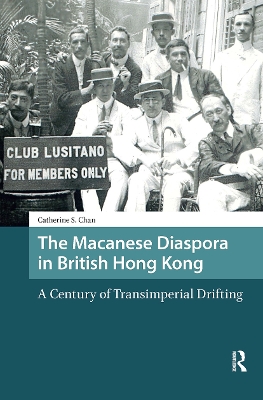
Diaspora transformed the urban terrain of colonial societies, creating polyglot worlds out of neighborhoods, workplaces, recreational clubs, and public spheres. It was within these spaces that communities reimagined and reshaped their public identities vis-à-vis emerging government policies and perceptions from other communities. Through a century of Macanese activities in British Hong Kong, The Macanese Diaspora in British Hong Kong: A Century of Transimperial Drifting explores how mixed-race diasporic communities survived within unequal, racialized, and biased systems beyond the colonizer-colonized dichotomy. Originating from Portuguese Macau yet living outside the control of the empire, the Macanese freely associated with more than one identity and pledged allegiance to multiple communal, political, and civic affiliations. They drew on colorful imaginations of the Portuguese and British empires in responding to a spectrum of changes encompassing Macaus woes, Hong Kongs injustice, Portugals political transitions, global developments in print culture, and the rise of new nationalisms during the inter-war period.

Arvustused

This is a timely study of a significant ethnic and cultural group that has hitherto been largely overlooked in the history of what is described as 'British Hong Kong'. [ ...] Dr Chan's very broad and detailed range of research and her deft use of it in footnotes is very impressive.- Stuart Braga, Journal of the Royal Asiatic Society Hong Kong Vol. 62 (2022)

Acknowledgments 7(2)
Prologue: Between Empires 9(34)
Drifting empires
18(5)
Contesting the `Macanese' identity
23(4)
Cosmopolitan and transnational arenas
27(3)
A kaleidoscope of Macanese experiences
30(13)
1 Crossing Imperial Borders
43(32)
The tightknit oligarchy
47(6)
A clerk, a businessman and a newspaper editor
53(8)
Channeling Macau's woes into Hong Kong developments
61(14)
2 Sandwiched in the Workplace
75(28)
The roots of the Macanese as `middle' people
79(3)
D'Almada's plight
82(5)
Grand-pre's poor performance
87(4)
Port wine and new opportunities
91(12)
3 Horseracing, Theater and Camoes
103(30)
Strictly male, strictly rich, strictly colored
106(10)
Abraco fraternal (fraternal embrace) and Camoes
116(5)
A stage for middle-class Macanese men
121(12)
4 Macanese Publics Fight for the `Hongkong Man'
133(30)
From Hong Kong to Lisbon to Shanghai
138(5)
Globalizing colonial Hong Kong
143(8)
The `Hongkong man'
151(12)
5 Uniting to Divide, Dividing to Unite
163(36)
`Kowloon Macanese' vs. `Hong Kong Macanese'
165(7)
Nationalizing the `Portuguese of the East'
172(4)
Contesting Macanese patriotism
176(4)
Por Deusepela Pdtria: Portuguese nationalism in Hong Kong
180(5)
Printing and disseminating diasporic nationalism
185(14)
Epilogue: A Place in the Sun
199(16)
Being Macanese in wartime Hong Kong
202(4)
Rethinking identity as response
206(3)
Towards a world without labels
209(6)
Appendix: Summary of Featured Macanese Individuals 215(6)
Index 221
Catherine S. Chan is Research Assistant Professor of History at Lingnan University. She has published extensively on transimperial networks and the Macanese diaspora across East Asia. Chan also works on urban history, particularly on heritage issues and animal welfare in East and Southeast Asia.