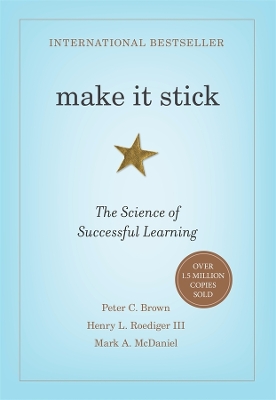
If you want to read a lively and engaging book on the science of learning, this is a must Make It Stick benefits greatly from its use of stories about people who have achieved mastery of complex knowledge and skills. Over the course of the book, the authors weave together stories from an array of learnerssurgeons, pilots, gardeners, and school and university studentsto illustrate their arguments about how successful learning takes place This is a rich and resonant book and a pleasurable read that will leave you pondering the processes through which you, and your students, acquire new knowledge and skills. -- Hazel Christie * Times Higher Education * Many educators are interested in making use of recent findings about the human brain and how we learn Make It Stick [ is] the single best work I have encountered on the subject. Anyone with an interest in teaching or learning will benefit from reading this book, which not only presents thoroughly grounded research but does so in an eminently readable way that is accessible even to students. -- James M. Lang * Chronicle of Higher Education * We have made Make It Stick a touchstone for our instructorsto gain a real advantage for our learners as they tackle some of the toughest work in the world. -- Carl Czech, former Senior Instructional Systems Specialist/Advisor, US Navy SEALs It is surprising to me [ that] we have such highly educated people coming to medical school who havent thought that deeply about learning. I feel like we are teaching the gospel of Make it Stick during our first weeks with the studentsWith the immense time pressure you have as a medical student, the importance of these principles becomes very clear to them. -- Randall King, Harry C. McKenzie Professor of Cell Biology, Harvard Medical School Its an illuminating readLearning ability is probably the most important skill you can have. Unfortunately, lots of the techniques for learning that we pick up in school don't help with long-term recall like cramming or highlighting For a deeper dig into the science of learning, make sure to pick up Make It Stick. -- Drake Baer * Business Insider * Aimed primarily at students, parents, and teachers, Make It Stick also offers practical advice for learners of all ages, at all stages of life With its credible challenge to conventional wisdom, Make It Stick does point the way forward, with a very real prospect of tangible and enduring benefits. -- Glenn C. Altschuler * Psychology Today * Make It Stick will help you become a much more productive learner. [ It] presents a compelling case for why we are attracted to the wrong strategies for learning and teachingand what we can do to remedy our approaches In clear language, Make It Stick explains the science underlying how people learn. But the authors dont simply recite the research; they show readers how it is applied in real-life learning scenarios, with engaging stories of real people in academic, professional, and sports environments The learning strategies proposed in this book can be implemented immediately, at no cost, and to great effect. -- Stephanie Castellano * TD Magazine * If I could, I would assign all professors charged with teaching undergraduates one book: Make It Stick: The Science of Successful Learning It lays out what we know about the science of learning in clear, accessible prose. Every educatorand parent, and student, and professionalought to have it on their own personal syllabus. -- Annie Murphy Paul, author of The Extended Mind The authors have provided a great service for educators by capturing the important lessons from decades of research in the learning sciencesIt should be highly recommended reading for anyone in the teaching, learning, and training professions. -- Robert H. Bruininks, Professor and President Emeritus, University of Minnesota This is a quite remarkable book. It describes important research findings with startling implications for how we can improve our own learning, teaching, and coaching. Even more, it shows us how more positive attitudes toward our own abilitiesand the willingness to tackle the hard stuffenables us to achieve our goals. The compelling stories bring the ideas out of the lab and into the real world. -- Robert Bjork, University of California, Los Angeles Learning is essential and life-long. Yet as these authors argue convincingly, people often use exactly the wrong strategies and don't appreciate the ones that work. Weve learned a lot in the last decade about applying cognitive science to real-world learning, and this book combines everyday examples with clear explanations of the research. Its easy to readand should be easy to learn from, too! -- Daniel L. Schacter, author of The Seven Sins of Memory Anyone who teaches anything would benefit from reading this book: coaches, tutors, classroom teachers, parents, even corporate trainers. Instead of doing what weve always done and wondering why some learners just dont get it, we can take a different approach thats based on research, even if it seems counterintuitive. -- Jennifer Gonzales * Cult of Pedagogy *