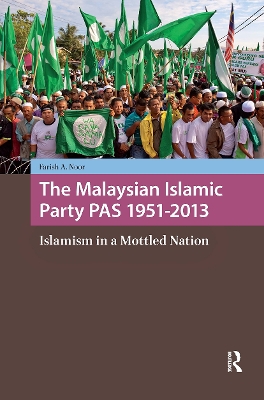
A historical recount on the development of Pan-Malaysian Islamic Party PAS and how it rose to become the most prominent Islamist party in Southeast Asia.
The Pan-Malaysian Islamic Party PAS is the biggest opposition party in Malaysia today and one of the most prominent Islamist parties in Southeast Asia. This work recounts the historical development of PAS from 1951 to the present, and looks at how it has risen to become a political movement that is both local and transnational, tracking its rise from the Cold War to the age of the War on Terror, and its evolving ideological postures - from anti-colonialism to post-revolutionary Islamism, as the party adapted itself to the realities of the postmodern global age. PAS's long engagement with modernity and its nuanced approach to the goal of state capture is the focus of this work, as it recounts the story of the Islamist party and Malaysia by extension.
Download the Table of Contents and IntroductionIntroduction, Islamism in a Mottled Nation: The Story of PAS, Where and
When We Are: Locating PAS in Todays Overdetermined and Highly Contested
Malaysia, 1 1951-1969: The Orphan of the Cold War, 2 From Internationalism to
Communitarianism, 3 PAS in the Global Islamist Wave: 1982-1999, 4 The Jihad
of the Ballot Box,
5. Religion, Politics, Islam, Islamism, Bibliography, Index
Farish A. Noor is Professor of Political History at the Faculty of Social Science FOSS, Universitas Islam Internasional Indonesia UIII. His work has focused on 19th century colonial Southeast Asia, looking at the modalities of racialised colonial-capitalism in the region. His recent works include Peta dan Kekuasaan (Mapping and Power, Lestari Hikmah, 2025), Data-Collecting in 19th Century Colonial Southeast Asia (Amsterdam University Press, 2020) and America's Encounters with Southeast Asia 1800-1900 (Amsterdam University Press, 2018).