Muutke küpsiste eelistusi

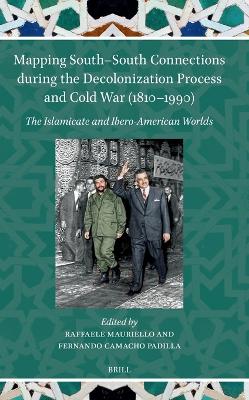
Mapping SouthSouth Connections during the Decolonization Process and Cold War (18101990): The Islamicate and Ibero-American Worlds [Kõva köide]

Volume editor , Volume editor
Teised raamatud teemal:
  • Kõva köide
  • Hind: 97,45 €*
  • * hind on lõplik, st. muud allahindlused enam ei rakendu
  • Tavahind: 121,81 €
  • Säästad 20%
  • Raamatu kohalejõudmiseks kirjastusest kulub orienteeruvalt 3-4 nädalat
  • Kogus:
  • Lisa ostukorvi
  • Tasuta tarne
  • Tellimisaeg 2-4 nädalat
  • Lisa soovinimekirja
Teised raamatud teemal:
Mapping SouthSouth Connections during the Decolonization Process and Cold War (18101990): The Islamicate and Ibero-American Worlds offers a groundbreaking exploration of the period's historical, political, and cultural networks. Through interdisciplinary approachesfrom diplomacy and visual culture to womens studies and political sciencethis volume highlights state and non-state actors who shaped international relations beyond Euro-American paradigms. Rooted in a research project and major international conference, and enriched by additional contributions, it introduces original studies on underexplored connections between Ibero-America and the Islamicate world, often drawing on primary sources difficult to access due to geographic, linguistic, or political barriers.


Contributors are Martín Bergel, Fernando Camacho Padilla, Eudald Cortina Orero, Fernando Escribano Martín, Alberto García Molinero, Mario Matus González, Raffaele Mauriello, Reinaldo M. Sánchez Porro, Juan José Vagni, and Bar Ahmet Yörümez.

Arvustused

In the best tradition of Connected and Global History, this volume brings together academic experts presenting us with a panoramic view of two centuries of political, cultural and intellectual interaction between Asia, Africa, Latin America and Europe. Drawing on primary sources in several languages, the authors offer fresh and fascinating accounts of decolonization and anti-imperialism unfolding across regions called the Global South, the Third World, or, as this book calls it, the Islamic and Ibero-American World, spanning from Spain, Morocco, Turkey, Iran, Cuba, Chile, Mexico and Argentina. There is nothing quite like this book out there!

Afshin Matin-asgari, author of Axis of Empire: A History of Iran-US Relations


This volume offers a vital contribution to global history by highlighting SouthSouth perspectives and engaging critically with decolonial ideas. It stands out for its long-term view of the links between anti-colonialism, anti-imperialism, and Third Worldism, its wide range of methods and approaches, and the diversity of voices and academic traditions it brings together.

Eugenia Palieraki, Maîtresse de conférences, Ecole d'Histoire, Université Paris 1 Panthéon-Sorbonne


The volume offers detailed understandings of the wider transboundary circulation of ideas and people connected through diverse collaborations and codependencies, without relying on distinct categories of cultural Otherness. This is one of the main reasons why the book and the project behind it have broad applicability. Last but not least, the capacity of the various contributors to propose and carry out ground-breaking interdisciplinary research is exceptional.

Marta Tawil-Kuri, Center for International Studies, El Colegio de México

Raffaele Mauriello is Assistant Professor at the Faculty of Persian Literature and Foreign Languages at Allameh Tabatabai University in Tehran. A historian and linguist of the modern and contemporary Persianate, Islamicate, and Ibero-American worlds, he is the author of Descendants of the Family of the Prophet in Contemporary History (Fabrizio Serra, 2011).


Fernando Camacho Padilla is Associate Professor of History at Universidad Autónoma de Madrid. He has studied the multiple effects that political crises, such as revolutionary experiences and military coups, have had on international relations. He also works on Latin America and the Middle East connections.