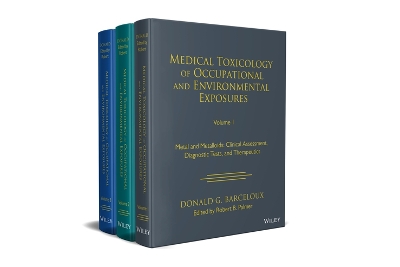
In-depth, evidence-based resource covering important toxins affecting human health and safety
Medical Toxicology of Occupational and Environmental Exposures presents crucial information on various important toxins that affect human health and safety, focusing on their chemical structures, analytical methods, clinical features, and comprehensive treatment options. Organized across three volumes, it provides comprehensive and insightful information for clinicians, students, and investigators with interests in metals, radiation, and cancer. The interdisciplinary, evidence-based approach of the work is designed to reach beyond clinical settings to increase the scientific understanding of those in associated fields.
To allow for quick reference, the information is presented in a consistent and easy-to-read format. Additional information is readily available to the interested reader through the detailed bibliographies included at the end of each chapter.
Volume 1Metals and metalloids, such as arsenic, lead, mercury, and rare earth metals Volume 2Radiation, including ionizing and non-ionizing radiation, radiation physics, radiation prevention, radiation diagnosis and treatment, and cosmic radiation Volume 3Cancer-causing exposures, histology, host susceptibility, and clinical featuresusing an organ-based approach to allow for seamless reader comprehension
Toxicologists, physicians, and many other professionals working in fields that intersect with human health and safety, especially those in leadership positions making decisions regarding metals, radiation, and chemical carcinogens, can use Medical Toxicology of Occupational and Environmental Exposures as a practical everyday reference to understand many important toxins found in our world that often affect our bodies in a negative manner.
List of Contributors ix
Preface xi
Accompanying Videos xiii
1. Practical Physical Concepts and Artifacts 1
Marc-André dAnjou and Dominique Penninck
2. Point of Care Ultrasound: Abdomen, Pleural Space, Lung and Cardiovascular
Applications 21
Sųren Boysen
3. Eye and Orbit 65
Stefano Pizzirani and Dominique Penninck
4. Neck 109
Julien Fages and Dominique Penninck
5. Thorax 139
Silke Hecht, Gabriela Seiler, and Dominique Penninck
6. Heart 173
Jonathan Lichtenberger, Shari Raheb, and Hugues Gaillot Copyrighted
Material
7. Hepatobiliary System 239
Marc-André dAnjou, Dominique Penninck, and Heather Spain
8. Spleen 287
Mathieu Harel and Wilfried Mai
9. Gastrointestinal Tract 311
Dominique Penninck, Marc-André dAnjou, and Heather Spain
10. Pancreas 371
Dominique Penninck, Marc-André dAnjou, and Mylčne Auger
11. Urinary Tract 397
Dominique Penninck, Marc-André dAnjou, James Sutherland-Smith, Emmanuelle
Butty, and Marilyn Dunn
12. Adrenal Glands 463
Marc-André dAnjou, Dominique Penninck, and Pascaline Pey
13. Female Reproductive Tract 481
Delphine Rault and Silke Hecht
14. Male Reproductive Tract 511
Silke Hecht and Julie De Lasalle
15. Abdominal Cavity and Lymph Nodes 547
Marc-André dAnjou and Éric Norman Carmel
16. Abdominal Vessels 583
Marc-André dAnjou, Swan Specchi, and Chick Weisse
17. Musculoskeletal System and Peripheral Nerves 611
Marc-André dAnjou and Laurent Blond
Index 673
Donald G. Barceloux, MD, is a Medical Toxicologist in the Department of Emergency Medicine at Pomona Valley Community Hospital. For over 20 years, he served as a Clinical Professor of Medicine at the Olive View/University of California, Los Angeles School of Medicine Department of Emergency Medicine.
Robert B. Palmer, PhD, is a board-certified clinical toxicologist in private practice with Toxicology Associates, PLLC and an attending toxicologist at the Rocky Mountain Poison and Drug Service in Denver, CO. He is a frequent author and speaker on many aspects of clinical and forensic toxicology.