Muutke küpsiste eelistusi

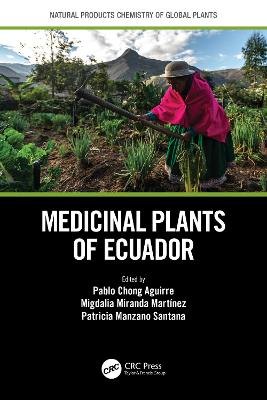
Medicinal Plants of Ecuador [Pehme köide]

Edited by (ESPOL, Ecuador), Edited by (ESPOL, Ecuador), Edited by (ESPOL, Ecuador)
  • Formaat: Paperback / softback, 210 pages, kõrgus x laius: 234x156 mm, kaal: 403 g, 12 Tables, black and white; 5 Line drawings, color; 6 Line drawings, black and white; 12 Halftones, color; 32 Halftones, black and white; 17 Illustrations, color; 38 Illustrations, black and white
  • Sari: Natural Products Chemistry of Global Plants
  • Ilmumisaeg: 30-Nov-2022
  • Kirjastus: CRC Press
  • ISBN-10: 1032003987
  • ISBN-13: 9781032003986
  • Pehme köide
  • Hind: 53,88 €*
  • * hind on lõplik, st. muud allahindlused enam ei rakendu
  • Tavahind: 71,84 €
  • Säästad 25%
  • Raamatu kohalejõudmiseks kirjastusest kulub orienteeruvalt 3-4 nädalat
  • Kogus:
  • Lisa ostukorvi
  • Tasuta tarne
  • Tellimisaeg 2-4 nädalat
  • Lisa soovinimekirja
  • Formaat: Paperback / softback, 210 pages, kõrgus x laius: 234x156 mm, kaal: 403 g, 12 Tables, black and white; 5 Line drawings, color; 6 Line drawings, black and white; 12 Halftones, color; 32 Halftones, black and white; 17 Illustrations, color; 38 Illustrations, black and white
  • Sari: Natural Products Chemistry of Global Plants
  • Ilmumisaeg: 30-Nov-2022
  • Kirjastus: CRC Press
  • ISBN-10: 1032003987
  • ISBN-13: 9781032003986
"This unique volume draws on the rich culture, folklore and environment of medicinal plants in Ecuador, which includes the important Rain Forest region. This country has rich plant resources and a large diversity of plants. In particular, the Biotechnological Research Center of Ecuador, CIBE is an important center of plant research and biodiversity. CIBE has more than 16 years performing scientific research on plants and microorganisms with extensive experience in biodiversity, biotechnology, bioproducts, phytopathology, molecular biology, tissue culture and technology transfer. The Center has state-of-the-art infrastructure and technology and a great strength in human resources"--

This volume describes the rich chemistry, pharmacological nature and complexity of a selection of natural products from Ecuador and their respective biosynthetic building blocks.

This unique volume draws on the rich culture, folklore and environment of medicinal plants in Ecuador, which includes the important rain forest region. This country has rich plant resources and a large diversity of plants. In particular, the Biotechnological Research Center of Ecuador, CIBE, is an important center of plant research and biodiversity. For more than 16 years, CIBE has been performing scientific research on plants and microorganisms with extensive focus on biodiversity, biotechnology, bioproducts, hytopathology, molecular biology, tissue culture and technology transfer. The Center has state-of-the-art infrastructure and technology and a great strength in human resources.
Ecuador: An Introduction xi
Acknowledgments xiii
Editor Biographies xv
List of Contributors
xvii
PART I Quality Control Considerations for South American Plants and Products
Chapter 1 Importance of Pharmacognosy Studies in the Quality Control of Herbal Drugs
3(16)
Yamilet Irene Gutierrez Gaitin
Ramdn Scull Lizama
Juan Abreu Payrol
Chapter 2 Application of DNA Barcodes to Medicinal Plants
19(12)
Efren Santos
Ricardo Pacheco
Liliana Villao
Chapter 3 Pharmacological Studies as Essential Tools for the Scientific Validation of the Traditional Use of Herbal Drugs: Some Considerations
31(26)
Rene Delgado Herndndez
Alejandro Felipe Gonzalez
Bdrbara Beatriz Garrido Suarez
Idania Rodeiro Guerra
PART II Ecuadorian Plants with Antimicrobial Activity
Chapter 4 Novel List of Ecuadorian Flowers with Antimicrobial Activity
57(12)
Elena Coyago-Cruz
Manuel E. Baldeon
Chapter 5 Medicinal Plants Against Helicobacter pylori
69(12)
Andrea Orellana-Manzano
Glenda Pilozo
Carlos Ordonez
Patricia Manzano
Chapter 6 Andean Traditional Medicine plants: the Case of "Limpia" (Cleansing Ceremony)
81(36)
Adriana Orellana-Paucar
PART III Important Plant Species of Ecuador
Chapter 7 Medicinal Plants and Epigenetic Mechanisms in Cancer
117(10)
Andrea Orellana-Manzano
Carlos Ordonez
Patricia Manzano
Glenda Pilozo
Chapter 8 Bursera graveolens (Palo Santo), Native Species of the Ecuadorian Dry Forest
127(8)
Patricia Manzano
Andrea Orellana-Manzano
Glenda Pilozo
Chapter 9 Pharmacognostic, Chemical and Pharmacological Studies of Corynaea crassa growing in Ecuador
135(14)
Alexandra Jenny Lopez Barrera
Chapter 10 Smilax Species Used in Traditional Medicine of Ecuador. Chemical Composition and Pharmacological Properties
149(16)
Pilar Soledispa
Raisa Mangas
Glenda Sarmiento
Migdalia Miranda
Chapter 11 Malva pseudolavatera Webb & Berthel
165(14)
Glenda Marcela Sarmiento Tomald
Migdalia Miranda Martinez
Yamilet Irene Gutierrez Gaiten
Chapter 12 Nutraceutical and Functional Properties of the Andean Grain Amaranthus caudatus L
179(16)
Adriana Orellana-Paucar
Chapter 13 Cinchona pubescens (Cascarilla), Native Species from the Andes Mountains of South America
195(8)
Juan Peharreta
Patricia Manzano
Efren Santos
Index 203
Pablo Chong Aguirre has seventeen years of experience in biotechnology, molecular biology and plant pathology. He has a PhD degree in Biotechnology obtained at Wageningen University and Research, Wageningen, the Netherlands. In 2001, Pablo started his research career as junior researcher in Plant pathology at the Ecuadorian Biotechnology Research Centre from ´Escuela Superior Politécnica del Litoral´, ESPOL University. In 2007 he obtains his masters degree in Biotechnology at ESPOL and became the molecular biology head in the ESPOL biotechnology research Centre until 2009 and the Plant pathology head until 2013. In September 2012, he started his PhD program in the Netherlands at the Plant Research International banana group, and Laboratory of Phytopathology from Wageningen University and Research Centre on the analysis of fungicide resistant in Pseudocercospora fijiensis (Banana Black Sigatoka disease). His main research focus on fungi molecular resistant mechanism to systemic fungicides. His research has led to publications related to a new resistance mechanism discovered in the specie. Since 2016 he continues his work as invited biology professor of the Life Science Faculty at ESPOL University and Research Head Coordinator of the molecular biology and plant tissue culture departments at CIBE-ESPOL.

Migdalia Miranda Martínez has 41 years of experience in Pharmacognosy and Natural Products Chemistry. She has a PhD in Chemical Sciences since 1990 from the University of Havana, Cuba. She is a Consulting Professor at the University of Havana and a full-time Professor-Researcher hired from ESPOL. She holds the highest category of Researcher granted by Senescyt (Principal Investigator 4) and was an advisor to the Prometheus Program of Senescyt for 3 years at the Center for Biotechnological Research CIBE-ESPOL. She has 29 Master thesis and 8 PhD. She has published 53 articles in indexed journals and more than 59 in other journals. It has also published 4 textbooks and 4 book chapters.

Patricia Manzano Santana has 30 years of experiences Chemical and biological characterization of Ecuadorian biodiversity and the development of bioproducts useful for health, food, agriculture, construction and industry in general. Pharmaceutical Chemistry training has a master's degree in Pharmaceutical Chemistry, a PhD in Chemistry and Pharmacy and another PhD in Pharmaceutical Sciences. Full-time Professor ESPOL. She is the research coordinator of the Bioproducts and Bioprocesses Laboratory of the Research Center of Ecuador (CIBE-ESPOL). She has tutored 22 Undergraduate thesis: 8 master thesis and 3 PhD thesis. She has published 55 publications, 43 in indexed journals and 22 in Scopus in the last 5 years, including the publication of 4 chapters in books and the edition of 2 books. He has made 8 research stays, 3 Post-doctoral.