Muutke küpsiste eelistusi

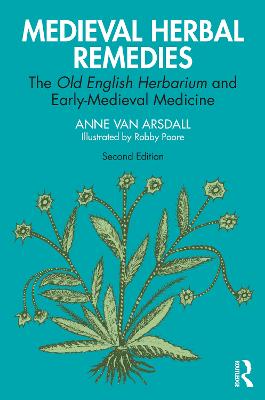
Medieval Herbal Remedies: The Old English Herbarium and Early-Medieval Medicine 2nd edition [Pehme köide]

  • Formaat: Paperback / softback, 246 pages, kõrgus x laius: 234x156 mm, kaal: 120 g, 65 Line drawings, black and white; 65 Illustrations, black and white
  • Ilmumisaeg: 28-Feb-2023
  • Kirjastus: Routledge
  • ISBN-10: 0367753774
  • ISBN-13: 9780367753771
  • Pehme köide
  • Hind: 41,73 €*
  • * hind on lõplik, st. muud allahindlused enam ei rakendu
  • Tavahind: 55,64 €
  • Säästad 25%
  • Raamatu kohalejõudmiseks kirjastusest kulub orienteeruvalt 3-4 nädalat
  • Kogus:
  • Lisa ostukorvi
  • Tasuta tarne
  • Tellimisaeg 2-4 nädalat
  • Lisa soovinimekirja
  • Raamatukogudele
  • Formaat: Paperback / softback, 246 pages, kõrgus x laius: 234x156 mm, kaal: 120 g, 65 Line drawings, black and white; 65 Illustrations, black and white
  • Ilmumisaeg: 28-Feb-2023
  • Kirjastus: Routledge
  • ISBN-10: 0367753774
  • ISBN-13: 9780367753771
"Featured here is a modern translation of a medieval herbal, preceded by a study showing how this technical treatise on herbs was turned into a literary curiosity. The transformation began with its first translation in 1864, one that continues to affect how this and other early-medieval medical texts are read. As a counterweight, here the medieval text is read as an example of technical writing (i.e., intended to convey instructions/information), not as literature. With a skilled audience in mind, it is intended to be used by persons with ability to diagnose and treat medical conditions and knows or is learning how to follow its instructions. For that reason, while working on the translation, specialists in relevant fields were asked to shed light on itsterse wording, for example herbalists and physicians. Unlike many current studies, this work discusses the Herbarium and other medical texts in Old English as part of a tradition developed throughout early-medieval Europe associated with monasteries and their libraries. The contours of this edition replicate the original, updated to reflect new scholarship and new findings, particularly concerning Oswald Cockayne, nineteenth-century philologist who was the first to translate the Old English medical textsfor the modern world. The intended audience is scholars in cross-cultural fields; that is, with roots in one field and branches in several, such as nineteenth-century or medieval studies, as well as historians of herbalism, medicine, pharmacy, botany, and of the Western Middle Ages very broadly and inclusively defined"--

Featured here is a modern translation of a medieval herbal, preceded by a study showing how this technical treatise on herbs was turned into a literary curiosity. The transformation began with its first translation in 1864, one that continues to affect how this and other early-medieval medical texts are read.

Arvustused

Praise for the second edition

"I was delighted to see a revised edition of Anne Van Arsdalls Medieval Herbal Remedies. For two decades, her book has served as an example of how to make medieval herbalism accessible to readers beyond just specialists in the field, through a much-needed modern translation of the Old English Herbarium, a study of the nineteenth-century antiquarian Oswald Cockayne and his own, curious 1864 translation of the Herbarium, and a fascinating comparison of early medieval herbalists to modern folk-healers. A welcome update to this edition is Van Arsdalls placement of the Old English Herbarium in a broader European context, as an heir to Galenic, monastic, and vernacular medical traditions."

Winston Black, St. Francis Xavier University, Nova Scotia

"In the nineteenth century T. Oswald Cockayne introduced Old English medical texts to the modern world. In her 2002 edition Anne Van Arsdall reintroduced Cockayne and his work to the twenty-first century. Now, a valuable second edition dramatically expands the story of the man whose tragic life reads like a bittersweet Victorian novel and whose scholarly work has gone largely unrecognized. More, it dramatically re-envisions the Old English medical texts Cockayne valued only for the vocabulary they contributed to the Old English lexicon. By resituating them, not in an 'Anglo-Saxon' context, but in the larger early medieval European tradition and by reading them as technical medical texts based on herbalism, Van Arsdall charts a promising new path for the study of The Old English Herbarium and its textual kin."

Dabney A. Bankert, Professor Emerita of Medieval Literature, James Madison University

"This significantly revised text offers a thought-provoking introduction to medieval medicine through the Old English Herbarium. Van Arsdall vividly shows how early medical texts were long thought to be of little value except for studying Germanic philology or folklore. The substantial introductory chapters and notes to the translation presented here show how we need to rethink such texts as technical literature and indeed a literature that grew out of rich cultures of medical knowledge and practice across Christendom rather than just among the English. The crisp translation of the Herbarium makes this fascinating and complex world of learning further accessible. Medieval Herbal Remedies will be a valuable resource for teaching new histories of premodern medicine and encouraging new research in the field."

James T. Palmer, Professor of History, University of St Andrews

Praise for the first edition

"Anne Van Arsdall's new and elegant translation with its extensive and thoroughly documented introduction comes as a welcome correction to Cockayne's antiquated and often misleading nineteenth-century edition of the Old English Herbarium. At last the Herbarium is restored to a prominent position among the texts of late classical and medieval medicine in Western Europe, and offers to a wide audience a fascinating opportunity for understanding the value of herbals in the development of the medieval tradition of healing."

Maria Amalia D'Aronco, University of Udine, Italy

"Presents a modern, readable, accurate, and lucid new translation of the Old English Herbarium, one that replaces Cockayne's and one that will be the standard translation for many years to come."

Helen Damico, Professor of Old English, University of New Mexico

Foreword Linda Ehrsam Voigts

Acknowledgments

Introduction

1. Oswald Cockayne: The scholar whose long shadow hangs over medieval
medicine

2. Cockaynes Herbarium

3. New contexts for the Old English Herbarium

4. About the Old English Herbarium: Manuscripts, illustrations, and need for
an alternative to Cockaynes translation

5.The Old English Herbarium: A modern translation

References and online resources

Alphabetical indexes of plant names

Index of medical complaints

General index
Anne Van Arsdall, Ph.D. (ret.) Publications include papers, book chapters; and (ed.) Herbs and Healers from the Ancient Mediterranean through the Medieval West (2012) and The Old French Chronicle of Morea (2015), a translation of a crusade chronicle set in Greece.