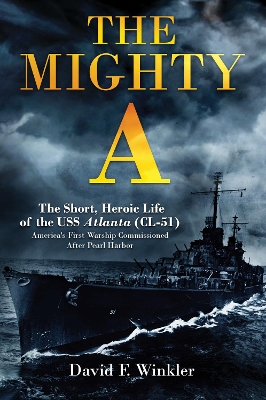
The attack on Pearl Harbor shocked the nation. With the declaration of war, lines formed outside of recruiting stations as Americans desired to don the uniform and go after the Japanese aggressors. With Margaret Mitchell serving as the ships sponsor, Atlantas Christmas Eve commissioning in December 1941, served as a rallying point for a country weary of bad news overseas. Some of those new recruits who signed on to fight the Axis after December 7, would find their way to Atlantas quarterdeck. For the capital of the Peachtree State, the ship was not only a source of civic pride, but a reason for many young men to join the Navy with the promise of assignment. The Mighty A will be the first book to tell their collective story.
Prior to the Japanese attack on Pearl Harbor and the subsequent loss of the British battleships Repulse and Prince of Wales off Malaysia, the U.S. Navys leadership discovered that the surface fleet was highly vulnerable to air attack, thanks to the introduction of drone aircraft that could simulate attacks on its warships. The Navys gunners simply did not have the coordinated firepower to knock them down. Hence the development of 1.1 inch, 20 mm, and 5 inch 38 caliber guns married with fire-control radar technology that could rapidly expend ordnance against incoming aircraft. The result of this vulnerability recognition is a new class of warship led by USS Atlanta. Unfortunately, not all of the Navys sea commanders will have a full appreciation of the light cruiser designed mission. Lieutenant Commander Mustin terms these tactically inept officers as Jugheads.
This story reinforces the notion that American military officers during this era are unafraid of taking their own initiatives without the permission of superiors in combating the enemy. Lieutenant Commander Wade McClusky typifies this breed of independent thinkers, who played a hunch to follow the wake of a speeding Japanese destroyer at the Battle of Midway with his bomber squadron that led him and his compatriots to the Japanese carriers.
The narrative also covers a part of the war that even the U.S. Navy overlooks. In elevating the Battle of Midway anniversary to join the Navys Birthday as an official annual Navy commemoration in 1998, the Chief of Naval Operations Jay Johnson unintentionally slighted the importance of subsequent actions in the southwest Pacific. The Guadalcanal campaign has been a narrative long owned by the Marine Corps who complain they were abandoned by the Navy to forage for themselves against a determined Japanese foe. This storyline has served to build up the lore and enhance the reputation of the Corps. However, not to denigrate the Marines' struggle ashore, the battle for Guadalcanal was predominantly naval. The Navys casualties during the six-month campaign were triple that of the Marine Corps.