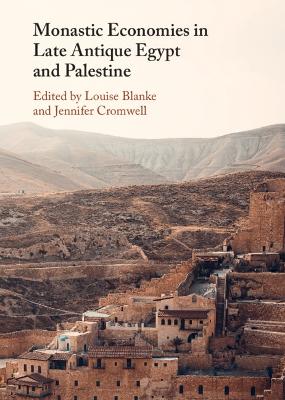
This book situates discussions of Christian monasticism in Egypt and Palestine within the socio-economic world of the long Late Antiquity, from the golden age of monasticism into and well beyond the Arab conquest (fifth to tenth century). Its thirteen chapters present new research into the rich corpus of textual sources and archaeological remains and move beyond traditional studies that have treated monastic communities as religious entities in physical seclusion from society. The volume brings together scholars working across traditional boundaries of subject and geography and explores a diverse range of topics from the production of food and wine to networks of scribes, patronage, and monastic visitation. As such, it paints a vivid picture of busy monastic lives dependent on and led in tandem with the non-monastic world.
Arvustused
'This remarkable and important book offers a valuable and necessary deepening of our understanding of early Christian monasticism by turning our attention again and again to the social-material-economic dimensions of that world. The exacting and painstaking scholarship found throughout this book reveals how much we can learn by taking seriously the eloquence of the hidden, the obscure, and the minute: papyri, pottery shards, barely legible inscriptions, paleobotanical evidence, the ghostly presence of ancient waterways, and so much more. It is hard not to marvel at the imaginative reach required to build an entire world out of this fragmentary evidence and to appreciate the immense effort undertaken to do so.' Doug Christie, Cistercian Studies Quarterly 'Well-written and accompanied by images, tables, a rich bibliographical list and other tools, the book is a useful tool both for historians and theologians and should surely constitute a book to read for any researcher interested in the field.' Iuliu-Marius Morariu, Anuario de la Historia de Iglesia
Muu info
Produces a new picture of monastic economies in Egypt and Palestine using current research and crossing traditional disciplinary divides.
Introduction: the monastic economies in late antique Egypt and
Palestine: past, present and future Louise Blanke and Jennifer Cromwell; Part
I. The Monastic Estate:
2. Monastic estates in Byzantine Arabia and
Palaestina (FourthNinth Centuries) Basema Hamarneh;
3. Monastic estates in
transition from Byzantine to Islamic Egypt: evidence from Aphrodito Isabelle
Marthot-Santaniello;
4. The naqlun fathers and their business affairs:
private assets and activities of the monks in a semi-anchorite community in
the late antique fayum Tomasz Derda and Joanna Wegner; Part II. Production
and Consumption of Food and Material Goods:
5. Monastic vintages: the
economic role of wine in Egyptian monasteries in the sixth-eighth centuries
Dorota Dzierzbicka;
6. Cooking, baking and serving: a window into the kitchen
of Egyptian monastic households and the archaeology of cooking Darlene L.
Brooks Hedstrom;
7. The refectory and the kitchen in the early Byzantine
monastery of tell bi'a (Syria): the Egyptian and Palestinian connections
Gįbor Kalla;
8. It's a dung job: exploring fuel disc production in Egyptian
monasteries Mennat-Allah El Dorry;
9. Illuminating the scriptorium: monastic
book production at the medieval monastery of St Michael Andrea Myers Achi;
Part III. Monastic Encounters: Travel, Pilgrimage, and Donations:
10.
Distinguishing offerings from blessings in early Byzantine Monasticism: The
significance of P. Ness. III 79 (c. 600 CE) Daniel F. Caner;
11. Staple for
body and soul working at and visiting the upper Egyptian monastery deir anba
hadra Lena Sophie Krastel, Sebastian Olschok and Tonio Sebastian Richter;
12.
The monastic landscape of mount Nebo: an economic pattern in the province of
Arabia Davide Bianchi;
13. Travel in the texts: monastic journeys in late
antique Egypt Paula Tutty.
LOUISE BLANKE is Lecturer in Late Antique Archaeology at the University of Edinburgh. She has authored An Archaeology of Egyptian Monasticism: Settlement, Economy, and Daily Life at the White Monastery Federation (2019) and has directed archaeological projects and participated in fieldwork at sites in Egypt, Denmark, Jordan, and Qatar. JENNIFER CROMWELL is Senior Lecturer in Ancient History at Manchester Metropolitan University. Her research interests lie in the study of village and monastic life in late antique and early Islamic Egypt. She is the author of Recording Village Life: A Coptic Scribe in Early Islamic Egypt (2017).