Muutke küpsiste eelistusi

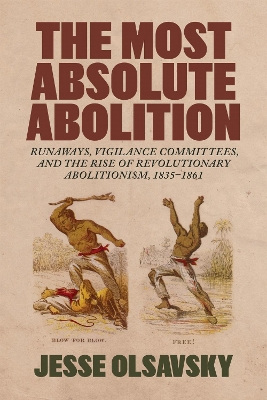
Most Absolute Abolition: Runaways, Vigilance Committees, and the Rise of Revolutionary Abolitionism, 18351861 [Kõva köide]

  • Formaat: Hardback, 294 pages, kõrgus x laius x paksus: 228x152x20 mm, kaal: 151 g, 6 illustrations
  • Ilmumisaeg: 17-Aug-2022
  • Kirjastus: Louisiana State University Press
  • ISBN-10: 080717730X
  • ISBN-13: 9780807177303
  • Kõva köide
  • Hind: 42,50 €*
  • * hind on lõplik, st. muud allahindlused enam ei rakendu
  • Tavahind: 50,00 €
  • Säästad 15%
  • Raamatu kohalejõudmiseks kirjastusest kulub orienteeruvalt 3-4 nädalat
  • Kogus:
  • Lisa ostukorvi
  • Tasuta tarne
  • Tellimisaeg 2-4 nädalat
  • Lisa soovinimekirja
  • Formaat: Hardback, 294 pages, kõrgus x laius x paksus: 228x152x20 mm, kaal: 151 g, 6 illustrations
  • Ilmumisaeg: 17-Aug-2022
  • Kirjastus: Louisiana State University Press
  • ISBN-10: 080717730X
  • ISBN-13: 9780807177303

Jesse Olsavsky’s The Most Absolute Abolition tells the dramatic story of how vigilance committees organized the Underground Railroad and revolutionized the abolitionist movement. These groups, based primarily in northeastern cities, defended Black neighborhoods from police and slave catchers. As the urban wing of the Underground Railroad, they helped as many as ten thousand refugees, building an elaborate network of like-minded sympathizers across boundaries of nation, gender, race, and class.

Olsavsky reveals how the committees cultivated a movement of ideas animated by a motley assortment of agitators and intellectuals, including famous figures such as Frederick Douglass, Harriet Tubman, and Henry David Thoreau, who shared critical information with one another. Formerly enslaved runaways—who grasped the economy of slavery, developed their own political imaginations, and communicated strategies of resistance to abolitionists—serve as the book’s central focus. The dialogues between fugitives and abolitionists further radicalized the latter’s tactics and inspired novel forms of feminism, prison reform, and utopian constructs. These notions transformed abolitionism into a revolutionary movement, one at the heart of the crises that culminated in the Civil War.

Acknowledgments ix
Introduction: The "Noble System" 1(14)
One The Politics and Political Economy of Running Away
15(35)
Two Radical and Practical Abolition, 1835--1849
50(37)
Three The Pedagogy of Radical Abolitionism, 1850--1861
87(37)
Four All Shall Be Thrown Down
124(38)
Five Toward Revolutionary Abolitionism
162(38)
Conclusion: Marching Onward 200(13)
Notes 213(62)
Index 275