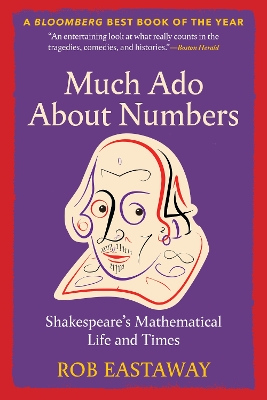
Shakespeares era was abuzz with mathematical progress, from the new concept of zero to Galileos redraft of the heavens. Now, Rob Eastaway uncovers the many surprising ways math shaped Shakespeares playsand his worldthrough astronomy, code-breaking, time-keeping, navigation, music, games, and more.
How does division feature in Juliets parting scene?
Why was it hazardous to play with dice?
How did audiences get to the Globe on time?
Which of Galileos discoveries has a cameo in Cymbeline?
Were cryptic messages hidden in the First Folio?
Full of delights for devotees of both Tudor history and the Bard, Much Ado About Numbers is proof that the arts and sciences have always danced together.
Arvustused
"A Bloomberg Best Book of the Year
A 2025 Mathical Honor Book for Grades 912
"Presents the Bards characters as calculating in a way you probably never considered." -- The Washington Post "An entertaining look at what really counts in the tragedies, comedies and histories." -- Boston Herald "As Eastaway explains, Shakespeares works are richly adorned with numbers." -- Financial Times "Highly readable. . . . Shakespeares surprising yet unsurprising mathematical sophistication led to some of his most creative feats." -- Bloomberg, a Best Book of the Year, selected by Chris Flowers "This entertaining history . . . succeeds in outlining the mathematical and scientific ideas that trickled into the Bards plays." -- Publishers Weekly "A playful and engaging book . . . bound to excite the appetite of all Shakespeare junkies." -- Patrick Spottiswoode, Founder, Shakespeares Globe Education "A fascinating and hugely entertaining guide to Shakespearean mathematics." -- Sarah Hart, author of Once Upon A Prime "You can count on both Rob Eastaway and Shakespeare to make mathematics entertaining." -- Sir Tim Rice "A spectacular journey. . . . Highly recommended!" -- Dr. Simon Smith, The Shakespeare Institute "Instead of cleaving math and English in twain, Eastaway brings them together to surprise and delight the reader." -- Dr. Rebecca Fisher, The English Association "A light, witty, and engaging tour through the mathematics hidden in Shakespeares plays. . . . The books charm lies in its balance: it is part literary insight, part math puzzle, and entirely enjoyable. Even readers who are not Shakespeare experts (or math enthusiasts) will find something entertaining and informative in the way Eastaway reveals just how much numerical playfulness is woven into the Bards work." -- The Use of English "This delightful book provides surprising examples of Shakespeares references in his sonnets and plays to new discoveries in mathematics and science that were occurring at the end of the 16th century. . . . It offers an excellent opportunity for secondary school mathematics, science, and English teachers to collaborate." -- Mathical Book Prize selection committee, a 2025 Honor Book
Contents
Prologue
Shakespearean Numbers
A Playfulness with Numbers
Huge Numbers
Much Ado About Nothing
School Life
Math at Grammar School
The Book of Arithmetic
The Seven Liberal Arts
Girls and Math
Sport and Games
Anyone for Tennis? Or Football?
Hazard and Risk
Nine Mens Morris
Noddy, Primero, and Other Card Games
Money
Shakespearean Currency
Shakespeare the Accountant?
Borrowing, Lending, and Interest
Measure for Measure
An Era of Imprecise Measurements
Length and Distance
Telling the Time
Navigation and Maps
Music, Rhythm, and Dance
The Measure of Dance
Patterns of Verse
Rhyming Patterns
Music as a Mathematical Subject
The Music of the Spheres
Astronomy and Astrology
Telescopes and Horoscopes
Ruled by the Seven Planets
The Science of Astronomy
The New Calendar
Colors and the Rainbow
Rainbows in Shakespeares World
Shakespeares Colors
The Emerging Math of Color
Putting Ink to Paper
Writing with a Quill
Writing with Ink
Arrival of the Pencil
Printing and Publishing
Mathematics, Magic, and Witchcraft
John Dee, Mathematician and Magician
The Book of Magic
Think of a Number
Codes and Conspiracy
Secret Messages and Chronograms
Acrostics and Other Hidden Words
Numerology and Codes
Shakespeares Calculator
Appendix: Mathematical Asides
Tactics for Winning at Three Mens Morris
The Pythagorean Octave and Dorian Mode
Shakespeare, Orange, and Sir Isaac Newton
Philip Henslowes Diary
Francis Bacons Cipher System
A Shakespeare/Historic Event Timeline
Timeline of Shakespeares Plays and Poems
Bibliography
Acknowledgments
Picture Credits
Index
Rob Eastaway has authored and coauthored several bestselling books that connect math with everyday life, including Why Do Buses Come in Threes? and How Many Socks Make a Pair? He is the director of Maths Inspiration, an interactive lecture program that has reached over 250,000 teenagers in the United Kingdom, New York, and Sydney. In 2017, he received the Zeeman Medal for excellence in the public communication of mathematics, and in 2025, he delivered the BSHM Gresham College Lecture on the subject of Shakespeare and mathematics. He lives in London.