Muutke küpsiste eelistusi

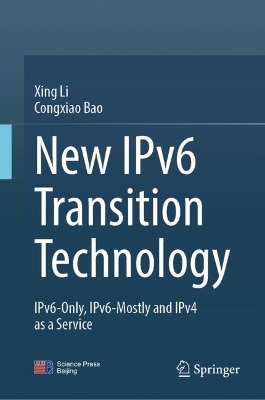
New IPv6 Transition Technology: IPv6-Only, IPv6-Mostly and IPv4 as a Service [Kõva köide]

  • Formaat: Hardback, 495 pages, kõrgus x laius: 235x155 mm, 230 Illustrations, color; 31 Illustrations, black and white
  • Ilmumisaeg: 21-Jun-2026
  • Kirjastus: Springer Verlag, Singapore
  • ISBN-10: 9819584264
  • ISBN-13: 9789819584260
  • Kõva köide
  • Hind: 182,09 €*
  • * hind on lõplik, st. muud allahindlused enam ei rakendu
  • Tavahind: 242,79 €
  • Säästad 25%
  • See raamat ei ole veel ilmunud. Raamatu kohalejõudmiseks kulub orienteeruvalt 3-4 nädalat peale raamatu väljaandmist.
  • Kogus:
  • Lisa ostukorvi
  • Tasuta tarne
  • Tellimisaeg 2-4 nädalat
  • Lisa soovinimekirja
  • Formaat: Hardback, 495 pages, kõrgus x laius: 235x155 mm, 230 Illustrations, color; 31 Illustrations, black and white
  • Ilmumisaeg: 21-Jun-2026
  • Kirjastus: Springer Verlag, Singapore
  • ISBN-10: 9819584264
  • ISBN-13: 9789819584260
This book introduces the transition technologies for migrating from IPv4 to IPv6, a process initiated by the Internet Engineering Task Force (IETF) with the release of the IPng (IPv6) protocol standard in 1998. Despite the passage of 25 years, the adoption of IPv6 has been slow. To address this challenge, this book presents innovative solutions based on stateless translation technology tailored for various IPv6-only scenarios. Exploring Internet architecture and design principles, it demonstrates why the stateless translation-based scheme is not only feasible but essential for achieving IPv6 single-stack Internet.


The solutions presented in this book are rooted in the authors' extensive experience designing, managing, and operating the China Education and Research Network (CERNET) and its transition to IPv6. These methods have been thoroughly tested and validated through prototypes and commercial products deployed on large-scale operational networks. The authors' active roles as co-authors of IETF standards further ensure that the content combines both theoretical expertise and practical implementation. 


Enriched with numerous case studies, this book illustrates IPv6-only, IPv6-mostly, and IPv4 as a Service solutions across a range of network scenarios, including campus and enterprise networks, backbone networks, metropolitan area networks, data centers, exchange points, and virtual private networks. Whether you are a researcher, developer, or network operator, this book offers valuable insights and practical designs to help you quickly and effectively engage with IPv6 transition technologies. 


The translation of this book was done with the help of artificial intelligence. A subsequent human revision was done primarily in terms of content.
.- Part I Foundations:.
Chapter 1 Introduction.
Chapter 2 Design
Principles of the Internet.
Chapter 3 Evolution of IPv6 Transition.
Chapter
4 IPv6 Transition Scenarios.- Part II Technologies:.
Chapter 5 Protocol
Processing.
Chapter 6 Address Mapping.
Chapter 7 DNS for IPv6 Transition.-
Chapter 8 IPv6 Parameter Discovery and Configuration.
Chapter 9 Single
Translation.
Chapter 10 Stateless Double Translation and Encapsulation.-
Chapter 11 Stateful Double Translation and Encapsulation.
Chapter 12
Stateless IPv6 Prefix Translation.- Part III Deployment and Outlook:.-
Chapter 13 Roadmap for IPv6-only Transition.
Chapter 14 IPv6-only (and
IPv6-mostly) Network Design.
Chapter 15 Strategies for IPv6-only Network
Integration.
Chapter 16 Transition to Future Network Protocols.
Xing Li is a Professor of Electrical Engineering at Tsinghua University, China. He serves as the Deputy Director of the CERNET Centre, which oversees one of the largest academic networks in the world. In 1998, he led his students in establishing the first IPv6 testbed in China. He was the principal technical architect behind the IPv6-only backbone of CERNET2, deployed in 2004. Professor Li has co-authored eleven IETF RFCs. He has also served as a board member of the Internet Architecture Board (IAB) and is an inductee of the Internet Hall of Fame.


Congxiao Bao is an Associate Professor at the Institute of Network Science and Cyberspace at Tsinghua University. She has co-authored nine IETF RFCs, focusing on IPv6 transition technologies discussed in this book. Her research interests span computer network architecture, IPv6 transition technologies, and network measurement.