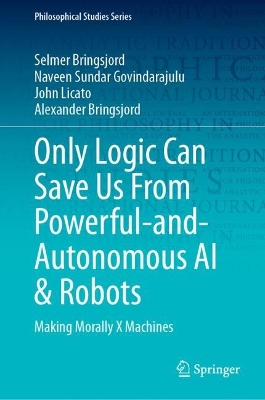
This book explains, in clear, non-technical terms, using three Star Trek TOS episodes (in which malevolent, destructive machines are thwarted) as a springboard, the existential threat posed to humanity from future malevolent machines. Then book presents the way to ensure that this threat is safely dodged: build AIs that are certifiably safe because they are morally correct, and provably so. Anyone on Earth who wishes against a future in which humanity is harmed or even outright destroyed by future machines, or perhaps even contribute to this warding off, is a member of the book’s intended audience. (A full, technical book, Making Morally X Machines, explains in detail the science and engineering that this book depicts in accessible-to-all form.)
1.Introduction and Plan.- 2.Existential Threats to Humanity.- 3.PAID
Problem an Existential Threat.- 4.Brand of AI Needed: Logicist.- 5.The Four
Steps to Salvation.- 6.Our Case-Study Approach.- 7.Case Study #1: Norman et
al..- 8.Case Study #2: M5.- 9.Case Study #3: Landru.- 10.Case Study #4:
Nomad.- 11.Exemplar #1: The Robot Augustine.- 12.Exemplar #2: The AI
Solomon.- 13.Really Only Logic Can Save Us?.- 14.The Two Remaining
Challenges.- Epilogue: How to Support Salvational AI.
Selmer Bringsjord is Director of the Rensselaer AI & Reasoning Laboratory at RPI, devoted to the engineering of logic-based AI, CogSci, and robotics. He is Professor of: Logic & Philosophy; Computer Science; Cognitive Science; and Management & Technology. He specializes in the building of robust AI systems and cognitive robots, and at the same time the logical/mathematical and philosophical foundations of AI (as well as that of CompSci & CogSci). Bringsjord has long held that human persons have a level of intelligence beyond Turing-level computation, but can nonetheless be eliminated by such inferior machines if they are sufficiently powerful, autonomous, and intelligent.
Naveen Sundar Govindarajulu is an AI and ML researcher and engineer with experience in subfields of both. Recent such experience includes building autonomous systems that reason with ethical principles; making machine-learning models fairer; and combining reasoning systems with learning ones. His experience includes work on deep-learning systems at Meta Platforms, ML-based time-series forecasting at Workday, natural-language processing research at Yahoo Research, fraud detection at Wepay, image recognition at HP Labs, and an experimental fingerprint-recognition system for the Indian Space Research Organization. He obtained his PhD in computer science from RPI, partly sponsored by the International Fulbright Science and Technology Scholarship. He also holds an MSc in physics and BE in electrical and electronics engineering from the Birla Institute of Technology and Science, Pilani.
John Licato is Associate Professor in the Bellini College of Artificial Intelligence, Cybersecurity, and Computing, and Director of the Advancing Machine and Human Reasoning Lab at the University of South Florida. He earned his PhD in Computer Science in 2015 at RPI under the supervision of S Bringsjord. He is a 2017 awardee of the AFOSR Young Investigators Program grant. His research interests lie in the intersection of reasoning, cognitive science, logic, and natural-language processing. The mission of Dr. Licatos AMHR lab is to not only make computers better at reasoning, but to help people reason better too. Current dominant models in AI fail at replicating the kinds of brilliant insights displayed by children starting at very young ages. Dr. Licato and his lab are devoted to figuring out why this is.
Alexander Bringsjord has developed innovative AI for over two decades, and has co-founded multiple AI businesses on the strength of numerous platforms (including the one central to the OLCSU book: HyperSlate®) and patents. Alexander spent a decade in industry providing services to Fortune-500 companies, first for PwC as Associate & Senior Associate, then for Deloitte as a Manager; this work was fundamentally declarative/logic-based. He actively lectures and consults in accounting & management, AI, entrepreneurship, and philosophy of business, and currently spends most conscious moments working toward endowing statistical/numerical ML systems -- e.g., LLMs and LRMs -- with verifiable, logic-based automated-reasoning and automated-decision-making. Alexander holds a BS Dual Major in Business & Philosophy from RPI, an MS in Accounting from The University at Albany, and is currently pursuing a PhD at RPI in Management & Technology. His doctoral research weaves AI into economics, entrepreneurship, fintech, innovation, and philosophy of business; expected graduation: May 2028.