Muutke küpsiste eelistusi

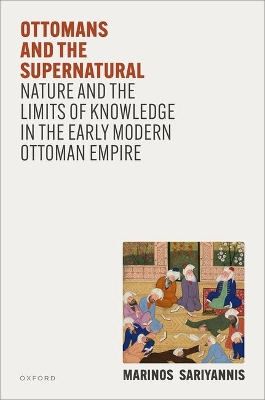
Ottomans and the Supernatural: Nature and the Limits of Knowledge in the Early Modern Ottoman Empire [Kõva köide]

(Research Director, Institute for Mediterranean Studies/FORTH)
  • Formaat: Hardback, 384 pages, kõrgus x laius x paksus: 240x164x25 mm, kaal: 778 g
  • Ilmumisaeg: 04-Dec-2025
  • Kirjastus: Oxford University Press
  • ISBN-10: 0198954778
  • ISBN-13: 9780198954774
  • Kõva köide
  • Hind: 130,92 €*
  • * hind on lõplik, st. muud allahindlused enam ei rakendu
  • Tavahind: 163,65 €
  • Säästad 20%
  • Raamatu kohalejõudmiseks kirjastusest kulub orienteeruvalt 3-4 nädalat
  • Kogus:
  • Lisa ostukorvi
  • Tasuta tarne
  • Tellimisaeg 2-4 nädalat
  • Lisa soovinimekirja
  • Formaat: Hardback, 384 pages, kõrgus x laius x paksus: 240x164x25 mm, kaal: 778 g
  • Ilmumisaeg: 04-Dec-2025
  • Kirjastus: Oxford University Press
  • ISBN-10: 0198954778
  • ISBN-13: 9780198954774
A comprehensive exploration of Ottoman-era magic and occult sciences that employs a unique methodology involving close readings of a very wide range of textual sources.

In recent years, supernatural beliefs systems in medieval and modern Islamicate cultures have been the subject of sustained scholarly attention. But we know very little about these concepts and practices in an Ottoman context.

Marinos Sariyannis proposes here to rectify this with a comprehensive exploration of Ottoman-era magic and occult sciences. Employing a unique methodology that involves close readings of a very wide range of textual sources taken from across four centuries - including geographical and cosmographical treatises, treatises focusing on philosophy, theology, and medicine, literary works, non-literary narratives, such as historiography, travelogues and biographies, and administrative documents - he analyses events and ideas that were classified as 'miraculous', 'strange', or 'extraordinary' by their authors. This enables him to build a detailed and coherent picture of how different sociocultural groups in Ottoman society understood nature and its counterpart, the supernatural - and how this related to and influenced broader systems of thought and knowledge.

In so doing, Ottomans and the Supernatural demonstrates the extent to which these intellectual and popular foundations differed from the (better-studied) notions of the 'supernatural' used by European Christian and Enlightenment thinkers. Such a thorough and contextualised understanding of the topic has important implications for all those interested in the history of science and knowledge in the Ottoman Empire, and as a first step towards situating the Ottoman case into the broader historiography on magic and the occult across world history.

This is an open access title available under the terms of a CC BY-NC-ND 4.0 International licence. It is free to read on the Oxford Academic platform and offered as a free PDF download from OUP and selected open access locations.

Arvustused

The book fills a significant gap in the field by presenting the Ottoman perception of the supernatural not as a static body of beliefs, but as a dynamic domain that continuously evolved in response to social and cultural developments. In this respect, it constitutes a foundational reference work not only for specialists in Ottoman science and intellectual history, but also for scholars working on the early modern period, occultism, and cultural history. * Faruk Akyildiz, slam Aratrmalar Dergisi *

Marinos Sariyannis is Research Director at the Institute for Mediterranean Studies/FORTH in Rethymno, Greece. He has led research projects on the history of Ottoman political thought and on the Ottoman perceptions of the supernatural. He has published several books, articles and chapters on Ottoman social, cultural and intellectual history. His recent books include A History of Ottoman Political Thought Up to the Early Nineteenth Century (Leiden 2019), Perceptions ottomanes du surnaturel. Aspects de l'histoire intellectuelle d'une culture islamique à l'époque moderne (Paris 2019) and , The Horizons, Limits, and Taxonomies of Ottoman Knowledge (Berlin 2021).