Muutke küpsiste eelistusi

PakistanThe Garrison State: Origins, Evolution, Consequences (1947-2011) [Pehme köide]

(Professor Emeritus of Political Science, Stockholm University)
  • Formaat: Paperback / softback, 508 pages, kõrgus x laius x paksus: 210x139x32 mm, kaal: 450 g, 8 plates colour and black and white mix
  • Ilmumisaeg: 30-Apr-2020
  • Kirjastus: OUP Pakistan
  • ISBN-10: 0190702443
  • ISBN-13: 9780190702441
  • Pehme köide
  • Hind: 16,43 €*
  • * hind on lõplik, st. muud allahindlused enam ei rakendu
  • Tavahind: 20,54 €
  • Säästad 20%
  • Raamatu kohalejõudmiseks kirjastusest kulub orienteeruvalt 3-4 nädalat
  • Kogus:
  • Lisa ostukorvi
  • Tasuta tarne
  • Tellimisaeg 2-4 nädalat
  • Lisa soovinimekirja
  • Formaat: Paperback / softback, 508 pages, kõrgus x laius x paksus: 210x139x32 mm, kaal: 450 g, 8 plates colour and black and white mix
  • Ilmumisaeg: 30-Apr-2020
  • Kirjastus: OUP Pakistan
  • ISBN-10: 0190702443
  • ISBN-13: 9780190702441
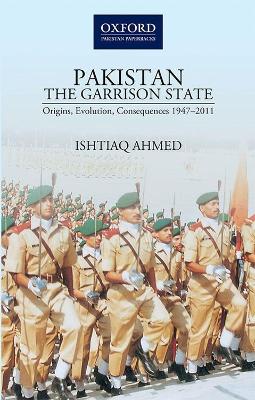
This study seeks to solve the following puzzle: In 1947, the Pakistan military was poorly trained and poorly armed. It also inherited highly vulnerable territory vis- -vis the much bigger India, aggravated because of serious disputes with Afghanistan. Over the years, the military, or rather the Pakistan Army, continued to grow in power and influence, and progressively became the most powerful institution. Moreover, it became an institution with de facto veto powers at its disposal to overrule other actors within society including elected governments. Simultaneously, it began to acquire foreign patrons and donors willing to arm it as part of the Cold War competition (the United States), regional balance-of-power concerns (China), and ideological contestants for leadership over the Muslim world (Saudi Arabia, to contain Iranian influence). A perennial concern with defining the Islamic identity of Pakistan, exacerbated by the Afghan jihad, resulted in the convergence of internal and external factors to produce the fortress of Islam self-description that became current in the early twenty-first century. Over time, Pakistan succumbed to extremism and terrorism within, and was accused of being involved in similar activities within the South Asian region and beyond. Such developments have been ruinous to Pakistans economic and democratic development. This study explains how and why it happened.
List of Illustrations
vi
Preface vii
Acknowledgements xi
1 The Fortress of Islam: A Metaphor for a Garrison State
1(27)
2 British, American, and Soviet Attitudes Towards the Pakistan Scheme
28(21)
3 The Colonial Roots of the Pakistan Army
49(16)
4 The First Kashmir War, 1947--1948
65(22)
5 Wooing the Americans, and Civil--Military Relations
87(25)
6 The First Military Takeover
112(22)
7 The 1965 War
134(26)
8 Alienation between East and West Pakistan
160(23)
9 Civil War and Pakistan-India War of 1971
183(20)
10 The Rise and Fall of Zulfikar Ali Bhutto
203(27)
11 General Zia Braces the Fortress of Islam
230(23)
12 The Afghan Jihad
253(27)
13 Civilian Governments and the Establishment
280(32)
14 Vicissitudes of the Musharraf Regime
312(39)
15 Transition to Democracy and Proliferation in Terrorism
351(36)
16 The United States Prepares for Exit
387(28)
17 The Gory End of Osama bin Laden
415(29)
18 Analysis and Conclusion
444(27)
Bibliography 471(12)
Index 483
Ishtiaq Ahmed was born in Lahore on 24 February 1947. He received a PhD in Political Science from Stockholm University in 1986. He taught at Stockholm University from 1987 to 2007, and was then invited as Senior Research Fellow and Visiting Research Professor by the Institute of South Asian Studies, National University of Singapore, during 2007-2010. He is now Professor Emeritus of Political Science, Stockholm University and Honorary Senior Fellow, Institute of South Asian Studies, National University of Singapore. He has published extensively on Pakistani and South Asian politics. His research interests cover fields as diverse as political Islam, ethnicity and nationalism, human and minority rights, and indeed, partition studies.