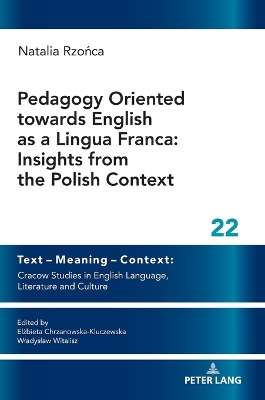
The book explores how the evolving global role of English as a lingua franca (ELF) challenges traditional approaches to English language teaching. Focusing on Polish in-service EFL teachers, it investigates their views and attitudes towards ELF-oriented pedagogy and outlines five key principles that form its foundation. Through a mixed-methods study conducted among English language teachers in Poland, alongside an innovative classroom project with secondary school learners, the author highlights both the benefits and challenges of implementing ELF-aware practices. Additionally, the book provides practical guidelines and sample activities to support teachers in effectively integrating ELF-oriented strategies. This work offers valuable insights for teachers and researchers seeking to adapt ELT to today's multilingual and multicultural realities, promoting a more inclusive, flexible, and context-sensitive way of teaching English in the 21st century.
Introduction
Chapter 1: English as a lingua franca: Theoretical
background
Chapter 2: ELF-oriented pedagogy: a shift from an EFL to an ELF
approach
Chapter 3: A study of Polish EFL teachers' attitudes to
ELF-oriented pedagogy: methodology
Chapter 4: Results
Chapter 5:
Discussion
Chapter 6: Post-face: Sample ELF-aware activities - Conclusions
Natalia Rzoca, PhD, is an assistant professor in the Faculty of Humanities and Social Sciences at the University of Applied Sciences in Tarnów, Poland. She earned her doctoral degree in linguistics with distinction from the Jagiellonian University, Cracow. Her research interests focus mainly on English as a lingua franca and its pedagogical implications in the context of English language teaching.