Muutke küpsiste eelistusi

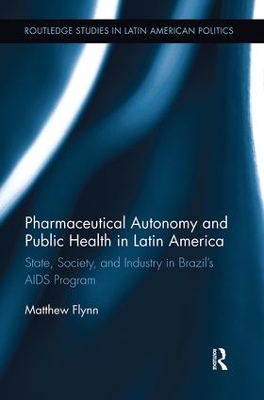
Pharmaceutical Autonomy and Public Health in Latin America: State, Society and Industry in Brazils AIDS Program [Pehme köide]

(Georgia Southern University, USA.)
  • Formaat: Paperback / softback, 252 pages, kõrgus x laius: 229x152 mm, kaal: 358 g, 7 Tables, black and white; 6 Line drawings, black and white
  • Sari: Routledge Studies in Latin American Politics
  • Ilmumisaeg: 20-Jun-2018
  • Kirjastus: Routledge
  • ISBN-10: 1138314358
  • ISBN-13: 9781138314351
Teised raamatud teemal:
  • Pehme köide
  • Hind: 51,85 €*
  • * hind on lõplik, st. muud allahindlused enam ei rakendu
  • Tavahind: 69,14 €
  • Säästad 25%
  • Raamatu kohalejõudmiseks kirjastusest kulub orienteeruvalt 3-4 nädalat
  • Kogus:
  • Lisa ostukorvi
  • Tasuta tarne
  • Tellimisaeg 2-4 nädalat
  • Lisa soovinimekirja
  • Raamatukogudele
  • Formaat: Paperback / softback, 252 pages, kõrgus x laius: 229x152 mm, kaal: 358 g, 7 Tables, black and white; 6 Line drawings, black and white
  • Sari: Routledge Studies in Latin American Politics
  • Ilmumisaeg: 20-Jun-2018
  • Kirjastus: Routledge
  • ISBN-10: 1138314358
  • ISBN-13: 9781138314351
Teised raamatud teemal:
Brazil has occupied a central role in the access to medicines movement, especially with respect to drugs used to treat those with the human immunodeficiency virus (HIV) that causes the acquired immune deficiency syndrome (AIDS). How and why Brazil succeeded in overcoming powerful political and economic interests, both at home and abroad, to roll-out and sustain treatment represents an intellectual puzzle.In this book, Matthew Flynn traces the numerous challenges Brazil faced in its efforts to provide essential medicines to all of its citizens. Using dependency theory, state theory, and moral underpinnings of markets, Flynn delves deeper into the salient factors contributing to Brazil’s successes and weaknesses, including control over technology, creation of political alliances, and instrumental use of normative frameworks and effectively explains the ability of countries to fulfill the prescription drug needs of its population versus the interests and operations of the global pharmaceutical industryPharmaceutical Autonomy and Public Health in Latin America is one of the only books to provide an in-depth account of the challenges that a developing country, like Brazil, faces to fulfill public health objectives amidst increasing global economic integration and new international trade agreements. Scholars interested in public health issues, HIV/AIDS, and human rights, but also to social scientists interested in Latin America and international political economy will find this an original and thought provoking read.

Arvustused

"This wonderful book chronicles Brazil's efforts to expand access to AIDS drugs in the face of a challenging and, at times, unforgiving external environment. Flynn's detailed research, including extensive interviews with key players, shows how dynamic interaction between actors in the Brazilian state, civil society, and pharmaceutical industry contributed to the country's efforts to secure 'pharmaceutical autonomy.' Much has been written about Brazil's policies to combat HIV/AIDS. Flynn's book provides fresh insights with its focus on how activist health professionals (sanitaristas), gained prominence in key state agencies, and in doing so promoted a universalistic, comprehensive, and rights-based vision of health." Ken Shadlen, London School of Economics "This wonderful book chronicles Brazil's efforts to expand access to AIDS drugs in the face of a challenging and, at times, unforgiving external environment. Flynn's detailed research, including extensive interviews with key players, shows how dynamic interaction between actors in the Brazilian state, civil society, and pharmaceutical industry contributed to the country's efforts to secure 'pharmaceutical autonomy.' Much has been written about Brazil's policies to combat HIV/AIDS. Flynn's book provides fresh insights with its focus on how activist health professionals (sanitaristas), gained prominence in key state agencies, and in doing so promoted a universalistic, comprehensive, and rights-based vision of health." Ken Shadlen, London School of Economics

"Readers interested in development studies will benefit from this book as Flynn makes an effort to revise the influential literature of dependent development and global capitalism to the current conjuncture of a democratic regime and, arguably, technological capacity in Brazil. This is not an easy task. This field has remained under-researched, and recent attempts of Brazilian social scientists have been published only in Portuguese, unknown to a wider audience. Flynns book offers an opportunity to calibrate development theories, and shows that the pharmaceutical sector is indeed a fertile laboratory." - Elize Massard da Fonseca, The Journal of Development Studies

List of Abbreviations
ix
Timeline xiii
Foreword xv
Acknowledgements xix
Introduction: Access to AIDS Medicines, Public Health, and the Brazilian Solution 1(6)
1 Pharmaceutical Autonomy: Technology, Alliances, and Norms
7(21)
2 Elements of Global Pharmaceutical Power
28(39)
3 The Brazilian Context: Contradictions between Democracy and Neoliberalism
67(28)
4 Asserting Antiretroviral Autonomy (1990-2001)
95(29)
5 Patent Power and the Limits of Treatment Activism (2002-2006)
124(26)
6 Consolidating the Pharmaceutical Alliance (2007-2013)
150(35)
Conclusion 185(20)
Appendices 205(18)
Index 223
Matthew B. Flynn is an Assistant Professor of Sociology and International Studies at Georgia Southern University in Statesboro, Georgia. His research focuses on the political economy of pharmaceuticals in contemporary society.