Muutke küpsiste eelistusi

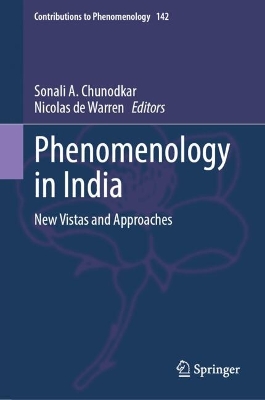
Phenomenology in India: New Vistas and Approaches [Kõva köide]

  • Formaat: Hardback, 258 pages, kõrgus x laius: 235x155 mm, 1 Illustrations, color; 1 Illustrations, black and white
  • Sari: Contributions to Phenomenology
  • Ilmumisaeg: 19-Jun-2026
  • Kirjastus: Springer Nature Switzerland AG
  • ISBN-10: 3032208726
  • ISBN-13: 9783032208729
Teised raamatud teemal:
  • Kõva köide
  • Hind: 92,17 €*
  • * hind on lõplik, st. muud allahindlused enam ei rakendu
  • Tavahind: 122,89 €
  • Säästad 25%
  • See raamat ei ole veel ilmunud. Raamatu kohalejõudmiseks kulub orienteeruvalt 3-4 nädalat peale raamatu väljaandmist.
  • Kogus:
  • Lisa ostukorvi
  • Tasuta tarne
  • Tellimisaeg 2-4 nädalat
  • Lisa soovinimekirja
  • Formaat: Hardback, 258 pages, kõrgus x laius: 235x155 mm, 1 Illustrations, color; 1 Illustrations, black and white
  • Sari: Contributions to Phenomenology
  • Ilmumisaeg: 19-Jun-2026
  • Kirjastus: Springer Nature Switzerland AG
  • ISBN-10: 3032208726
  • ISBN-13: 9783032208729
Teised raamatud teemal:
This volume showcases the vibrant and diverse landscape of phenomenological thinking in India. Critically engaging with the works of phenomenological thinkers like Edmund Husserl, Emmanuel Levinas, Franz Brentano, Hannah Arendt, Jitendra Nath Mohanty, Martin Heidegger, Maurice Merleau-Ponty, and R. Sundara Rajan, the contributors of this volume offer exciting insights and interdisciplinary examinations that help expand our understanding of phenomenology within a global context. Among this volumes rich contributions are new accounts that delve into the hitherto lost reception history of phenomenology in India, the as-yet inadequately acknowledged extent of Edmund Husserls engagement with Buddhist philosophy, R. Sundara Rajans decolonizing thinking on geophilia, a cross-cultural dialogical exploration between phenomenology and yoga philosophy, a phenomenology of tribal identity formation in Northeast India, a critical phenomenology of caste, a feminist and anti-caste phenomenology of labor, and aesthetic phenomenology in the context of curatorial technologies as well as theatrical experiences. The volume also offers a novel phenomenological methodology for environmental ethics research in addition to timely interventions to the problem of referentiality in Husserl and decision in Heidegger. The varied contributions of this volume would serve as thought-provoking resources for graduate students and researchers in related fields.
Chapter 1 Phenomenology in India (Sonali Arvind Chunodkar and Nicolas de
Warren).
Chapter 2 Sundara Rajan on Finite Transcendence: Phenomenology as
Geophilia (Sanil V).
Chapter 3 Kaivalya as Only-ness: An Intercultural
Curation of Phenomenological and Yogic Conceptualizations (Meera Baindur).-
Chapter 4 Phenomenology of Tribal Identity of Northeast India (Karilemla).-
Chapter 5 Introducing the Phenomenological Research Methodology to
Environmental Philosophy: An Exploration of Value-Action Gap (Soumyajit Bhar
and Kalpita Bhar Paul).
Chapter 6 Hetero-Aversion: A Phenomenological
Account of the Subject of Caste (Siby K George).
Chapter 7 Finding a World
in Labor: Hannah Arendt, Womens Writings from the Self-Respect Movement in
India, and the Emergence of an Interactionist Multi-World Thesis for Feminist
Phenomenology (Amrita Banerjee).
Chapter 8 Aesthetics and the Curatorial:
Towards a New Phenomenology of Art (Srajana Kaikini).
Chapter 9 Being in the
Theater: On the Possibility of Belief among Theater Audiences (Sonali Arvind
Chunodkar).
Chapter 10 Intentionality and Referentiality: The Problem of
Referentiality in Husserls Zeitdenken (Babu Thaliath).
Chapter 11 A
Revolutionary Sense of Entscheidung: Clearing Up Some Misunderstandings about
Heideggers Notion of Decision (Arun Iyer).
Sonali A. Chunodkar is an independent researcher based in Mumbai, India.


Nicolas de Warren is Professor of Philosophy and Jewish Studies at Pennsylvania State University, USA.