Muutke küpsiste eelistusi

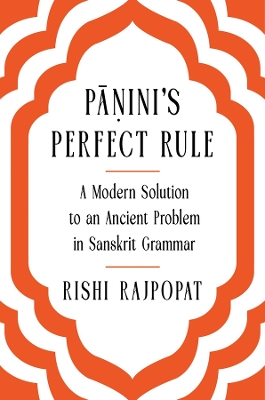
Pini's Perfect Rule: A Modern Solution to an Ancient Problem in Sanskrit Grammar [Kõva köide]

  • Formaat: Hardback, 288 pages, kõrgus x laius: 235x156 mm
  • Ilmumisaeg: 16-Dec-2025
  • Kirjastus: Harvard University Press
  • ISBN-10: 0674297644
  • ISBN-13: 9780674297647
Teised raamatud teemal:
  • Kõva köide
  • Hind: 43,38 €*
  • * hind on lõplik, st. muud allahindlused enam ei rakendu
  • Tavahind: 54,23 €
  • Säästad 20%
  • Kaupluses 1 eks Tule tutvuma - Raekoja plats 11, Tartu, E-R 10-18
  • Kogus:
  • Lisa ostukorvi
  • Tasuta tarne
  • Saadame välja 1 tööpäeva jooksul
  • Lisa soovinimekirja
  • Formaat: Hardback, 288 pages, kõrgus x laius: 235x156 mm
  • Ilmumisaeg: 16-Dec-2025
  • Kirjastus: Harvard University Press
  • ISBN-10: 0674297644
  • ISBN-13: 9780674297647
Teised raamatud teemal:
Linguist Rishi Rajpopat solves an ancient puzzle, showing that Pa ini’s Sanskrit grammar is self-sufficient. Centuries of commentators, having misunderstood it, created tools to overcome its supposed flaws, but to no avail. By reinterpreting some key Pa inian rules, Rajpopat shows that the language machine is in fact entirely free of such glitches.

A new interpretation of a 2,500-year-old Sanskrit text upends millennia of debate and affirms an ancient linguist’s remarkably sophisticated grammatical system.

Around 500 BCE, the Indian scholar Pa ini wrote a treatise on Sanskrit, the A adhyayi, describing a kind of language machine: an algebraic system of rules for producing grammatically correct word forms. The enormity and elegance of that accomplishment—and the underlying computational methodology—cemented Pa ini’s place as a founder of linguistics. Even so, centuries of commentators have insisted that there are glitches in the machine’s ability to tackle rule conflict (that is, a situation in which two or more rules are simultaneously applicable) and have responded with complex rules and tools aimed at resolving the issues apparently besetting the ancient system.

In one fell swoop, this book renders the overwhelming majority of that work obsolete. Linguist Rishi Rajpopat lays out a novel interpretation of Pa ini’s grammar, focusing on Pa ini’s only rule dealing with rule conflict, known as 1.4.2. Pa ini’s Perfect Rule shows that the A adhyayi indeed functions like a well-oiled machine, capable of handling challenges without any of the complications introduced by later scholars.

Rajpopat thus solves an ancient and important problem in Indology and linguistics that will fascinate anyone interested in how language systems—including those of computer programming—operate. In addition, Pa ini’s Perfect Rule offers meditations on the history of the early Pa inian tradition, its philosophy, the relationship between rule conflict and accentuation, and aspects of theoretical phonology. A nontechnical preface lays out key findings and foregrounds the deep history of Sanskrit scholarship. This volume opens new horizons for the study of Sanskrit, inviting seasoned experts and novices alike to behold its majesty.

Arvustused

This is a wonderfully interesting, enjoyable book on a new solution to an ancient problem of word construction in Sanskrit. As a longtime admirer of Pini, I join Rishi Rajpopat in inviting general readers not just grammarians and linguists to the fun hidden in the great Pinian rules. -- Amartya Sen, winner of the Nobel Prize in Economic Sciences This book resolves a major dilemma in the long history of the reception of Pinis grammar, centering on its metarule devoted to rule conflict. Rishi Rajpopat's ingenious and revolutionary reinterpretation of the metarule emanates from an accurate and elegant analysis of the usus scribendi of Pinis grammar. He brilliantly demonstrates that the metarule far more effectively resolves rule conflicts than was previously thought possible. -- Tiziana Pontillo, University of Cagliari Pinis Perfect Rule is a splendid book. With understated boldness, Rajpopat steps around the work in Pinian studies that has obscured rather than illumined Pinis straightforward directive. Not only grammarians but also scholars in a wider range of Indian intellectual systems will benefit greatly from this magisterial demonstration of how best to reappropriate the great stra texts of the tradition. -- Francis X. Clooney, Harvard University

Rishi Rajpopat holds a PhD in Sanskrit Studies from the University of Cambridge. His research on Pinis grammar has been covered by the BBC, Daily Mail, The Telegraph, Times of India, The Hindu, and other global news outlets.