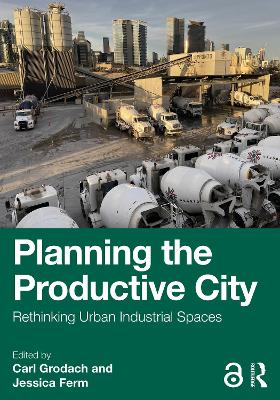
Planning the Productive City focuses on the overlooked role of industry and industrial land in contemporary urban development. Bringing together detailed studies of over 25 cities in 14 countries (including the US, the UK, Canada, Italy, Germany, South Korea, and Türkiye), this comprehensive volume puts the diverse forms, geographies, and conflicts over urban industrial land and productive activities at the center of discussions around the future of cities. The chapters collectively reconsider the role of industry in the city, arguing that industry can play a critical role in promoting socially equitable, economically resilient, and climate-sensitive places. This edited volume is the first to comprehensively explore the challenges and opportunities of achieving these goals through planning the productive city. This book is essential for students, researchers, and professionals across the range of urban studies fields (geography, urban planning, architecture and urban design, urban economics, and urban politics).
Chapter 12 of this book is freely available as a downloadable Open Access PDF at http://www.taylorfrancis.com under a Creative Commons Attribution (CC BY) 4.0 license.
Arvustused
Planning the Productive City: Rethinking Urban Industrial Spaces asks how after decades of being ignored manufacturing can be reintegrated into urban economic development strategies. The rich European and U.S. cases presented in this edited volume examine how cities deemphasized manufacturing mostly to their peril and how many are prioritizing industry and industrial land to create new economic activity. The book is a hopeful examination of how manufacturing still matters.
Joan Fitzgerald, Professor of Public Policy and Urban Affairs, Northeastern University
Cities once produced things, which helped to grow ideas and the economy. Great cities now live off an economy of ideas and dont know how or where things are produced. Without spaces for production, cities cannot eat, be sanitized, build, move, or grow. Through making things, materials have knowledge, ideas are grounded, and waste is just a resource. This book brings together an excellent collection of insights from across the world, on how cities can make place for production.
Adrian Hill, Director, Osmos Network and Cities of Making
"This book debuts with a relevance that the editors and contributors could not have foreseen. Well over half of the worlds population (4.4 billion) lives in urban areas. The global economys ability to meet this populations needs requires high functioning international supply chains. In turn, urban industrial spaces are essential inputs to these supply chains. This is especially the case when global politics are disrupting supply chains. The authors' contributions to this book give us greater and much needed understanding for creating productive industrial spaces that support and improve urban global population conditions."
Nancey Green Leigh, Professor Emerita, School of City and Regional Planning, Georgia Institute of Technology
1. Introduction: Planning the Productive City Part I: Evolving Planning
Approaches and Visions of Industrial Lands
2. Two Steps Forward, One Step
Back? Adaptation in Regional Industrial Land Preservation
3. Regional
Planning for Industrial Land Use: The Case of Portland, Oregon (United
States)
4. Production Activities and Spaces Within the Ecological Transition
in Italy: Approaches, Visions, and Challenges in Industrial Land Use Planning
5. From the City of Dreadful Night to MedTech and Microbrews: Evolving
Planning Imaginaries of the Industrial City Part II: Industrial Policies and
Land Use Conflicts
6. Urban Industrial Districts, Property Market
Displacements, and "Clusters of Last Resort"
7. New Industrial Policies, Old
Inequalities: The Case of Chicagos Lincoln Yards
8. From Industrial Areas to
Industrious Neighborhoods: Examining the London Model
9. Resisting Industrial
Displacement and Gentrification: Insights from Germany Part III:
Transformations in Industrial Economies and Spaces
10. What Does the Growth
of E-Commerce Mean for the Future of Industrial Lands?
11. Cultural
Manufacturing Resilience in Seouls Seongsu Neighborhood: Urban Industrial
Transformation and Survival Tactics
12. Making the Future of the City:
Insights and Lessons from Athens and Rotterdam
13. Finding Space for
Industries: Clustering Patterns and Building Typologies of Urban
Manufacturing in Munich and Stuttgart
14. Dialectics of Urban and Peri-Urban
Industries: An Explorative Analysis of the Turkish Context Part IV: Labor,
Skills, and Learning
15. Made with Equity: Inclusive Innovation in Urban
Manufacturing
16. Educational and Technology Campuses in Industrial Parks
17.
Walk and Talk Perspectives on Productive Lands: Advocating for Industrial
Lands Through Janes Walk Experiences
18. A Labor Perspective on the
Productive City: The Case of Hamerkwartier in Amsterdam Part V: Urban
Industry and the Climate Imperative
19. Bluing the Green: Nurturing
Manufacturing as Green City Strategy
20. Fixed in the City: Accessibility of
Different Types of Repair in London and Amsterdam
21. The Shape of Urban
Industry in a Regenerative Economy: An Adaptation Scenario for Medium-Sized
Cities
22. Making Space for Construction Companies in a Context of No Net
Land Take: The Case of Flanders, Belgium
Carl Grodach is Foundation Professor of Urban Planning and Design at Monash University, Australia. His research focuses on economic development and land use planning in relation to urban manufacturing, industrial lands, cultural industries, and circular economies.
Jessica Ferm is Associate Professor in Planning and Urban Economies at the Bartlett School of Planning, University College London, UK. Her research expertise is in the planning and governance of diverse and inclusive economies, and she has published widely on industrial land use planning, sustainable urban manufacturing, and affordable workspace.