Muutke küpsiste eelistusi

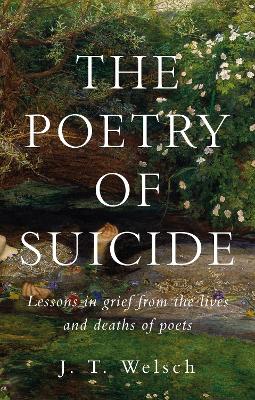
poetry of suicide: Lessons in grief from the lives and deaths of poets [Kõva köide]

  • Formaat: Hardback, 304 pages, kõrgus x laius x paksus: 216x140x22 mm, kaal: 451 g, 1 black & white illustration
  • Ilmumisaeg: 21-Apr-2026
  • Kirjastus: Manchester University Press
  • ISBN-10: 1526191997
  • ISBN-13: 9781526191991
  • Kõva köide
  • Hind: 24,00 €*
  • * hind on lõplik, st. muud allahindlused enam ei rakendu
  • Tavahind: 30,00 €
  • Säästad 20%
  • Raamatu kohalejõudmiseks kirjastusest kulub orienteeruvalt 3-4 nädalat
  • Kogus:
  • Lisa ostukorvi
  • Tasuta tarne
  • Tellimisaeg 2-4 nädalat
  • Lisa soovinimekirja
  • Formaat: Hardback, 304 pages, kõrgus x laius x paksus: 216x140x22 mm, kaal: 451 g, 1 black & white illustration
  • Ilmumisaeg: 21-Apr-2026
  • Kirjastus: Manchester University Press
  • ISBN-10: 1526191997
  • ISBN-13: 9781526191991
Interweaving stories of poets who took their own lives with the long history of suicide in his own family, J. T. Welsch reveals how poetry can help us to understand and come to terms with these difficult deaths.

A profound exploration of the connection between poetry and suicide.

‘Suicides have a special language’, Anne Sexton wrote in her 1964 poem ‘Wanting to Die’. But is it a language we can learn to read?

In The poetry of suicide, J. T. Welsch interweaves stories of poets who took their own lives with the long history of suicide in his own family, searching for a new way of understanding these difficult deaths. Beginning with Hamlet’s ‘To be or not to be?’, he delves into the work of Dante, Sylvia Plath, Vladimir Mayakovsky, and others, asking what it can teach us about suicide’s messy reality.

Suicide is more like poetry than we realise, Welsch argues. Both are filled with ambiguities, contradictions, and unknowable intentions. Both demand and resist interpretation. Recovering the personal dimension often lost in our medicalised public discourse, Welsch finds practical ways of confronting suicide’s poem-like difficulties.

Arvustused

A nuanced and deeply insightful book. Line by line, J. T. Welsch guides us towards a deeper reading of both suicide and poetry, helping us to interpret their silences and declarations. The poetry of suicide recognises that solace and meaning can often seem impossible to find, but it never loses sight of the importance of the quest. Emilie Pine, author of Notes to Self

Through sharp analysis and his own deftly folded-in personal narrative, Welsch has crafted a deeply moving study of suicide, loss and poetic creativity. As someone affected by suicide, it urged me towards new ways of understanding, or at least attempting to understand. A bold and truly vital work. Adam Farrer, author of Broken Biscuits: And Other Male Failures

J. T. Welsch has always been one of the poets I follow most closely. Here he proves why he's one of our most insightful and original critical thinkers on poetry as well. Andrew McMillan, author of Pity

'Astute analysis and a compelling demonstration of what creative-critical writing can do. Essential reading.' Anne Whitehead, author of Relating Suicide: A Personal and Critical Perspective

The poetry of suicide is a necessary, vital book. Moving between the personal and literary, J. T. Welsch elegantly shows how we might resist fixed narratives and interpretations as we confront loss and grief. A kind of manifesto against closure, the book reveals how much there is to learn from the poets that have sought to give expression to loss. It is testimony to the value of embracing negative capability or not quite knowing. Francesca Bratton, author of Stronger than Death: Hart Cranes Last Year in Mexico

A deeply compelling and reflexive book. J. T. Welsch shows us the power of poetry in bearing witness to the existential struggles that suicide embodies. For him, reading suicide is an ethical act, one that demands openness, respect and an honest sense of how language shapes our interpretation. A must read! Katrina Jaworski, author of The Gender of Suicide

'J. T. Welsch has written a book that is both moving and methodical in its exploration of the ways that "poetry can re-open the language of suicide". Drawing on the experience of his own family, as well as his extensive work as a scholar and poet, The poetry of suicide is an important contribution to our understanding of what Albert Camus called "the one serious philosophical problem".' Philip Coleman, Professor of English, Trinity College Dublin -- .

Prologue: reading and grieving suicide
1 The question: suicide as poem
2 The answer: suicides author
3 The forest: suicides readers
4 Suicide in youth
5 Suicide in the family
6 Suicide in later life
7 The politics of self-sacrifice
Epilogue: living with suicide
Index -- .
J. T. Welsch is a writer and academic born in the US and based in the UK, where he teaches at the University of York. He is the author of several books of and about poetry, including Orchids (2010), The Hell Creek Anthology (2015) and The Selling and Self-Regulation of Contemporary Poetry (2020). He also edited the anthology of migrant poetry Wretched Strangers (2018) with Ágnes Lehóczky. His writing has appeared in Poetry Review, Boston Review and the Guardian. -- .