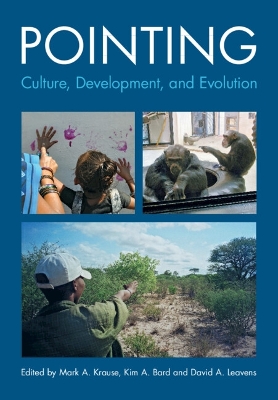
Pointing is a fundamental gesture that connects individuals with their social and physical worlds. Whether communicating information about the external environment or serving to clarify to whom or what someone is referring, pointing may appear to be a uniquely human and universal action. However, it develops in varied social and cultural contexts, and even some nonhuman species point and can understand pointing cues. While there has been substantial research on the cultural, developmental, and evolutionary aspects of pointing, these perspectives remain fragmented. This book bridges this gap by bringing together leading scholars from cognitive psychology, evolutionary anthropology and biology, animal behavior, developmental psychology, and comparative psychology to synthesize current findings, highlight emerging directions, and provide students and researchers with a comprehensive view of the field.
Arvustused
'This excellent edited volume is the first in more than two decades to examine pointing, a rudimentary referential social communication gesture that is foundational for human language development and for human and non-human social cognition. Environmental, contextual, cultural, configurational, and comparative aspects of pointing are examined in depth.' Deborah L. Best, William L. Poteat Professor of Psychology, Emerita, Wake Forest University, USA 'This book is a groundbreaking contribution to the developmental sciences with its holistic orientation. A seemingly small behavior, pointing as the target of the book, is demonstrated to be fundamentally integrated into an evolutionary framework as well as fundamentally situated in cultural contexts, which both shape its developmental embeddedness. The book is also exemplar in bringing together experts from different cultures.' Heidi Keller, Professor Emeritus of Psychology, Osnabrück University, Germany, and Distinguished Fellow, Hebrew University of Jerusalem, Israel 'This book is a must-have for those who are interested in development and evolution of communication. It takes us on an exciting intellectual journey that spans many species of animals and many human cultures, and makes us think deeply about what it means to communicate.' Sotaro Kita, Professor of Psychology of Language, University of Warwick, UK 'Pointing is an exceptional volume that reflects the amazing growth in the field concerning the nature and function of pointing. The work greatly expands an understanding of this important behavior in all its varieties and across many species. The editors have assembled a top-notch group of contributors and have organized their works in a manner that assembles insights of the larger literature in a single volume. Especially important are the messages brought to bear on the important role of pointing in socio-cognitive and language development, the cross-cultural focus that well documents the influence of environment and socialization on pointing, and the chapters documenting that pointing occurs in many animal species. Altogether, the book is a major contribution to the field that should be on all scholars' reading lists.' David Matsumoto, Professor of Psychology, San Francisco State University, USA, and Director, Humintell LLC
Muu info
A multi-disciplinary compendium exploring how pointing is used among human cultures and nonhuman species throughout the world.
Contents; List of Figures; List of Tables; List of Contributors;
Introduction to Pointing: Culture, Development, and Evolution Mark A. Krause,
Kim A. Bard and David A. Leavens; Part I. Culture and Development:
1.
Pointing at, talking about, and looking away: patterns of personal deixis in
the context of childhood socialisation in Indian families Nandita Chaudhary,
Deepa Chawla and Punya Pillai;
2. The design of pointing Kensy Cooperrider;
3. Development of pointing in toddlers: cultural and epistemological
perspectives Hélčne Cochet;
4. Attention management by deictic gestures and
demonstratives: analysis of the wayfinding practices of the Gui/Gana in the
Kalahari Akira Takada;
5. Pointing to dinner participants in deaf and hearing
children's and adults' signing and gesturing Aliyah Morgenstern and Stéphanie
Caėt;
6. The cultural nature of early social communication Zahra Halavani,
Srujana Duggirala, Gülce Özker, Yitong Wang and Tanya MacGillivray;
7.
Pointing at local knowledge: roaming place references in Gija conversations
Caroline de Dear;
8. The role of infant pointing in child-led caregiving: how
infants elicit the interactions that shape their development Claire D.
Vallotton, Rachel Albert, Yatma Diop and Loria Kim;
9. How infants learn to
follow attention from gaze-direction and pointing gestures Gedeon O. Deįk and
Yueyan Tang;
10. Thoughtless pointing: how the automatic coordination of
touch and vision may produce pointing and joint attention Cathal O'Madagain;
11. Socially signaling robotics: a novel way of looking at gaze following and
pointing Shoji Itakura;
12. Developmental significance of the human pointing
gesture Ulf Liszkowski and Katharina Kaletsch; Part II. Evolution:
13.
Pointing in chimpanzees who use American sign language Mary Lee A. Jensvold;
14. Are we missing the point? Reconsidering methods for detecting referential
components of ape gestural communication Vesta Eleuteri, Alexandra Safryghin
and Catherine Hobaiter;
15. The nature of the point: communication,
association, or methodological muddle, with examples Heidi Lyn;
16. Changing
the focus: pointing and attention in great Apes Marta Halina and Katja
Liebal;
17. The neural foundations of gestural communication in captive
chimpanzees William D. Hopkins;
18. Do baboons point? A review of research on
gestural communication in a monkey Adrien Megueritchian;
19. Pointing with
your nose: do elephants point, and how do we know? Lucy Bates, Richard Byrne
and Joyce Poole;
20. Pointing and the object choice task: findings, flaws,
and future directions Hannah Clark;
21. The use of human social cues in
domestic farm animals Désirée Brucks and Christian Nawroth.
Mark A. Krause is a professor of psychology at Southern Oregon University. He is co-editor of Evolution of Learning and Memory Mechanisms (Cambridge, 2022) and serves on the editorial boards for Journal of Comparative Psychology and Animal Behavior and Cognition. Mark has published research on chimpanzees, snakes, birds, and humans and began his career studying pointing in chimpanzees. Kim A. Bard is a former president of both the Primate Society of Great Britain and the European Federation for Primatology, and currently holds a Sponsored Affiliate position at the University of Michigan, Dearborn. She has worked combining comparative perspectives with developmental perspectives in the study of chimpanzees, orangutans, and humans for over forty years. Kim is co-editor of Reaching into Thought: The Minds of the Great Apes (Cambridge, 1996), and The Cultural Nature of Attachment: Contextualizing Relationships and Development (2017). David A. Leavens is an Emeritus Reader in Comparative Psychology at the University of Sussex. For the last thirty years, he has studied pointing, pointing comprehension, and other aspects of joint attention in a variety of species, including chimpanzees, humans, dogs, and cats. David currently holds positions on the editorial boards for Animal Cognition and the Journal of Comparative Psychology.