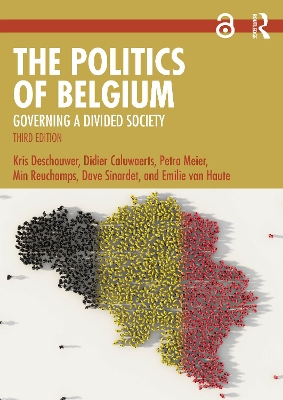
The third edition of this highly respected text covers the numerous political developments that have taken place in Belgium since 2012.
This book covers topics such as the implementation of the sixth state reform, the rebranding of political parties with new party leaders, several elections at all levels of government (from local to European) leading to new governing coalitions, democratic innovations in several parliaments and, of course, the impact of the COVID-19 crisis and the challenges of climate changes on all political and social institutions.
Key features:
- Gives an even-handed and analytically sophisticated account of contemporary Belgium politics.
- Explains the background to the territorial divide between a Dutch-speaking north and a French-speaking south that has shaped the political system and led to polarized communities and the need for institutional responses to internal conflict.
- Provides a thorough example of a consociational democracy, and shows how this form of democratic government, along with Belgium’s particular federal system has provided a basis – most of the time – to govern a deeply divided country.
- Provides a comprehensive picture of Belgian politics which helps answer the question of whether Belgium – and indeed other divided societies – can be governed in a legitimate democratic manner.
This text is essential reading to students and scholars of Belgian politics and society, democracy and democratic innovations, political systems, and more broadly to European and comparative politics.
The third edition of this highly respected text covers the numerous political developments that have taken place in Belgium since 2012.
Arvustused
This new edition of The Politics of Belgium: Governing a Divided Society remains a definitive guide to the workings of Belgian politics. Like the previous editions, it is comprehensive yet succinct. A treasure for scholars and students of Belgian politics. Ruth Dassonneville, KU Leuven, Belgium
This book offers a balanced and analytically sophisticated account of contemporary Belgian politics and its evolution. It represents an excellent entry point for non-Belgian scholars, while its analytical depth renders it highly relevant for specialists: a reliable guide and a pleasure to read. Anna Kern, Universiteit Gent, Belgium
This book, produced by leading scholars in the field from both major language groups, is a must-read introduction for anyone interested in the politics of Belgium and the lessons it holds for the comparative governance of plural societies in the 21st century. Wilfried Swenden, University of Edinburgh, UK
1. Why Belgium?
2. A Short Political History
3. Territorial Organization
and Reorganization
4. Political Parties
5. Voting and Elections
6. The
Government
7. The Parliament
8. Policymaking
9. Belgium in the World
10.
Still Belgium?
Kris Deschouwer is Emeritus Professor at the Vrije Universiteit Brussel (VUB), Belgium. .
Didier Caluwaerts is Professor of Political Science at the Vrije Universiteit Brussel (VUB), Belgium. .
Petra Meier is Professor of Political Science at the University of Antwerp (UA), Belgium. .
Min Reuchamps is Professor of Political Science at the Université catholique de Louvain (UCLouvain), Belgium. .
Dave Sinardet is Professor of Political Science at the Vrije Universiteit Brussel (VUB), Belgium. .
Emilie van Haute is Professor of Political Science at the Université libre de Bruxelles (ULB), Belgium.