Muutke küpsiste eelistusi

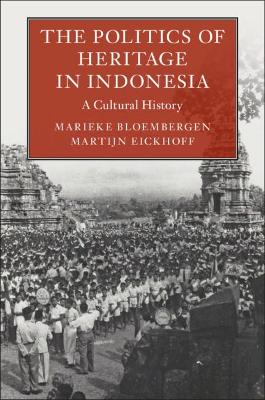
Politics of Heritage in Indonesia: A Cultural History [Kõva köide]

  • Formaat: Hardback, 338 pages, kõrgus x laius x paksus: 235x159x20 mm, kaal: 670 g, Worked examples or Exercises; 29 Halftones, black and white
  • Sari: Asian Connections
  • Ilmumisaeg: 16-Jan-2020
  • Kirjastus: Cambridge University Press
  • ISBN-10: 1108499023
  • ISBN-13: 9781108499026
  • Kõva köide
  • Hind: 97,43 €*
  • * hind on lõplik, st. muud allahindlused enam ei rakendu
  • Tavahind: 129,90 €
  • Säästad 25%
  • Raamatu kohalejõudmiseks kirjastusest kulub orienteeruvalt 3-4 nädalat
  • Kogus:
  • Lisa ostukorvi
  • Tasuta tarne
  • Tellimisaeg 2-4 nädalat
  • Lisa soovinimekirja
  • Formaat: Hardback, 338 pages, kõrgus x laius x paksus: 235x159x20 mm, kaal: 670 g, Worked examples or Exercises; 29 Halftones, black and white
  • Sari: Asian Connections
  • Ilmumisaeg: 16-Jan-2020
  • Kirjastus: Cambridge University Press
  • ISBN-10: 1108499023
  • ISBN-13: 9781108499026
This study offers a new approach to the history of sites, archaeology, and heritage formation in Asia, through the lens of colonial and post-colonial Indonesia. It focuses on the mobility of heritage as a multi-sited phenomenon that engages with, and goes beyond, the interests of states.

This study offers a new approach to the history of sites, archaeology, and heritage formation in Asia, at both the local and the trans-regional levels. Starting at Hindu-Buddhist, Chinese, Islamic, colonial, and prehistoric heritage sites in Indonesia, the focus is on people's encounters and the knowledge exchange taking place across colonial and post-colonial regimes. Objects are followed as they move from their site of origin to other locations, such as the Buddhist statues from Borobudur temple, that were gifted to King Chulalongkorn of Siam. The ways in which the meaning of these objects transformed as they moved away to other sites reveal their role in parallel processes of heritage formation outside Indonesia. Calling attention to the power of the material remains of the past, Marieke Bloembergen and Martijn Eickhoff explore questions of knowledge production, the relationship between heritage and violence, and the role of sites and objects in the creation of national histories.

Arvustused

'Bloembergen and Eickhoff demonstrate the Dutch roots of modern Indonesian conceptualisations of heritage, and how Indonesian practices stretch across Southeast Asia to India and beyond. This is a highly original and provocative contribution to global understandings of tradition and its ownership.' Adrian Vickers, University of Sydney

Muu info

Presents a new approach to heritage formation in Asia, conveying the power of the material remains of the past.
List of Figures
vi
Preface and Acknowledgements ix
List of Abbreviations
xiv
Introduction: Towards a Mobile History of Heritage Formation in Asia 1(21)
1 Site Interventions, Knowledge Networks, and Changing Loyalties on Java, 1800--1850s
22(39)
2 Exchange, Protection, and the Social Life of Java's Antiquities, 1860s--1910s
61(36)
3 Great Sacred Majapahit: Biographies of a Javanese Site in the Nineteenth Century
97(32)
4 Greater Majapahit: the Makings of a Proto-Indonesian Site across Decolonisation, 1900s-1950s
129(35)
5 The Prehistoric Cultures and Historic Past of South Sumatra on the Move
164(30)
6 Resurrecting Siva, Expanding Local Pasts: Centralisation and the Forces of Imagination across War and Regime Change, 1920s--1950s
194(40)
7 Fragility, Losing, and Anxieties over Loss: Difficult Pasts in Wider Asian and Global Contexts
234(33)
Epilogue: Heritage Sites, Difficult Histories, and `Hidden Forces' in Post-Colonial Indonesia 267(15)
Bibliography 282(32)
Index 314
Marieke Bloembergen is senior researcher at the Koninklijk Instituut voor Taal-, Land- en Volkenkunde (KITLV), and Professor in Archival and Postcolonial Studies at Universiteit Leiden. She has published on the politics and mobility of knowledge in colonial and post-colonial Indonesia, through the lens of policing and violence, material culture, and heritage practices within inter-Asian and transnational contexts. Martijn Eickhoff is senior researcher at NIOD Instituut voor Oorlogs-, Holocaust- en Genocidestudies, and Professor in Archaeology and Heritage of War and Mass Violence at Rijksuniversiteit Groningen, The Netherlands. He has published widely on the relation between archaeology, politics, heritage formation, and mass violence, in Asia and Europe during the nineteenth and twentieth centuries.