Muutke küpsiste eelistusi

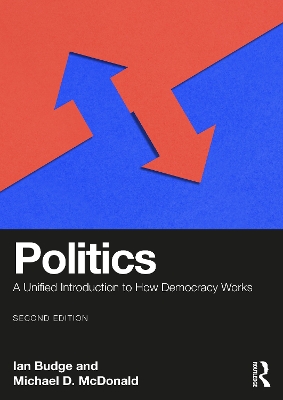
Politics: A Unified Introduction to How Democracy Works 2nd edition [Pehme köide]

(University of Essex, UK.), (Binghamton University, USA)
  • Formaat: Paperback / softback, 480 pages, kõrgus x laius: 246x174 mm, kaal: 453 g, 34 Tables, black and white; 55 Line drawings, black and white; 55 Illustrations, black and white
  • Ilmumisaeg: 22-Jun-2026
  • Kirjastus: Routledge
  • ISBN-10: 1032775181
  • ISBN-13: 9781032775180
Teised raamatud teemal:
  • Pehme köide
  • Hind: 44,76 €*
  • * hind on lõplik, st. muud allahindlused enam ei rakendu
  • Tavahind: 59,69 €
  • Säästad 25%
  • See raamat ei ole veel ilmunud. Raamatu kohalejõudmiseks kulub orienteeruvalt 3-4 nädalat peale raamatu väljaandmist.
  • Kogus:
  • Lisa ostukorvi
  • Tasuta tarne
  • Tellimisaeg 2-4 nädalat
  • Lisa soovinimekirja
  • Formaat: Paperback / softback, 480 pages, kõrgus x laius: 246x174 mm, kaal: 453 g, 34 Tables, black and white; 55 Line drawings, black and white; 55 Illustrations, black and white
  • Ilmumisaeg: 22-Jun-2026
  • Kirjastus: Routledge
  • ISBN-10: 1032775181
  • ISBN-13: 9781032775180
Teised raamatud teemal:
The second edition of this comprehensive introduction to politics remains an essential framework for assessing the health and workings of present-day democracy. The book explores how democratic processes bring public policy into line with popular, basically centrist, preferences. In helping explain its workings, it equips us to better defend democracy.

Applying newly integrated theories of democratic processes to contemporary developments such as the use of right-wing populism across the world, it is the first textbook to help readers develop and apply predictive explanations for themselves. In doing so, it provides straightforward practical tools for evaluating how current events impact on democratic procedures and processes.

Key features:


Provides answers to key questions such as how much contemporary democracies have lost direction under the impact of populist parties, big business and international threats Validated against statistical evidence and examples from across the world, it details more exactly when and how democracy goes wrong and how to put it right Shows how to develop predictive explanations as a basis for action, thus strengthening democracy by understanding it better Outlinesin easy-to-understand termsthe basic statistical approaches that drive empirically informed analysis In-text features include chapter summaries, reviews, key points, illustrative briefings, key concepts and project and essay suggestions, plus further reading

Politics is an essential resource for students of political science hoping for a rules-based global order, and of key interest to economics, public policy analysis, and more broadly, the social sciences.

Arvustused

Ian Budge and Michael McDonald demonstrate not only how democratic systems work under changing conditions but also how to empirically investigate the relationship between citizens preferences and policy performances of governments using predictive theorizing. The exceptional strength of this book is the accessible text and application of testing theories. This 2nd edition provides up-to-date information on democracies in a changing world. I hold this introduction to Politics as unique and is a must-read for political scientists and beyond. Hans Keman, Emeritus Professor of Comparative Political Science, Vrije Universteit Amsterdam, The NetherlandsThis is a really comprehensive and thorough introduction to political science. It pioneers predictive theory that is theory based on realistic assumptions about political actors, institutions and processes and which is validated by extensive testing for its accuracy. The focus is on providing general explanations of the causes and consequences of political action across countries and in institutions making it is essential reading for introductory students of politics. Paul Whiteley, Emeritus Professor of Government, University of Essex, UKI really like this book. Driven by predictive political theory that builds on and extends the large body of research on modern representative democracies, it helps explain the politics and policy that we actually observe. Politics, second edition not only makes that real world more understandable, but it does so in an engaging and compelling way. I heartily recommend it. Christopher Wlezien, Hogg Professor of Government, University of Texas at Austin, USA

1. Introduction: politics and policy what do we want to explain and
how? PART 1 PROCESSES: elections alternate party-based governments with
different preferences and priorities, thus bringing public policies into line
with centrist majority preferences in the long run
2. Why politics? Making
policies to provide public goods
3. How popular preferences develop
4.
Measuring electoral preferences
5. Electors policy thinking: from a
joined-up left-right perspective to issue-by-issue reactions
6. Party policy
thinking: framing policy targets and estimating majority preferences from
elections
7. Matching public policy to popular preferences
8. Opening up to
populists: Using alternation theory to analyse US Policy Representation
1952-2025 PART 2 RULES: rules designate but may misrepresent majority
preferences, thus biasing policy outcomes
9. Majority choice of policies:
voting paradoxes and attempted solutions
10. General elections and election
systems: finalizing the collective choice of policies PART 3 PROTAGONISTS:
parties and governments shape popular preferences and reflect them in public
policies
11. Citizens, parties and governments: interactive preference
formation
12. Political parties: ideological policy carriers
13. Governments:
prime participants in policymaking
14. Ministries: separating out policy
areas PART 4 STATES: collective action without binding rules
15.
Globalization and world democracy
16. Challenges to a rule-based
international order PART 5 EXPLANATION: explaining politics by specifying
its processes more exactly so as to predict outcomes
17. Generating Big
Data: sources, procedures, error checks
18. Simplifying Big Data:
dimensions, majorities and the (missing?) middle
19. Managing Big Data:
theoretical explanation and statistical analysis
20. Developing political
science by explaining democracy
Ian Budge is Emeritus Professor in the Department of Government, University of Essex, UK, and well known internationally as the author of numerous research articles and textbooks on democratic politics.

Michael D. McDonald is Emeritus Professor of Political Science at Binghamton University, USA, a former Director of the Center on Democratic Performance, and a gold medallist for his work in that area.