Muutke küpsiste eelistusi

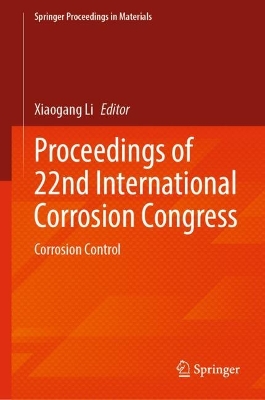
Proceedings of 22nd International Corrosion Congress: Corrosion Control [Kõva köide]

Edited by
  • Formaat: Hardback, 898 pages, kõrgus x laius: 235x155 mm, 462 Illustrations, color; 144 Illustrations, black and white
  • Sari: Springer Proceedings in Materials
  • Ilmumisaeg: 14-Apr-2026
  • Kirjastus: Springer Verlag, Singapore
  • ISBN-10: 9819551994
  • ISBN-13: 9789819551996
  • Kõva köide
  • Hind: 182,09 €*
  • * hind on lõplik, st. muud allahindlused enam ei rakendu
  • Tavahind: 242,79 €
  • Säästad 25%
  • Raamatu kohalejõudmiseks kirjastusest kulub orienteeruvalt 3-4 nädalat
  • Kogus:
  • Lisa ostukorvi
  • Tasuta tarne
  • Tellimisaeg 2-4 nädalat
  • Lisa soovinimekirja
  • Formaat: Hardback, 898 pages, kõrgus x laius: 235x155 mm, 462 Illustrations, color; 144 Illustrations, black and white
  • Sari: Springer Proceedings in Materials
  • Ilmumisaeg: 14-Apr-2026
  • Kirjastus: Springer Verlag, Singapore
  • ISBN-10: 9819551994
  • ISBN-13: 9789819551996
This book is a comprehensive collection of research papers presented at 22nd International Corrosion Congress held on October 2226, 2024, in Xi'an, China. The book serves as a valuable resource of the critical progress and technical advances in corrosion and protection for academics, researchers, and professionals worldwide. The book focuses on the latest findings and progress of corrosion control approaches including corrosion and scale inhibitors, intelligent corrosion control, metallic coatings, surface treatment and inorganic coatings, functional coatings, and corrosion monitoring.


The International Corrosion Council (ICC), founded in 1961, consists of representatives of countries interested in increasing the benefits to be derived from the advancement of corrosion science and engineering. These representatives, currently from 64 member countries, are generally appointed by nationally recognized corrosion societies or by national organizations with a significant interest in corrosion. This committee acts for the Council between International Corrosion Congress meetings which are normally held every three years.
Chapter
1.    Analysis of the Performance of Electroplated Zn-Ni
Coatings on Pickled Steel Surfaces.
Chapter
2.    Based on the new coating
technology as a pipeline corrosion protection layer Study on resistance to
cathode stripping.
Chapter
3.    Design and Application of Intelligent
Modification of Impressed Current Cathodic Protection System in Nuclear Power
Plants.
Chapter
4.    Benzotriazole derivative as an effective corrosion
inhibitor for X80 steel corrosion in acidic medium.
Chapter
5.    Design of
Corrosion Protection Monitoring System for FPSO Risers Support Structure.-
Chapter
6.    Crevice corrosion resistance of Zn-Al-Mg and GI coated
materials.
Chapter
7.    Development and Testing of Corrosion Rate Monitor
Based on CMAS Technology.
Chapter
8.    Discussion on Testing Parameters of
Solid State Decoupler.
Chapter
9.    Durable lubricant-infused anodized
aluminum oxide surfaces and its Long-term deterioration in NaCl solution.-
Chapter
10.    Effect of annealing atmosphere dew point on electrophoretic
corrosion resistance of DH hot-dip galvanized materials.
Chapter
11.  
 Effect of Gl GA coating on the hydrogen embrittlement of 1180MPa grade
steel.
Chapter
12.    Effect of Phosphate Pretreatment on Surface Defects
Transmission of auto steel Sheets.
Chapter
13.    Effect of Strip-entry
Temperature on the Surface Quality of Hot-rolled Galvanized Steel Sheets.-
Chapter
14.    Electrochemical Properties of Graphene Modified TiIrTaSnSb-G
Mixed Metal Oxide Anodes in Low Temperature and Low Salt NaCl Solution.-
Chapter
15.    Development of hot-rolled galvanized low-alloy high-strength
steel for automobile chassis.
Chapter
16.    Effect of pulse anodizing on
mechanical properties of TC4 titanium alloy.
Chapter
17.    Evaluation of
the performance of rust-bearing coatings for electric power towers.
Chapter
18.    Experimental Study of a Low-Cost Schiff Base as a High-Efficiency
Corrosion Inhibitor for Mild Steel in 1M HCl.
Chapter
19.    Effectiveness
Evaluation of Cathodic Protection for Nearshore Submarine Pipelines based on
Measurement and Numerical Simulation.
Chapter
20.    Experimental Study of a
Schiff Base as Corrosion Inhibitor for Mild Steel in 1M HCl.
Chapter
21.  
 Experimental study on the application of ultrasonic guided wave technology
in low-pressure gas pipelines.
Chapter
22.    Exploration of quinoline
quaternary ammonium salt mixture as a highly effective corrosion inhibitor
for HP-13Cr in acid solution.
Chapter
23.    Failure prediction and
intelligent control methods for REAC system based on flow-corrosion
mechanism.
Chapter
24.    Fluorocarbon resin coating of G SiO2 in the
Conservation of Iron Relics.
Chapter
25.    Impact of Aging on the
Electrical Strength of Different Pipeline Coating Materials.
Chapter
26.  
 High-efficient automatic corrosion detection for large steel structures of
power stations in coastal area based on an improved YOLOv8 model.
Chapter
27.    Improved anti-corrosion property of bronzes based on CeO2 quantum dots
epoxy hybrid material.
Chapter
28.    How to improve the barrier properties
of flexible riser lining materials to retard the corrosion of the metal
functional layer.
Chapter
29.    In situ growth of Ni@MOFs pre-treatment
coating to enhance hydrogen barrier and corrosion resistance of epoxy resin.-
Chapter
30.    Influence of Annealing Parameters on the Properties of Nickel
Plated Steel Plates for New Energy Battery Cases.
Chapter
31.    Inhibition
efficiency of honeysuckle plant extract as an eco-friendly inhibitor for acid
corrosion of mild steel.
Chapter
32.    In-situ growth and corrosion
protection of ZIF-8 film on copper-zinc alloy surface.
Chapter
33.  
 Preparation of high solid polyurethane coatings and testing of their basic
properties.
Chapter
34.    Research and application of highly durable,
eco-friendly, surface-tolerant, and heavy-duty anticorrosive coatings.-
Chapter
35.    Research on Non-Destructive Monitoring System for Reinforced
Concrete Corrosion Based on Indirect Polarization Technology.
Chapter
36.  
 Research on online monitoring technology of insulated pipes.
Chapter
37.  
 Fabrication and Corrosion Resistance of Ternary FeCoNi Coating via Cathodic
Plasma Electrolytic Deposition.
Chapter
38.    Research on Real-time
Prediction Method of Corrosion Rate under Dynamic Stray Current
Interference.
Chapter39.    Process protection evaluation and intelligent
prevention and control technology of atmospheric tower system based on flow
corrosion prediction.
Chapter40.    Research on the changing law of AC
interference parameters and test methods of buried pipeline.
Chapter41.  
 Research on the optimal evaluation method of pipeline body reinforcement and
repair technology.
Chapter
42.    Research Progress on Formation of
Zirconium Conversion Coatings.
Chapter
43.    Study and application of a
novel theory on microstructure control of magnesium magnesium-containing
ternary alloy coatings.
Chapter
44.    Research on the Impact of PV power
Generation Systems on Pipeline AC and DC Interference Based on Numerical
Simulation.
Chapter
45.    Study of Corrosion Behavior of Zn-6%Al-3%Mg Alloy
Coated Steel Sheets and Hot-Dipped Galvanized Steel Sheets in Simulated
Seawater.
Chapter
46.    Study of phosphating behavior of AA6014 AA6014
automotive sheets.
Chapter
47.    Study of Environmentally Friendly
Anti-corrosion Coatings in Salt Spray Environment Based on Spearman
Analysis.
Chapter
48.    Study on a ZnAlMgNi plating.
Chapter
49.    Study
on AC Interference Law of High Voltage AC Cable to Submarine Pipeline and
Safe Distance.
Chapter
50.    Study on Corrosion Inhibition Properties of
X80 Steel with N-acetyl-L-cysteine and Compound Corrosion Inhibitor.
Chapter
51.    Study on Corrosion Resistance of GI coating after Heat Treatment.-
Chapter
52.    Study on Influence of Micro-structure on Phosphating
Performance of Acid Pickled Steel.
Chapter
53.    Study on Performance and
Preparation of Pre-anticorrosion Working Fluid for CO2 Displacement.
Chapter
54.    Study on the aging resistance of heavy-duty anti-corrosion coating
system.
Chapter
55.    Study on the Corrosion Inhibition Performance and
Mechanism of Moringa oleifera Leaf Extract on Steel in Aminosulfonic Acid.-
Chapter
56.    Study on the influence of hydrogen permeation on the
performance of pipeline internal coating.
Chapter
57.    Study on the
Microstructure Evolution and Corrosion Resistance of a ZnAlMg Coating after
Heat Treatment.
Chapter
58.    Study on the Relationship Between AC
Interference Levels and Corrosion Rates of Buried Pipelines Though Buried
Coupon tests.
Chapter
59.    Study on the Synergistic Corrosion Inhibition
Performance of H2S Corrosion Inhibitor and Desulfurizer Composite System on
X65 Steel.
Chapter
60.    Surface Properties of Continuous Laser Cleaning
Affected Carbon Steel Substrate.
Chapter
61.    Synthesis and evaluation of
corrosion inhibitory performance of DFC.
Chapter
62.    The construction of
corrosion inhibition organic coatings via incorporating black phosphorene.-
Chapter
63.    The Impact of Corrosion Inhibitors on the Performance of
Etched Foil Prepared for Aluminum Electrolytic Capacitors at High Production
Speeds.
Chapter
64.    A Study of Microstructure and Electrochemical
Corrosion Behavior of Coatings with Different Aluminum and Magnesium
Contents.
Chapter
65.    The influence of anti-corrosion technology on the
performance of railway fastener.
Prof. Xiaogang Li is one of the leaders in the field of materials corrosion and protection in China and currently serves as the director of the National Materials Corrosion and Protection Data Centre, the head of the National Field Observatory Network of Environmental Corrosion of Materials, the president of the Chinese Society of Corrosion and Protection, the delegate of China in the International Corrosion Council, the editor-in-chief of the Springer Nature partner journal "npj Materials Degradation," and chief advisor to the editorial board of Corrosion Science. He has published 12 books and 650 peer-reviewed papers with 26,695 citation of over 27000. He has been one of the world's most highly cited authors during the past three years.