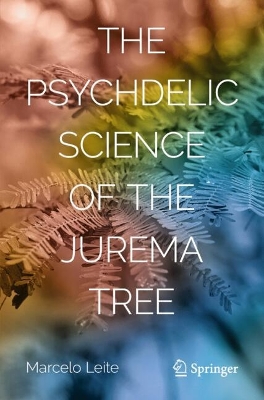
This book tells the story of jurema-preta, a plant which shaped the culture of Indigenous and Afro-Brazilian peoples, and withstood oppression from colonial forces to take a leading role in today's clinical research on psychedelics.
Following a path that starts with contemporary biomedical research conducted by Brazilian scientists who are testing if psychedelic DMT extracted from jurema-preta can be used in the treatment of depression, the author shows how current psychedelic science opens the door to a world in which clinical and psychopharmacological research live side by side with Indigenous and Afro-Brazilian religions and mysticism. And how the global psychedelic renaissance has created the networks for the circulation of these resurgent traditional practices connecting neoshamanic groups in places as distant as Brazil, the United States, the Netherlands and Australia.
At the end of this journey, the reader is invited to reflect about the challenge of combining rigorous research rooted on Western scientific thought with the radically different epistemologies that stem from the Indigenous way of thinking, which fully embraces the role played by altered states of consciousness in the way one experiences reality.
This is the English edition of a book originally published in Brazilian Portuguese. The translation of the original manuscript into English was done with the help of artificial intelligence. A subsequent human revision was done primarily in terms of content.
Chapter 1: The goddess Jurema and the devil of science against the
dragon of anxiety.
Chapter 2: The origin of Catimbó in Alhandra, a former
colonial settlement.- Chapter 3: The power of Jurema in Indigenous resistance
in the Northeast.- Chapter 4: The Sacred Jurema at the crossroads between
Catimbó and Umbanda.- Chapter 5: Juremahuasca, a sacrament challenging
doctrines.- Chapter 6: Changa and DMT crystals, engines of cosmopolitan
neoshamanism.- Chapter 7: The eternal return of mysticism.- Chapter 8: Life
lessons and wisdom with ancestors of all beings.- Chapter 9: Seek truth, act
independently, minimize harm.
Marcelo Leite is a Brazilian science journalist who writes about science and environment for Folha de S.Paulo, one of the largest newspapers in Brazil, where he has acted in different roles across his career, such as Science, Opinion and International editor, as well as ombudsman and correspondent in Berlin. Marcelo holds a BA in journalism from the University of Sćo Paulo and a PhD in social sciences from the University of Campinas. He was a Nieman Fellow at Harvard University and a Knight-Wallace Fellow at the University of Michigan. He is the author of various books about science published in Brazil, such as Promessas do Genoma (Genomas Promises; Editora Unesp, 2007) and Psiconautas: Viagens com a Ciźncia Psicodélica Brasileira (Psychonauts: Trips with Brazilian Psychedelic Science; Fósforo, 2021).