Muutke küpsiste eelistusi

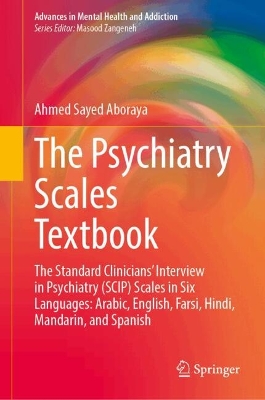
Psychiatry Scales Textbook: The Standard Clinicians Interview in Psychiatry (SCIP) Scales in Six Languages: Arabic, English, Farsi, Hindi, Mandarin, and Spanish [Kõva köide]

  • Formaat: Hardback, 262 pages, kõrgus x laius: 235x155 mm, VI, 262 p.
  • Sari: Advances in Mental Health and Addiction
  • Ilmumisaeg: 23-Jun-2026
  • Kirjastus: Springer Nature Switzerland AG
  • ISBN-10: 303222327X
  • ISBN-13: 9783032223272
Teised raamatud teemal:
  • Kõva köide
  • Hind: 100,34 €*
  • * hind on lõplik, st. muud allahindlused enam ei rakendu
  • Tavahind: 133,79 €
  • Säästad 25%
  • See raamat ei ole veel ilmunud. Raamatu kohalejõudmiseks kulub orienteeruvalt 3-4 nädalat peale raamatu väljaandmist.
  • Kogus:
  • Lisa ostukorvi
  • Tasuta tarne
  • Tellimisaeg 2-4 nädalat
  • Lisa soovinimekirja
  • Formaat: Hardback, 262 pages, kõrgus x laius: 235x155 mm, VI, 262 p.
  • Sari: Advances in Mental Health and Addiction
  • Ilmumisaeg: 23-Jun-2026
  • Kirjastus: Springer Nature Switzerland AG
  • ISBN-10: 303222327X
  • ISBN-13: 9783032223272
Teised raamatud teemal:
This book aims to encourage the use of the SCIP scales in clinical settings. The SCIP was developed as a measurement-based care (MBC) tool to help clinicians diagnose mental disorders, assess their severity, and guide clinical decision-making. One of its key features is the application of simple, consistent measurement rules across all scales, making it particularly useful for patients with comorbid conditionsa common occurrence in psychiatric populations. For instance, patients with depression often also experience anxiety and panic, while those with schizophrenia may suffer from mood swings, depression, and substance use disorders.  Mental health professionals value the convenience of using a single instrument that includes 18 clinician-administered (CA) scales, covering most adult psychiatric domains, and 15 self-administered (SA) scales that patients can complete prior to evaluation. Each scale takes only 2-5 minutes for a clinician to administer.


This book supports research efforts by including research versions of 18 SCIP scales. While these research versions feature the same questions as their clinical counterparts, they also include additional questions designed specifically for research purposes. Mental health researchers can easily integrate them into their studies.


Most importantly, this book also makes the SCIP scales accessible to over four billion people worldwide who speak six major languages: Arabic, English, Farsi, Hindi, Mandarin, and Spanish. The SCIP scales were translated from English into these five target languages using Machine Translation Post-Editing (MTPE), where bilingual experts carefully reviewed and refined the machine-generated translations to ensure linguistic, contextual, cultural, and semantic accuracy. Providing culturally appropriate translations of the SCIP scales will improve clinical services and expand research opportunities in diverse linguistic and cultural contexts. The target audience for this book includes mental health professionalssuch as psychiatrists, psychiatry residents, psychologists, therapists, clinical social workers, counsellors, nurses, nurse practitioners, and physician assistantswho are motivated to integrate the SCIP scales into their practice. 
Chapter
1. The Development of the SCIP as a New Assessment Tool for
21st-Century Advances.
Chapter
2. Psychometric Properties of the SCIP
Assessment Tool.
Chapter
3. Translation of the SCIP Scales into Five
Languages: Arabic, Farsi, Hindi, Mandarin, and Spanish.
Chapter
4.
Development of the Three Versions of the SCIP Scales from the Glossary of
Adult Psychopathology.
Chapter
5. Mental Health Codes .
Chapter
6. The
Periodic Table of Psychopathology: A Novel Framework for Advancing
Experimental Psychopathology Research in the Age of Artificial Intelligence.-
Chapter
7. Measurement-Based Care (MBC) Curriculum for Clinicians, Psychiatry
Residency Programs, and Online Training Courses.
Dr. Ahmed Sayed Aboraya, MD, DrPH, currently holds the position of Chief of Psychiatry at William R. Sharpe Jr. Hospital. He also serves as a Clinical Professor of Psychiatry at West Virginia School of Osteopathic Medicine in Lewisburg, West Virginia (WV), and as adjunct faculty in the School of Public Health at West Virginia University (WVU) in Morgantown, WV. Dr. Aboraya obtained his medical degree (MD) from Cairo University and pursued further education with a Master of Public Health (MPH) and a Doctor of Public Health (DrPH) from Johns Hopkins University. After completing his doctoral studies at Johns Hopkins in 1991, he finished his psychiatry residency at WVU in 1995. Since then, he has remained on faculty with WVU while practicing as an attending psychiatrist at Sharpe Hospital.


Dr. Aboraya specializes in treating chronic mental illnesses such as schizophrenia spectrum disorders and mood disorders, accumulating over 30 years of experience in West Virginia. His primary research focus centers on the clinical assessment of psychopathology. Notably, he developed the Standard for Clinicians Interview in Psychiatry (SCIP) as an assessment tool for adult psychiatric disorders. The SCIP, administered by clinicians and researchers, underwent testing between 2000 and 2020 in an international multisite study spanning three countries: the USA, Canada, and Egypt, with a total sample size of 1,064 subjects. The SCIP has proven to be a reliable and valid assessment tool, with results from the SCIP project published and presented at numerous national and international conferences.