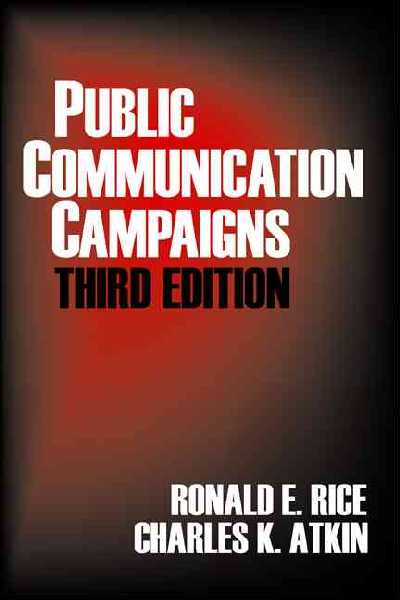
In this new, fully revised and expanded Third Edition, Rice and Katz provide readers with a comprehensive, up-to-date look into the field of public communication campaigns. Largely rewritten to reflect the latest theories and research, this text continues in the tradition of ongoing improvement and expansion into new areas. This Third Edition contains several new features. First, an expanded "sampler" section including more recent, intriguing and controversial campaigns has been added. Second, more attention is given to specific practical implications and evaluation of campaigns, using examples from both AIDS and anti-drug campaigns. Third, the book's final section introduces a variety of recent campaign dimensions including community-oriented campaigns, entertainment-education campaigns, and Internet/Web-based campaigns.
This volume will be a valuable resource for both students and researchers in the fields of communication, journalism, public relations, mass media, advertising, and public health programs.
In this new, fully revised and expanded Third Edition, Rice and Katz provide readers with a comprehensive, up-to-date look into the field of public communication campaigns. Largely rewritten to reflect the latest theories and research, this text continues in the tradition of ongoing improvement and expansion into new areas. This Third Edition contains several new features. First, an expanded "sampler" section including more recent, intriguing and controversial campaigns has been added. Second, more attention is given to specific practical implications and evaluation of campaigns, using examples from both AIDS and anti-drug campaigns. Third, the book's final section introduces a variety of recent campaign dimensions including community-oriented campaigns, entertainment-education campaigns, and Internet/Web-based campaigns.
This volume will be a valuable resource for both students and researchers in the fields of communication, journalism, public relations, mass media, advertising, and public health programs.
Muu info
Winner of National Communication Association Gerald M. Phillips Award 2010.
Preface ix PART I: HISTORICAL AND THEORETICAL FOUNDATIONS Public Communication Campaigns: The American Experience 3(19) William J. Paisley Input and Output Variables Currently Promising for Constructing Persuasive Communications 22(27) William J. McGuire Theory and Principles of Media Health Campaigns 49(20) Charles K. Atkin Sense-Making Methodology: Communicating Communicatively With Campaign Audiences 69(19) Brenda Dervin Micheline Frenette Creating Fear in a Risky World: Generating Effective Health Risk Messages 88(17) Michael T. Stephenson Kim Witte PART II: CAMPAIGN DESIGN AND EVALUATION Evaluating Communication Campaigns 105(20) Thomas W. Valente Formative Evaluation Research in Campaign Design 125(21) Charles K. Atkin Vicki S. Freimuth A Systems-Based Evaluation Planning Model for Health Communication Campaigns in Developing Countries 146(22) Ronald E. Rice Dennis R. Foote Communication Campaign Effectiveness: Critical Distinctions 168(13) Charles T. Salmon Lisa Murray-Johnson How Effective Are Mediated Health Campaigns? 181(12) Leslie B. Snyder PART III: LESSONS FROM THE FIELD The Stanford Community Studies: Campaigns to Reduce Cardiovascular Disease 193(21) June A. Flora Using Theory to Select Messages in Antidrug Media Campaigns: Reasoned Action and Media Priming 214(17) Joseph N. Cappella Martin Fishbein Robert Hornik R. Kirkland Ahern Sarah Sayeed Public Relations as Communication Campaign 231(18) David M. Dozier Larissa A. Grunig James E. Grunig Strategic Communication for International Health Programs 249(20) Phyllis Tilson Piotrow D. Lawrence Kincaid PART IV: A CAMPAIGN SAMPLER Singing the (VD) Blues 269(4) Bradley S. Greenberg Walter Gantz The McGruff Crime Prevention Campaign 273(3) Garrett J. O Keefe Kathaleen Reid-Martinez Smokey Bear 276(4) Ronald E. Rice Littering: When Every Litter Bit Hurts 280(3) Robert B. Cialdini The Strategic Extension Campaigns on Rat Control in Bangladesh 283(3) Ronny Adhikarya Mass Campaigns in the Peoples Republic of China During the Mao Era 286(4) Alan P. L. Liu The Designated Driver Campaign 290(5) Jay A. Winsten William DeJong RU SURE? Using Communication Theory to Reduce Dangerous Drinking on a College Campus 295(5) Linda C. Lederman Lea P. Stewart Sherry L. Barr Richard L. Powell Lisa Laitman Fern Walter Goodhart Sensation Seeking in Antidrug Campaign and Message Design 300(5) Philip Palmgreen Lewis Donohew Nancy Grant Harrington The Cumulative Community Response to AIDS in San Francisco 305(4) James W. Dearing Americas Sacred Cow 309(6) Matilda Butler The Nazi Antitobacco Campaign 315(8) Robert Proctor PART V: NEW APPROACHES AND CURRENT CHALLENGES Community Partnership Strategies in Health Campaigns 323(20) Neil Bracht The Entertainment-Education Strategy in Communication Campaigns 343(14) Arvind Singhal Everett M. Rogers A Web-Based Smoking Cessation and Prevention Program for Children Aged 12 to 15 357(16) David B. Buller W. Gill Woodall John R. Hall Ron Borland Bryan Ax Melissa Brown Joan Marquardt Hines Using Interactive Media in Communication Campaigns for Children and Adolescents 373(16) Debra A. Lieberman Putting Policy Into Health Communication: The Role of Media Advocacy 389(14) Lawrence Wallack Lori Dorfman Related References 403(4) Index 407(12) About the Authors 419
Ronald E. Rice (Ph.D. & M.A., Stanford University; B.A., Columbia University) is both the Arthur N. Rupe Chair in the Social Effects of Mass Communication in the Department of Communication and Co-Director of the Carsey-Wolf Center at UC, Santa Barbara. He has been elected divisional officer in the International Communication Association and the Academy of Management, elected President and Fellow of the ICA, awarded a Fulbright Award to Finland, appointed as Wee Kim Wee Professor and then University Professor of the School of Communication and Information at Nanyang Technological University in Singapore, and awarded an Honorary Doctorate from the University of Montreal. He has co-authored or co-edited ten books, including The New Media: Communication, Research and Technology (1984), and The Internet and Health Communication (2001), both also with SAGE. He is widely published in communication science, public communication campaigns, computer-mediated communication systems, methodology, organizational and management theory, information systems, information science and bibliometrics, and social networks. Charles K. Atkin (Ph.D., University of Wisconsin; B.A., Michigan State University) is University Distinguished Professor in the Department of Communication at Michigan State, where he has served as Chair for 15 years. He teaches and conducts research on mass communication campaigns, particularly in the health domain. Based on sustained accomplishments in applied research on health campaigns, he received the 2006 Decade of Behavior Award from the American Psychological Association and a consortium of 54 social science organizations as well as the 2008 career award as "Outstanding Health Communication Scholar" from National Communication Association and the International Communication Association Health Communication Divisions. In 2010, he was selected for the Phillips Award for Distinguished Applied Communication Research by the National Communication Association. He has been a Fellow of the International Communication Association since 1999. He has published almost 100 journal articles and ten books, including Mass Communication and Public Health (1990, SAGE) and Public Communication Campaigns (1989, 2001, SAGE). His federal grant research has been extensive, with recent major projects on breast cancer and binge drinking.