Muutke küpsiste eelistusi

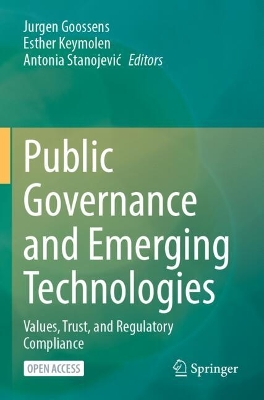
Public Governance and Emerging Technologies: Values, Trust, and Regulatory Compliance [Pehme köide]

Edited by , Edited by , Edited by
  • Formaat: Paperback / softback, 397 pages, kõrgus x laius: 235x155 mm, 4 Illustrations, color; 13 Illustrations, black and white
  • Ilmumisaeg: 27-Mar-2026
  • Kirjastus: Springer International Publishing AG
  • ISBN-10: 3031847504
  • ISBN-13: 9783031847509
Teised raamatud teemal:
  • Pehme köide
  • Hind: 34,94 €*
  • * hind on lõplik, st. muud allahindlused enam ei rakendu
  • Tavahind: 46,59 €
  • Säästad 25%
  • Raamatu kohalejõudmiseks kirjastusest kulub orienteeruvalt 3-4 nädalat
  • Kogus:
  • Lisa ostukorvi
  • Tasuta tarne
  • Tellimisaeg 2-4 nädalat
  • Lisa soovinimekirja
  • Formaat: Paperback / softback, 397 pages, kõrgus x laius: 235x155 mm, 4 Illustrations, color; 13 Illustrations, black and white
  • Ilmumisaeg: 27-Mar-2026
  • Kirjastus: Springer International Publishing AG
  • ISBN-10: 3031847504
  • ISBN-13: 9783031847509
Teised raamatud teemal:
This open access book focuses on public governances increasing reliance on emerging digital technologies. Disruptive or emerging digital technologies, such as artificial intelligence and blockchain, are often portrayed as highly promising, with the potential to transform established societal, economic, or governmental practices. Unsurprisingly, public actors are therefore increasingly experimenting with the application of these emerging digital technologies in public governance.


The first part of the book shows how automatization via algorithmic systems, the networked nature of distributed technologies such as blockchain, and data-driven use of AI in public governance can promote hyper-connectivity and hyper-complexity. This trend and the associated concerns have drawn societal, political, and scholarly attention to regulatory compliance considering the current and potential future uses of emerging technologies. Accordingly, the second part of the book focuses on regulatory compliance and regulatory solutions. It explores the compatibility of technology with existing regulations, existing legal tools that could be innovatively applied for the successful regulation of emerging technologies, and approaches to updating existing legislation or creating new legislation for the regulation of emerging technologies. While socio-ethical considerations on upholding public values in a digital world are at the heart of all chapters, the third part specifically focuses on public values and trust. It advances a conceptual, normative discussion, putting the spotlight on trust and other fundamental public values that should be safeguarded.


The book shows that the success of using emerging technologies in public governance depends to a large extent on the choices made by key stakeholders in public administration, legislative and regulatory bodies, and tech companies. When using and regulating emerging technologies in public governance, it is crucial to uphold public values and comply with legislation in a way that prioritizes the citizens perspective. To this end, the book offers an interdisciplinary approach based on qualitative and conceptual research.
Governance by Technology, Governance of Technology: The Quest for Public
Values, Trust, and Regulatory Compliance.- PART I - Governance: by and of
Technology.- Municipalities Enacting Algorithms: A Typology of Dutch
Municipal Strategies for Leveraging Algorithmic Systems.- The Role of
Technology in Citizens' Right to Good Administration: Examining the Impact of
Smart Governments.- Explainable AI Is No Silver Bullet: Towards a Contextual
Understanding of Appropriate Reliance on AI in Law Enforcement.- European
Digital Infrastructure Consortium (EDIC): A New Governance Framework for the
European Blockchain Services Infrastructure (EBSI).- Privacy-By-Design in the
Belgian Public Sector: Pseudonymising & Joining Personal Data Fragmented over
Multiple Organizations.- Our Stakes in Data: How Do We (Re)gain Democratic
Control over Digital Practices?.- PART II - Regulatory Compliance - Here we
Must Run as Fast as we Can, Just to Stay in Place.- Regulatory Equivalence
in Blockchain Systems: The Role of Public Values and Legitimacy.- The Need
for Responsible Use of AI by Public Administration: Algorithmic Impact
Assessments (AIAs) as Instruments for Accountability and Social Control.- As
Much as Faith: A Speculation on Quantum Computing with Fiduciary Law in
Public Governance.- The Rule of Tech? Submitting Legislation to Digital
Constraints.- The Shaping of AI Policies in Latin America: A Study of
International Influence and Local Realities.- PART III -  Public Trust and
Values in Technology we Trust?.- Empathy as a Public Value: Overcoming
Administrative Vulnerability and Rehumanizing (Digital) Government.- Civic
Vice in Digital Governance.- Algorithmic Governance and Social Vulnerability:
a Value Analysis of Equality and Trust.- The Frameworks of Trust and
Trustlessness Around Algorithmic Control Technologies: A Lost Sense of
Community.- Learning-Loop Bureaucracies: A Configuration Approach to AI, Law,
and Organizations.
Prof. Mr. Dr. Jurgen Goossens is Full Professor of Constitutional Law and Head of the Institute of Jurisprudence, Constitutional and Administrative Law at Utrecht University.


Prof. Dr. Esther Keymolen is Full professor of Digital Technology Regulation and Head of the Tilburg Institute for Law and Technology (TILT) Tilburg University.


Dr. Antonia Stanojevi is Postdoctoral research fellow at Tilburg Institute for Law, Technology, and Society (TILT) and Tilburg Institute for Law and Economics (TILEC) at Tilburg University.