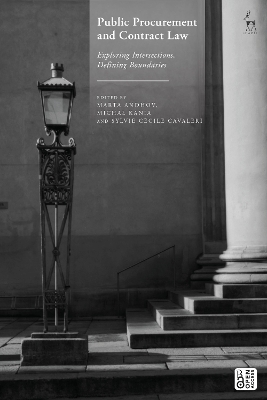
This open access anthology explores intersections and boundaries between public procurement and contract law, examining how these legal regimes diverge, influence, and occasionally overlap during the performance stage of public contracts.
While public procurement processes are largely harmonised across Europe through the EU Public Procurement Directives, the performance phase is only partially regulated. A sizeable part of public contract implementation remains subject to national laws, governed through a combination of administrative and contract law. This gives rise to a set of foundational questions: Does public procurement law fully occupy the legal space of public contract performance? In which instances-if any-does contract law retain relevance? Are classical contract law concepts transformed or distorted when applied to public contracts, and how does this affect mechanisms such as arbitration? To what extent do the answers to these questions vary depending on the regulatory model adopted by a given jurisdiction?
Part 1 introduces the topic, covering regulatory models for public contracts from procurement and contract law perspectives. Part 2 examines general issues such as legal review asymmetries, tacit modifications, due diligence, loyalty obligations, and the doctrine of hardship under EU law. Part 3 explores contemporary challenges, including digitalisation and sustainability. Part 4 analyses arbitration in public contract disputes.
This book is an essential resource for scholars, lawyers, practitioners, policymakers, and students, providing analytical depth and practical guidance to help navigate the complexities of public contracts.
The ebook editions of this book are available open access under a CC BY-NC-ND 4.0 licence on bloomsburycollections.com.
Explores intersections and boundaries between public procurement and contract law, examining how these legal regimes diverge, influence, and occasionally overlap during the performance stage of public contracts.
Muu info
Explores intersections and boundaries between public procurement and contract law, examining how these legal regimes diverge, influence, and occasionally overlap during the performance stage of public contracts.
Part One: The Roadmap
1. Introduction, Marta Andhov (University of Auckland, New Zealand &
University of Copenhagen, Denmark) and Michal Kania (University of Silesia,
Poland & University of Copenhagen, Denmark)
2. Where Public Procurement Meets Contract Law: Mapping Entry Points, Marta
Andhov (University of Auckland, New Zealand & University of Copenhagen,
Denmark) and Michal Kania (University of Silesia, Poland & University of
Copenhagen, Denmark)
3. National Models for Regulating Public Contracts, Marta Andhov (University
of Auckland, New Zealand & University of Copenhagen, Denmark) and Michal
Kania (University of Silesia, Poland & University of Copenhagen, Denmark)
4. Freedom of Contract: Contrasting Values and Principles in Contract Law and
Public Procurement Law, Vibe Garf Ulfbeck (University of Copenhagen,
Denmark), Marta Andhov (University of Auckland, New Zealand & University of
Copenhagen, Denmark), Cristina Poncibņ (University of Turin, Italy) and
Michal Kania (University of Silesia, Poland & University of Copenhagen,
Denmark)
Part Two: General
5. Influencing Contractual Freedom through EU and Dutch Public Procurement
Law: Legal Review Asymmetries in Cases on Withdrawals, Awards and Division of
Risk, Matanja Pinto (Maastricht University, the Netherlands) and Willem
Janssen (Utrecht University, the Netherlands)
6. The Diligent Contracting Authority: The Concept of Due Diligence in Public
Procurement, Michael Steinicke (Aarhus University, Denmark)
7. The Duty of Loyalty in the Contract Performance Stage: Contractual
Adjustments Inside and Outside the Realm of Article 72 Directive 2014/24/EU,
Maria Edith Lindholm Gausdal (University of Copenhagen, Denmark), Ole Hansen
(University of Copenhagen, Denmark) and Vibe Garf Ulfbeck (University of
Copenhagen, Denmark)
8. I Did not Sign Anything Can A Tacit Modification Constitute A Contract
Amendment under EU Procurement Rules?, Aarne Puisto (University of Lapland,
Finland), Kirsi-Maria Halonen and Pirkko Heikkinen (University of Lapland,
Finland)
9. Applying the Doctrine of Hardship in Public Contracts, Michal Kania
(University of Silesia, Poland & University of Copenhagen, Denmark) and Marta
Andhov (University of Auckland, New Zealand & University of Copenhagen,
Denmark)
Part 3: Digitalisation and Sustainability
10. Deconstructing Computational Contracts: A Critical Analysis of Their
Application in Private and Public Domain, Alexandra Andhov (University of
Auckland, New Zealand) Sven Mikulic (University of Copenhagen, Denmark) and
Michal Kania (University of Silesia, Poland & University of Copenhagen,
Denmark)
11. Sustainability, ESG and Its Enforcement in Private and Public Contracts,
Désirée Klingler (University of St. Gallen, Switzerland), Patrick Zimmermann
(Ludwig Maximilian University of Munich, Germany) and Steven van Garsse
(Hasselt University, Belgium)
12. Enforcing Sustainability Clauses in Public Contracts: Third-party
Enforcement Caught Between the Privity of Contract and Conflicting Interests,
Ezgi Uysal (University of Copenhagen, Denmark) and Katerina Mitkidis (Aarhus
University, Denmark)
Part Four: Arbitration
13. Can the Effectiveness of European Public Procurement Law Be Ensured If
Disputes Related to the Performance of Public Contracts are Settled by
Commercial Arbitration?, Sylvie Cécile Cavaleri (University of Copenhagen,
Denmark) and Maciej Zachariasiewicz (Kozminski University, Poland)
14. Adjudicating Public Contracts: The Role of Arbitration in France,
Portugal and Spain, Miguel Assis Raimundo (University of Lisbon, Portugal),
Mehdi Lahouazi (University of Paris Nanterre, France), Franēois Lichčre
(University of Jean Moulin Lyon 3, France) and Isabel Gallego Córcoles
(University of Castilla-La Mancha, Spain)
15. Concluding Remarks, Marta Andhov (University of Auckland, New Zealand &
University of Copenhagen, Denmark) and Michal Kania (University of Silesia,
Poland & University of Copenhagen, Denmark)
Marta Andhov is Associate Professor, Business School and Law School, University of Auckland, New Zealand, and Affiliated Associate Professor, CEPRI, Faculty of Law, University of Copenhagen, Denmark. Michal Kania is Professor of Law at the University of Silesia in Katowice, Poland, Affiliated Senior Researcher, CEPRI, Faculty of Law, University of Copenhagen, Denmark. Sylvie Cécile Cavaleri is Associate Professor, CEPRI, Faculty of Law, University of Copenhagen, Denmark.