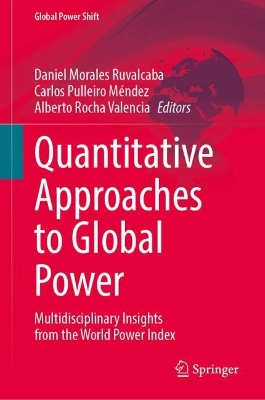
This book examines national power in the contemporary international system through an empirically grounded and theoretically integrated framework. Rooted in the trans-structural approach, it builds upon the theory of national-international power and consolidates the World Power Index (WPI) as a comprehensive measure of state capabilities across material, semimaterial, and immaterial dimensions.
The volume applies the WPI to measure, classify, and compare national power across the Global North and Global South, analyzing its implications for the provision of global public goods, health equity, artificial intelligence, ecological asymmetries, and the strategic role of elite sport in revealing national power and generating soft power.
More than a collection of studies, this book establishes the WPI as a reference framework for the study of national power and the international geostructure, offering scholars and policymakers a systematic foundation for interpreting the global power shift.
Chapter
1. Introduction.- Part I: National Power and Global Reordering
Through the World Power Index.
Chapter
2. New Perspectives on
National-International Power: A Theoretical, Methodological, and Technical
Review.
Chapter
3. National Power and Economic Dominance: Exploring Global
Influence Through the World Power Index.
Chapter
4. National Power and
Autonomous Foreign Policy.
Chapter
5. National Power in the Global South:
Multipolar Emergence and Geostructural Change.
Chapter
6. National Power in
the Global North: Divergence and Patterns of Internal Reordering.- Part II:
Empirical and Sectoral Applications of the World Powers Index.
Chapter
7.
National Power and the Provision of Global Public Goods.
Chapter
8. National
Power, Aid, and Health Equity: A Global Analysis.
Chapter
9. National Power
and Technology: Analyzing the Development of Artificial Intelligence From the
World Power Index.
Chapter
10. National Power and Ecologically Unequal
Exchange: Emissions, Aboveground Biomass Loss, and Recursive Exploitation in
the Semicore and Semiperiphery.
Chapter
11. National Power and Olympic
Success. An Analysis of the Medal Table From the World Power Index.
Chapter
12. National Power and World Sports Rankings: Measuring the Capacity of Elite
Sport to Reveal National Power and Produce Soft Power.
Daniel Morales Ruvalcaba is Associate Professor at Sun Yat-sen University (China) and creator of the World Power Index (WPI), a multidimensional framework for analysing national power in the contemporary international system. He has held academic positions in Mexico and been a visiting scholar at Sciences Po (France), Maria Curie-Skodowska University (Poland), and Universidad de la Repśblica (Uruguay). He serves on the editorial boards of several international journals. His research centres on Latin America, BRICS, and the Global South, examining shifting configurations of world power.
Carlos Pulleiro Méndez is an Associate Researcher at Tongji University, Shanghai, China. He holds a PhD in International Studies from the University of the Basque Country, Spain, and was a research fellow at Sun Yat-sen University (2018-2021) and a visiting scholar at the University of Deusto (2019-2020), Bilbao, Spain. In 2022, he became a lecturer at the European University of Gasteiz, Spain. His research focuses on sports diplomacy, international relations, and the geopolitics of sport.
Alberto Rocha Valencia holds a PhD in Sociology from the University of Paris VIII, France. He is Research Professor (Titular C) at the University of Guadalajara, Mexico, where he leads the consolidated research group Integration, Governance, and Development in Latin America and the Caribbean. He previously served as Director of the Institute of Economic and Social Research at the Universidad Nacional de Ingenierķa (Peru) and contributed to establishing postgraduate programmes in Political Science and Social Sciences at the University of Colima. A member of Mexicos National System of Researchers (19942024), his work focuses on Political Science, International Politics, regional integration, and globalisation.